Last updated: August 23, 2026
The half gallon jar is the one that makes people stop and stare on the store shelf. It holds 64 ounces, it looks like it could swallow an entire afternoon of tomatoes in four jars instead of sixteen, and it costs less per ounce of storage than anything else in the aisle. Every August somebody buys a case of them expecting to cut their canning day in half.
Then the question comes up in every canning group: can you actually process food in them? The honest answer is narrower than most buyers hope, and it has nothing to do with the jar being poorly made. It has to do with what has been tested, and what has not.
This article contains affiliate links. If you buy through them, we may earn a commission at no extra cost to you. Learn more.
Quick Answer
Can you can food in half gallon jars?
- The only home canning processes the USDA and the National Center for Home Food Preservation publish for half gallon jars are for apple juice and grape juice.
- There is no tested process for anything else in that size, and the NCHFP states plainly that a pint or quart process cannot be stretched to a bigger jar by any formula.
- Outside the canner, half gallon jars are excellent: dry goods, fridge storage, cold brew, fermenting, and bulk pantry work.
- Buy wide mouth if you plan to reach into the jar, and check your shelf height before ordering a case.
Bottom line: treat half gallon jars as storage jars with two narrow canning exceptions, not as an oversized quart.
What Half Gallon Jars Are Actually Approved For
Two things, and both are juice. The National Center for Home Food Preservation lists tested boiling water canner processes for half gallon jars only for apple juice and grape juice, both of which are strongly acidic. Everything else you might want to put in a 64 ounce jar has no research tested process in that size at all.
That is not a technicality invented by cautious extension agents. Heat has to travel from the outside of the jar to the coldest point in the middle, and the bigger the jar, the longer that takes and the less predictable it becomes. The published times exist because somebody put temperature probes in the center of specific foods in specific jar sizes and measured it. Nobody has done that work for a half gallon of green beans, so no safe number exists to give you.
Why You Cannot Scale a Quart Recipe Up
You cannot double a quart time and call it a half gallon time. The NCHFP is explicit that boiling water processes published for pints or quarts cannot be extended to a larger jar by any formula. Heat penetration is not linear with volume, and the food itself changes how fast heat moves through it.
A jar of thin juice heats very differently from a jar packed with dense fruit or vegetable pieces, where heat has to conduct through solids rather than convect through liquid. That is exactly why the two approved half gallon processes are both juices. If you are working out which method a given food needs in the first place, our pressure canning guide and water bath canning guide cover the split, and what you cannot water bath can covers the foods that trip people up most.
What About Half Gallon Jars in a Pressure Canner?
Same answer, same reason. There are no USDA or NCHFP pressure canning processes published for half gallon jars, so there is no tested time and pressure combination to follow for low acid foods in that size. A pressure canner does not solve the heat penetration problem by itself, it just changes the temperature the process runs at.
What Half Gallon Jars Are Genuinely Good At
Plenty, once you stop thinking of them as canning jars. Half gallon mason jars are among the cheapest airtight glass containers per ounce you can buy, they stack in a pantry, they take standard mason jar lids and accessories, and glass does not absorb odors the way plastic does after a few rounds of garlic or chili.
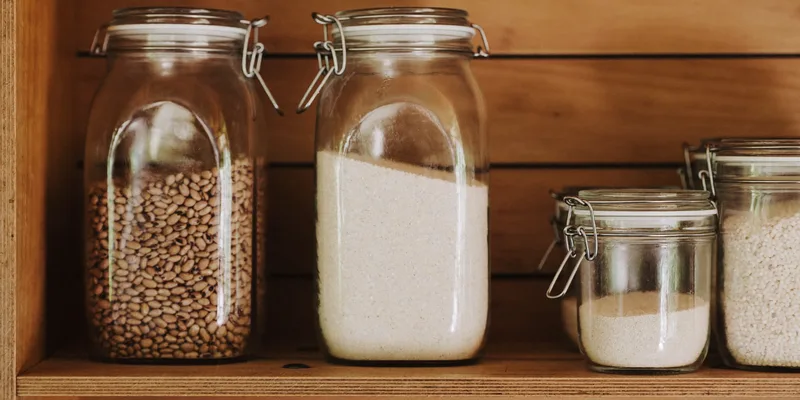
The workhorse uses are dry goods storage, refrigerator liquids, and fermenting. Rice, beans, flour, pasta, dried fruit and dehydrated vegetables all sit happily in a half gallon jar with a storage cap. Cold brew, iced tea, milk, stock and brine live in the fridge in them. Fermenters use them for small batch sauerkraut and pickles because the mouth takes a standard airlock lid and a standard weight.
Half Gallon Jars by Situation
The Standard Choice for Juice and Storage
Wide mouth is the default recommendation in this size. A 64 ounce jar is deep, and a regular mouth opening makes it awkward to fill, awkward to clean and nearly impossible to reach into with a hand. Wide mouth also takes the same lids and bands as your wide mouth quarts, which keeps your lid inventory simple.

If You Are Canning the Two Approved Juices
Juice canning needs new flat lids, the same as any other canning batch, because the sealing compound on a flat lid is formed to one jar rim and is not designed to be reused. Buying wide mouth lids in bulk during the off season is the cheapest way to stay stocked, and the bands from last year are fine to reuse if they are not bent or rusted.

For Pantry Dry Goods Rather Than Canning
If the jar is never going in a canner, you do not need a two piece canning lid at all. One piece plastic storage caps seal well enough for flour, rice, sugar and dried herbs, they do not rust, and they screw on and off endlessly without a band to lose. They are the single cheapest upgrade to a shelf of half gallon jars used as pantry containers.
![AOZITA [16 Pack] WIDE Mouth Mason Jar Lids for Ball, Kerr and Mor...](https://m.media-amazon.com/images/I/414UP-cksmL._AC_.jpg)
When You Want Something Bigger Than a Half Gallon
Gallon glass jars exist and are genuinely useful for bulk dry storage, cold brew and pickling crocks in the fridge, but they have no home canning use whatsoever. No tested process exists for any food in a gallon jar, and most of them are not tempered canning glass to begin with. Buy them as containers and nothing else.

Comparing the Large Jar Sizes
| Jar size | Approved canning use | Best non canning use | Watch out for |
|---|---|---|---|
| Quart (32 oz) | Wide range of tested processes, both methods | Everyday storage, fermenting | Nothing unusual, this is the workhorse |
| Half gallon (64 oz) | Apple juice and grape juice only, per the NCHFP | Bulk dry goods, cold brew, fridge liquids | People assuming a quart process scales up |
| Gallon (128 oz) | None | Bulk pantry, fridge pickling, cold brew | Often not canning tempered glass at all |
| Two gallon crock jar | None | Fermenting under a weight | Weight when full, and shelf strength |
The canning column reflects what the National Center for Home Food Preservation and the USDA Complete Guide to Home Canning publish tested processes for, which is the only list that matters for shelf stable food.
What to Check Before You Buy a Case
Measure your shelf first. A half gallon mason jar is noticeably taller than a quart, and a standard pantry shelf that fits quarts with room to spare often will not clear a half gallon with the band on. This is the single most common reason a case gets returned.
Then think about weight. A half gallon jar full of rice or liquid is heavy, and a shelf of them is a lot of load in one place. Reaching a full one down from a high shelf one handed is how jars get dropped, so keep the big ones low.
Mouth Size and Lid Compatibility
Half gallon jars come in both mouth sizes, and the lids are not interchangeable between them. If your existing lid drawer is all wide mouth, stay wide mouth. Our wide mouth versus regular mouth comparison goes through where each one actually wins, and the canning jar size chart lays out what every size is normally used for.
Frequently Asked Questions
What is the largest canning jar you can actually process food in? A half gallon, and only for apple juice and grape juice, which are the only two half gallon processes the NCHFP and USDA publish. For everything else the largest tested jar is the quart.
Can I water bath tomatoes or pickles in half gallon jars? No. There is no tested process for tomatoes, pickles or any other food in that size, and the NCHFP states that pint and quart processes cannot be extended to larger jars by any formula.
Are half gallon jars real canning jars or just storage jars? The mason style ones from the major brands are made from the same tempered canning glass and take standard two piece lids, so they are real canning jars. The limit is the lack of tested processes, not the glass.
Can I store flour and rice in half gallon jars long term? Yes, and it is one of the best uses for them. Glass is airtight and pest proof, which handles the two things that ruin bulk grain. For multi year storage most people still prefer mylar inside a bucket, since glass takes far more shelf space per pound.
Why are my half gallon jars breaking in the canner? Usually thermal shock or jars sitting on bare metal rather than a rack. Larger jars have more glass and more mass, so temperature differences stress them harder. Our canning rack guide covers the rack side of that problem.
Do half gallon jars use different lids? No, they use the same regular mouth or wide mouth lids as pints and quarts, depending on which mouth you buy. There is no special half gallon lid size.
The Bottom Line
Half gallon jars are worth owning, just not for the reason most people buy them. They will not shorten your canning day, because apple juice and grape juice are the only two things the USDA and NCHFP have tested processes for in that size. What they will do is give you the cheapest airtight glass storage in the pantry for bulk grain, fridge liquids and ferments. Buy wide mouth, measure your shelf, and keep your actual canning in pints and quarts. Next: our canning jars guide for the sizes you will use most, and the canning lids guide for the part that actually decides whether a jar seals.