Last updated: August 23, 2026
Your air fryer has a dehydrate button. That is a real function, not marketing, and it will genuinely dry apple slices. The question people are actually asking is whether that button means they can skip buying a dehydrator, and the honest answer depends entirely on how much food you want to dry at once.
The same question comes up with the oven, which has been the free dehydrator for decades. Both an air fryer and an oven can dry food. Neither was designed to do it, and the ways they fall short are the ways a purpose built machine earns its counter space. This comparison covers what each one actually does, and where the line sits.
This article contains affiliate links. If you buy through them, we may earn a commission at no extra cost to you. Learn more.
Quick Answer
Can an air fryer replace a dehydrator?
- For one small tray of fruit or herbs, yes, and the results are fine.
- For a garden batch or a hunting season of jerky, no. Capacity is the wall you hit.
- Ovens dry too, but many will not hold a low enough setting without propping the door.
- A dehydrator wins on capacity, low stable temperature and running cost, not on speed.
Bottom line: try it in the air fryer first; buy a dehydrator when you start drying by the tray load rather than the handful.
What Drying Actually Requires
Drying needs three things at once: a low steady temperature, moving air, and time. Miss any one of them and you get a different result. Too hot and the surface hardens while the inside stays wet, which is called case hardening. Too little airflow and the food steams rather than dries.
A dehydrator is a box built to deliver exactly those three things for hours at a stretch. An air fryer is a small convection oven built to deliver high heat fast. The dehydrate setting turns the fan down and the heat low, which is the right idea in a cabinet the size of a shoebox.
Why hours matter more than watts
Drying runs measured in hours, not minutes, are normal for most foods. That changes what you value in a machine. A timer that shuts off, a fan that is quiet enough to leave running overnight, and a cabinet you can load and forget all matter more than raw power.
The Air Fryer: Good, Until the Basket Is Full
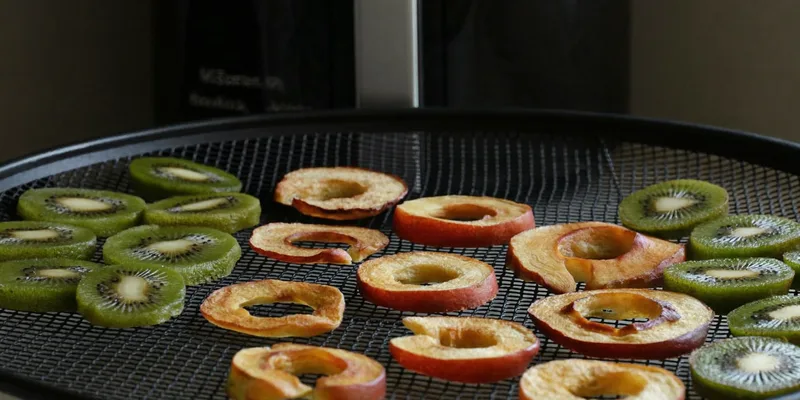
An air fryer dries small quantities well. Apple rings, citrus slices for drinks, herbs, a handful of mushrooms, banana chips for a lunchbox. The heat is controllable on most models with a dehydrate mode, and the fan is already there. For a first experiment it costs nothing.
The limit is the basket. Even a large air fryer gives you one or two shallow layers of usable surface, and drying needs food in a single layer with air on both faces. A pound of zucchini becomes three separate runs, each several hours long.
The noise and the kitchen
Air fryer fans are loud by design, because they are built for short bursts. Running one for eight hours in an open plan kitchen is a real complaint owners raise. A dedicated dehydrator running overnight is usually a background hum instead.
Best entry dehydrator when you outgrow the basket
A compact stackable is the cheapest way to find out whether you will keep drying. Trays expand the stack, and the running cost of a low wattage machine over a long session stays modest.

The Oven: Free, But Awkward
Oven drying is the oldest home method and it works. The catch is temperature. Extension guidance on oven drying notes that many home ovens will not hold a setting low enough for drying, and advises checking the actual cabinet temperature with a separate oven thermometer before trusting the dial.
The second catch is airflow. A conventional oven has none unless it has a convection fan, so the usual workaround is propping the door open with a wooden spoon. That works, and it also heats your kitchen and ties up the oven for most of a day.
When the oven is the right call
Small one off jobs. Drying orange slices for decorations, finishing herbs that are nearly dry already, or crisping something that has gone soft. For those, the oven is fine and you own it already.
Worth owning either way
An independent thermometer tells you what your oven or air fryer is really doing at a low setting, which is the one piece of information neither appliance display reliably gives you.

Side by Side on What Matters
Three appliances, four criteria that decide the outcome. Capacity is the one that pushes almost everyone toward a dedicated machine eventually, and it is the one hardest to judge from a product page.
| Criterion | Air fryer | Oven | Dehydrator |
|---|---|---|---|
| Usable drying area | One or two shallow layers | Two or three racks | Five to eleven full trays |
| Low temperature control | Good on dehydrate models | Often the weak point | Designed for it |
| Airflow | Strong but turbulent | None without convection | Even, front to back or bottom up |
| Running for hours | Loud, ties up the appliance | Heats the kitchen | Built for overnight runs |
Capacity and temperature ranges come from manufacturer specifications; the oven temperature caution comes from extension service drying guidance.
Jerky Is the Exception, Not a Preference
Meat changes the conversation. USDA FSIS guidance for home made jerky is to heat meat to 160F, and poultry to 165F, measured with a food thermometer, before drying, and then to dry it in a dehydrator that maintains 130F to 140F throughout. That guidance assumes a machine whose temperature you can set and verify.
An air fryer basket also cannot hold a jerky batch worth making, and strips overlapping in a basket dry unevenly. If jerky is your reason for drying anything, buy the machine built for it rather than adapting one that is not.
Best machine if jerky is the goal
A stainless tray machine with a numbered digital thermostat lets you hold and verify a drying temperature across a full load, which is what the FSIS guidance assumes. Our jerky dehydrator guide goes deeper on airflow and tray area.

Frequently Asked Questions
Is the dehydrate setting on an air fryer any good? Yes, for small quantities. It lowers the heat and slows the fan, which is the correct approach. The limitation is the basket, which gives you a fraction of the drying surface a dehydrator tray stack does.
Can I dehydrate in the oven instead of buying anything? You can, and extension drying guidance covers oven drying, but it warns that many ovens will not hold a low enough temperature. Check with an oven thermometer and expect to prop the door for airflow.
Which is cheaper to run for a long batch? A dehydrator, generally, because it draws far less power than an oven and is designed for long low temperature runs. Exact figures depend on your machine’s wattage and your electricity rate.
Can I make jerky in an air fryer? Not well, and the safety step still applies. USDA FSIS guidance calls for heating meat to 160F, or poultry to 165F, before drying and then drying at a maintained 130F to 140F, which needs a machine with a verifiable thermostat and room for the strips.
Do air fryer dried foods store the same way? Yes. However the food was dried, it needs conditioning and then airtight storage away from light. Our dehydrated food storage guide covers the process.
What should I dry first to test the water? Apple slices or herbs. Both are forgiving, both finish in a reasonable time, and both show clearly whether your appliance dries evenly or leaves damp spots in the middle of the load.
The Bottom Line
Use the air fryer to find out whether drying is a thing you enjoy, because it costs nothing to try and it genuinely works on a small scale. Buy a dehydrator the first time you are running the same batch three times over to get through a single harvest, and buy one with a numbered thermostat if meat is anywhere in your plans. Start with our dehydrator buying guide, and if the choice is really between drying and freeze drying, our freeze dryer comparison covers that fork.