Last updated: August 23, 2026
Most people buy their first dehydrator for one thing. Apples in October, jerky before hunting season, herbs from a garden that got out of hand in July, or a flat of strawberries that was too good a deal to pass up. Then it turns out the machine is either too small for the job or too loud to leave running overnight, and it goes to the basement.
The specifications on the box do not tell you which of those will happen. What decides it is airflow direction, tray area, how low and how accurately the thermostat holds, and whether the trays come apart for the dishwasher. This guide sorts the machines by the batches you actually plan to run.
This article contains affiliate links. If you buy through them, we may earn a commission at no extra cost to you. Learn more.
Quick Answer
Which food dehydrator should you buy?
- Small kitchen, occasional batches: a compact stackable unit with a digital timer.
- Jerky and big harvests: a box style machine with a rear fan and square shelves.
- Herbs and delicate work: a model whose thermostat reaches genuinely low temperatures.
- Tray area, not tray count, is the number that decides how much fits.
Bottom line: buy for the largest batch you will realistically run, because nobody ever wished their dehydrator were smaller.
What Separates a Good Dehydrator From a Cheap One
Three things: whether the air reaches every tray evenly, whether the thermostat actually holds the number on the dial, and whether the trays survive a season of scrubbing. Everything else, the recipe booklet included, is packaging. A machine that dries unevenly turns every batch into a rotation chore.
Cheap units skip the thermostat calibration and the fan sizing, which is why owners report the top tray done and the bottom still wet. Independent testing consistently finds the better mid range machines holding within a few degrees of their set point, while budget units wander enough to matter for meat.
Round and Stackable or Square and Shelved
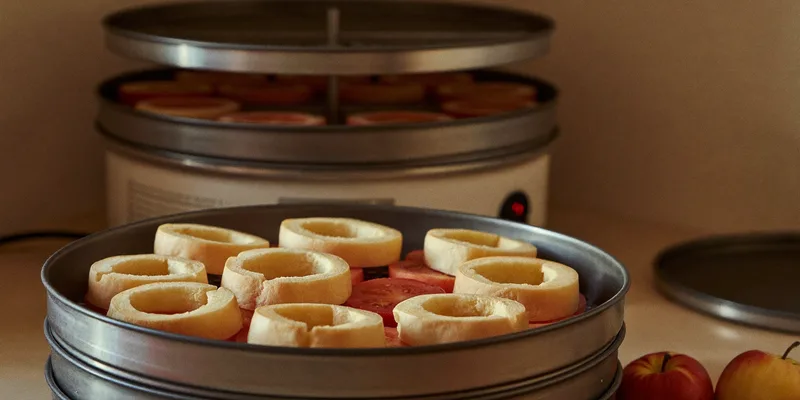
Stackable round dehydrators push air vertically through a stack of trays with a hole in the middle. Box style machines mount the fan at the back and push air horizontally across square shelves. Horizontal airflow dries more evenly and needs less tray rotation, and it is the reason box machines dominate serious jerky and bulk work.
Round stackables earn their keep on price and on storage: they nest down small, they expand by adding trays on many models, and for fruit and herbs the difference in evenness is manageable if you rotate. The donut hole does cost usable area on every tray. Our airflow comparison goes deeper.
Best all round box machine for a busy season
Excalibur’s nine tray models are the long standing reference for horizontal airflow at home, with square shelves that slide out and a fan across the whole back wall. It is bulky and it is not quiet, and it dries a full load without a rotation schedule.
Best stackable for a small kitchen
The Nesco Snackmaster line is the machine most households start with, expandable by adding trays and small enough to live in a cupboard. Round trays lose some area to the center hole, which is the trade for the size and the price.

How Many Trays You Actually Need
Count by what one harvest looks like. A flat of strawberries or five pounds of jerky meat fills far more tray space than people expect, and a machine you have to run three times in a row is a machine you stop using. Nine trays is the working size for anyone drying a garden; five is enough for herbs, snacks and the occasional batch.
Also read tray area rather than tray count, because a square shelf holds meaningfully more than a round tray of the same nominal size. Manufacturers publish square inches per tray in most listings, and that is the number worth comparing across brands.
Best for large harvests and bulk jerky
Stainless steel box machines with ten or eleven shelves handle a deer or a full orchard pick in one run. They take real counter space, which is the honest cost of not running four sequential batches.

Best compact machine for small batches
A five or six tray digital unit with a timer covers apples, herbs, fruit leather and a modest jerky run without dominating the counter. Presto’s digital Dehydro is the common pick here, and testing has repeatedly put its temperature accuracy near the top of its class.

Temperature Range, and Why the Low End Matters
A dehydrator is a heater with a fan, and the useful range runs from herb drying at the bottom to meat drying at the top. Herbs and greens want the lowest setting the machine offers to keep their color and oils; fruit sits in the middle; jerky needs the machine to hold a genuine drying temperature for hours without drifting.
For jerky specifically, USDA FSIS guidance is to heat meat to 160F, and poultry to 165F, before drying, and then to dry in a dehydrator that maintains 130F to 140F throughout. A machine with a vague dial and no way to verify the temperature makes that hard to follow, which is why an adjustable, accurate thermostat is a safety feature and not a luxury.
Best if accuracy is the priority
Stainless tray machines with digital control tend to hold their set point most tightly, and a clear panel means you can see the actual setting rather than guess at a dial position. Verify with an oven thermometer on the middle shelf if you dry meat regularly.

Comparing the Main Types
Every dehydrator on the market is one of four shapes, and the shape predicts almost everything about how it will behave in your kitchen. Use the table to narrow the type first, then pick a model within it.
| Type | Airflow | Typical capacity | Best suited to |
|---|---|---|---|
| Round stackable | Vertical, fan top or bottom | Four to twelve trays, expandable | Small kitchens, fruit, herbs |
| Compact box, plastic trays | Rear fan, horizontal | Five to six shelves | Everyday batches, fruit leather |
| Box, stainless shelves | Rear fan, horizontal | Six to eleven shelves | Jerky, big harvests, heavy use |
| Cabinet, high capacity | Rear fan, horizontal | Ten shelves and up | Hunters, market growers |
Capacities reflect manufacturer listings across the common models in each category.
Noise, Cleaning and Running Cost
Dehydrators run for hours, often overnight, so the fan noise matters more than the sales page admits. Box machines with a large rear fan are generally the loudest at close range and the most even; many owners solve it by running the machine in a garage, laundry room or basement rather than a kitchen.
Cleaning decides whether you use the thing. Trays that separate and go in the dishwasher get scrubbed; a fixed tray with a mesh liner glued in does not. Check the listing for dishwasher safe trays and for replacement tray availability, because a cracked tray should not retire a working machine.
What it costs to run
Most home machines sit in the same wattage bracket as a couple of light bulbs to a small toaster oven, and a long overnight run is a modest cost against the food it saves. Higher wattage generally means faster drying and a bigger cabinet rather than a worse deal.
Frequently Asked Questions
My dehydrator dries unevenly and I keep rotating trays. What fixes it? A rear fan machine with horizontal airflow, which pushes air across every shelf at once instead of up through a stack. Within a stackable, load evenly, slice to a consistent thickness and swap top and bottom halfway.
Are the trays dishwasher safe? On most modern machines, yes, and the listing will say so. Stainless shelves and removable plastic trays generally are; solid one piece bases and the motor housing never are.
How much electricity does a dehydrator use? Enough to notice on a long run but not enough to change the economics of drying your own food. Compare wattage across models if you plan overnight batches regularly.
What temperature should I use for jerky? Follow USDA FSIS guidance, which calls for heating the meat to 160F, or poultry to 165F, before drying, and drying in a dehydrator that maintains 130F to 140F. See our jerky time and temperature guide for the full sequence.
Is a nine tray machine overkill for two people? Not if you garden or hunt. Batch size follows the harvest, not the household. Two people with an apple tree will fill nine trays in an afternoon.
Can I dry herbs without cooking them? Yes, on the lowest setting with mesh liners so the leaves do not blow around. Our herb drying guide covers the liner question and the airflow problem.
The Bottom Line
Pick the shape first and the model second. A rear fan box machine with square shelves is the right answer for jerky and for anyone drying a garden’s worth of food; a compact stackable is the right answer for herbs, snacks and a small counter. Whatever you choose, buy for the biggest batch you will genuinely run, and check that trays are replaceable. If jerky is the reason you are shopping, go straight to our dehydrator for jerky guide.