Last updated: August 23, 2026
You open the dehydrator after an hour of drying basil and half the leaves are not where you put them. They are on the shelf below, against the back wall, and a few have found the fan housing. Herbs weigh almost nothing once the water starts leaving, and the airflow that dries apples politely turns a tray of parsley into confetti.
The other half of the problem is heat. Herbs are not fruit. Their value is in volatile oils that leave with the steam if you run them at a fruit temperature, which is how a jar of home dried oregano ends up smelling like hay. Both problems have specific fixes, and neither requires a different dehydrator than the one you own.
This article contains affiliate links. If you buy through them, we may earn a commission at no extra cost to you. Learn more.
Quick Answer
What makes a dehydrator good for herbs?
- A thermostat that goes genuinely low. Herbs need the bottom of the dial, not the fruit setting.
- Fine mesh liners, so leaves stay on the tray instead of in the fan.
- Gentle, even airflow. A rear fan cabinet keeps leaves flatter than a strong updraft through a stack.
- A short run you can watch. Herbs finish in a fraction of the time fruit takes.
Bottom line: low heat and mesh liners solve the two problems people blame on the machine.
Why Herbs Blow Around, and How to Stop It
A fresh basil leaf is mostly water. As it dries it loses weight faster than it loses surface area, so within the first hour it becomes a small sail sitting in a moving airstream. Nothing about the machine is faulty. The tray simply has nothing holding the leaves down.
Fine mesh liners fix it in two ways. The tighter weave stops small leaves and chopped stems from dropping through, and the liner surface gives the leaves a little more grip than open plastic ribs. They also make the harvest easier to pour off the tray at the end.

The Two Free Tricks
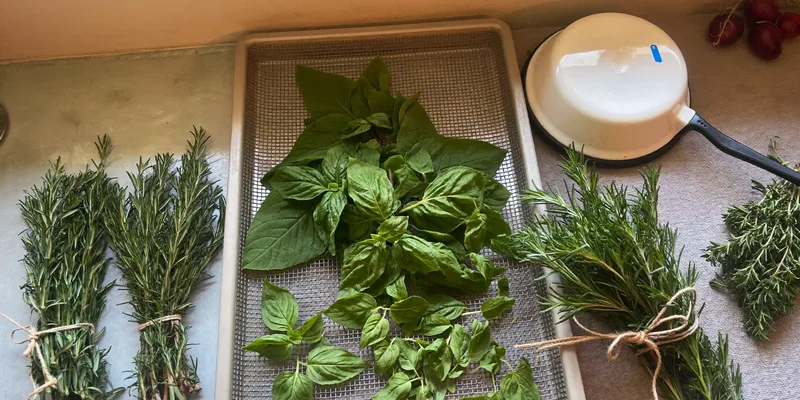
Dry herbs on stems where you can, since a whole sprig is heavy enough to stay put and you strip the leaves after drying. And load the lower trays rather than the top ones on a stackable machine, because the airflow at the far end of the stack is where the lightest leaves take off.
The Temperature Herbs Actually Need
Herbs get the lowest setting on the machine. The National Center for Home Food Preservation directs you to preheat the dehydrator with the thermostat set to 95F to 115F, and notes that in areas of higher humidity temperatures as high as 125F may be needed.
That is well below the fruit setting, and it is why a dehydrator with a single high thermostat is a poor herb machine. NCHFP describes the usual dehydrator thermostat range as running from 85F to 160F, so most units reach the herb range, but the cheapest fixed temperature models do not.
What Happens If You Run Them Hot
They dry faster and taste like less. The aromatic oils that make oregano worth growing are volatile, which means they evaporate along with the water when the temperature climbs. The leaf still looks right in the jar. The difference shows up the first time you cook with it.
Which Dehydrators Suit Herbs
Any machine that reaches the low range will dry herbs. What separates the good ones is a rear mounted fan that moves air across rather than up through the stack, a thermostat with real low end resolution, and trays that take a mesh liner without gaps at the edge.
Best If You Grow Herbs and Little Else
A compact stainless six tray unit with a digital thermostat handles a herb garden without taking a cabinet shelf. Cosori lists its premium six tray model with stainless trays and digital temperature control, and the low end of that dial is what makes it usable for herbs rather than only fruit.

Best If Herbs Are One Crop Among Many
A nine tray box dehydrator with a rear fan gives you the tray area for a summer harvest and dries every shelf evenly, so the delicate top tray is not a different climate than the bottom one. Excalibur lists the 3926TB with nine trays and a timer.
Best If You Only Want the Herb Setup
If your dehydrator already reaches the low range, buy liners rather than a machine. A set of fine mesh sheets plus a couple of jars turns whatever you own into a herb dryer. Check your tray dimensions first, since liners are cut to a few standard footprints.

Herb by Herb, What Changes
Leaf structure decides the run. Thin soft leaves give up their water quickly and scorch easily, while woody stemmed herbs are slower and far more forgiving. Group similar herbs in the same load so one tray is not finished while another is still limp.
| Herb type | Examples | Handling | Watch out for |
|---|---|---|---|
| Soft leaf | Basil, cilantro, mint | Single layer on mesh liner | Blows around, browns if too warm |
| Woody stem | Rosemary, thyme, oregano | Dry on the stem, strip after | Stems stay damp after leaves are done |
| Flat leaf | Parsley, sage | Flatten, do not overlap | Overlap leaves stay green and wet |
| Chopped aromatics | Chives, scallion tops | Mesh liner, shallow layer | Falls through standard tray mesh |
If you want the crop by crop detail rather than the gear, our herb drying walkthrough covers harvesting time, washing and stripping.
Storing Dried Herbs So They Keep Their Flavor
Store herbs whole and crush them when you cook. A whole leaf keeps its oils locked inside far better than crushed leaf does, which is the same reason whole spices outlast ground ones. Crushing at the point of use is the single biggest flavor difference in home dried herbs.
Jars, not bags, and away from the stove. Glass with a tight lid, kept in a dark cupboard, protects from light and humidity. If a jar shows any condensation in the days after filling, the herbs went in before they were fully dry and need to go back on the tray.
Herb Dehydrator: What to Look For
A herb dehydrator is judged on its floor, not its ceiling. Check that the listing states a thermostat starting at or below 95F, because NCHFP puts herb drying at 95F to 115F and a machine that begins at 125F will drive off the oils you are trying to keep. Airflow and liner fit decide the rest.
Three things on a listing tell you whether a machine suits herbs. A rear mounted fan dries every shelf at the same rate, so the top tray of basil is not finished an hour before the bottom one. Tray dimensions decide whether standard mesh liners fit, and liners are what keep dried leaves on the tray instead of in the fan housing. Tray depth barely matters here, since herbs take almost no height, and a timer saves you checking a load that finishes long before fruit would.
Frequently Asked Questions
My herbs keep blowing off the trays, what am I doing wrong? Nothing, other than drying them on bare mesh. Dried leaves weigh almost nothing and the airflow lifts them. Fit fine mesh liners, dry sprigs on the stem where possible, and use the lower trays on a stackable machine.
What temperature should I use for herbs? The lowest range your machine offers. NCHFP directs you to set the thermostat to 95F to 115F and notes that up to 125F may be needed in humid areas. Higher than that drives off the oils that give the herb its flavor.
How do I know when herbs are dry? The leaves crumble between your fingers rather than folding, and the stems snap instead of bending. Test a piece once it has cooled, because warm leaves feel more flexible than they will be at room temperature.
Should I wash herbs before drying? Rinse if they need it, then dry them thoroughly with a towel or a salad spinner first. Surface water adds time and, on soft leaves like basil, encourages the dark spotting that people mistake for scorching.
Can I dry herbs by hanging them instead? You can, and for woody herbs in a dry room it works well. A dehydrator wins on speed, on color, and in a humid climate, where air drying takes long enough that mold becomes a genuine risk.
The Bottom Line
Herbs need the bottom of the thermostat and something to keep them on the tray. Set the low range NCHFP publishes for herbs, fit fine mesh liners, dry sprigs on the stem where you can, and check them early because they finish long before fruit does. Store the leaves whole in glass and crush them when you cook. If you are still choosing a machine, prioritize a low end thermostat and a rear fan over tray count. Read next: how to choose a dehydrator and which liners fit which tray.