Last updated: August 23, 2026
The dehydrator arrives with a set of trays and nothing else, and the first three loads teach you what is missing. Strawberry slices weld themselves to the mesh. Chopped chives fall through. Marinade from the jerky drips onto the tray below and then onto the heater. None of that is a fault in the machine. It is the difference between a bare rack and a rack with the right surface on it.
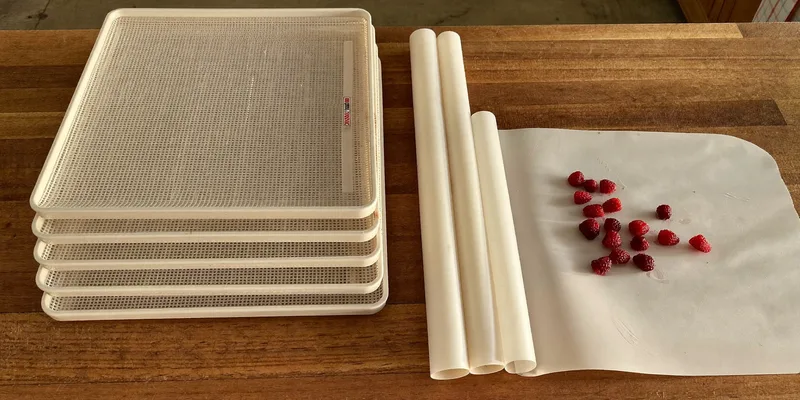
Liners, sheets and spare trays are the cheapest thing you will buy for a dehydrator and the accessories that decide whether you keep using it. This page sorts out which surface belongs under which food, what to check before you order, and where a generic sheet will not fit your machine.
This article contains affiliate links. If you buy through them, we may earn a commission at no extra cost to you. Learn more.
Quick Answer
Which dehydrator trays and sheets do you actually need?
- Solid sheets for anything wet or pourable: fruit leather, sauces, yogurt drops, and as a drip catcher under marinated meat.
- Fine mesh liners for anything small: herbs, chopped onion, berries, seeds and peas that fall straight through the standard grid.
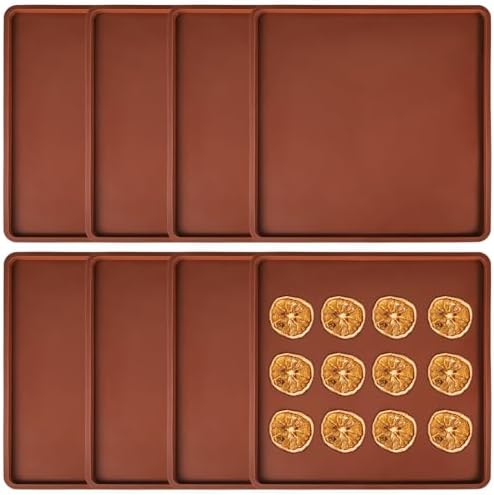
- Perforated silicone mats for sticky sliced fruit that welds itself to bare mesh.
- Spare trays only if your model officially supports the extra height. Stacking past the limit strangles airflow.
Bottom line: measure your tray before ordering. Universal sheets are cut to a handful of common sizes and yours may not be one of them.
The Four Surfaces and What Each One Solves
There are only four things you can put on a dehydrator shelf: bare mesh, a fine mesh liner, a perforated silicone mat, and a solid sheet. Each blocks a different amount of airflow, and that trade between airflow and containment is the entire decision. More containment always means slower drying on that tray.
Bare mesh gives maximum air movement and works for anything that holds its shape and is bigger than the grid. That covers most vegetable slices, mushroom pieces, thick apple rings and unmarinated meat strips. If your food falls through, sticks, or runs, you need one of the other three.
Fine Mesh Liners
A fine mesh liner is a flexible screen with a much tighter weave than the tray it sits on. It keeps small pieces from dropping to the tray below while barely reducing airflow, which is why it is the default for herbs, chopped aromatics, berries and anything that shrinks a lot as it dries.
Solid Sheets and Fruit Leather Trays
Solid sheets are non stick and have a raised lip. They hold puree in place for fruit leather, catch drips from marinated jerky on the shelf above, and let you dry sauces down to a powder. Because they block airflow from underneath, food on a solid sheet always takes longer than the same food on mesh.
Why Fruit Sticks to the Tray and What Fixes It
Sticking is sugar, not a defect. As sliced fruit loses water, the sugars concentrate at the contact points and glue themselves to whatever they touch. Perforated silicone mats fix it because the food releases cleanly from silicone while the holes keep air moving through from below.
The other half of the fix is timing. Lifting and turning fruit once, partway through the run, breaks the bond before it sets and also evens out the drying. If you dry a lot of berries and stone fruit, silicone mats plus one turn will save more frustration than any change of machine.
What Not to Use
Wax paper melts and sticks. Aluminum foil blocks airflow completely and can react with acidic fruit. Parchment is acceptable for a single emergency load on a solid tray but it curls in the airflow and lifts the food with it. Buy the mats once and stop improvising.
Marinade Drips and the Tray Underneath
Marinated jerky drips for the first hour or two, and on a vertical airflow machine those drips reach the heating element. The National Center for Home Food Preservation makes exactly this point about vertical flow units, noting that liquids can drip into the heating element while horizontal flow keeps juices away from it.
The practical fix costs almost nothing. Let strips drain on a rack for a few minutes before loading, then run a solid sheet on the bottom shelf as a drip catcher. Clean it after every jerky run rather than at the end of the season, because dried marinade turns into a job.

Small Food Falls Through, and Mesh Liners Stop It
Standard dehydrator mesh has openings sized for slices, not for chopped herbs, chia seeds, peas, corn or small berries. Fine mesh liners drop the opening size enough that those stay put, and unlike a solid sheet they cost you almost no airflow, so the run time barely changes.
Herbs are the clearest case. They are so light that the fan lifts them off the tray entirely on the higher shelves, which is the single most common complaint about drying herbs at home. Our guide to drying herbs covers the low temperature side of that problem.

Buying Spare Trays Without Choking the Airflow
Extra trays are worth it only when the manufacturer supports them. Stackable units usually publish a maximum tray count, and going past it starves the top shelves because the fan was sized for a specific stack height. Cabinet machines rarely accept more shelves than they shipped with.
Fit is also model specific in a way listings gloss over. Trays and sheets come in a small number of common footprints, and a sheet cut for one brand will sit a fraction short in another and let food slide off the edge. Measure the inside dimension of your own tray before you order.

Which Surface for Which Food
The table below is the short version. When two options both work, pick the one with more airflow, because the faster a food gets through the moist stage the better it keeps its color and the less it can spoil on the tray.
| Food | Surface | Why | Watch out for |
|---|---|---|---|
| Fruit leather | Solid sheet with lip | Holds puree, releases cleanly | Spread evenly or edges crisp first |
| Sliced sticky fruit | Perforated silicone mat | Airflow plus clean release | Turn once partway through |
| Herbs and chopped onion | Fine mesh liner | Stops pieces blowing or dropping | Lightest leaves still lift on top trays |
| Marinated jerky | Mesh, solid sheet below | Air all round, drips caught | Drain strips before loading |
For the fruit leather side of the table, our fruit leather guide covers thickness and doneness, which is where most first attempts go wrong.
Frequently Asked Questions
My jerky marinade dripped all over the machine, what should I have done? Drain the strips on a rack before loading and put a solid sheet on the shelf below the meat. On a vertical airflow unit that sheet is what keeps marinade off the heating element, and it is far easier to wash than the base of the machine.
Are silicone mats safe at dehydrator temperatures? Food grade silicone mats sold for dehydrators are rated well above the range these machines run in, and NCHFP describes dehydrator thermostats as covering 85F to 160F. Check that the listing states food grade silicone rather than unspecified rubber.
Can I use parchment paper instead of buying sheets? For one load, on a solid tray, it will get you through. It curls in the airflow, lifts the food, and cannot be used on mesh without blocking most of the tray, so it is a stopgap rather than a plan.
Do liners make drying take much longer? Fine mesh adds very little. Perforated silicone adds a modest amount. Solid sheets add the most, because no air reaches the underside of the food, which is why fruit leather is a long run even when the top feels dry.
Will generic 14 by 14 sheets fit my dehydrator? Only if your trays are that size. Several popular nine tray machines use that footprint, but stackable round units and many cabinet models do not. Measure the usable inside area of one tray and compare it to the listed dimensions before ordering.
The Bottom Line
A dehydrator without liners is a machine you will slowly stop using. Buy one set of fine mesh liners for herbs and small pieces, one set of solid sheets for leather and drip catching, and perforated silicone mats if sticky fruit is your main crop. Measure your tray first, because these come in a handful of fixed sizes and the wrong one is useless. Spare trays only make sense within the tray limit your manufacturer publishes. Read next: choosing the dehydrator itself and what to check when a load dries unevenly.