Last updated: August 23, 2026
Every jerky recipe online gives a drying time, and almost none of them will be right in your machine. Thickness, load size, humidity in the room, how wet the marinade left the strips and how hard your fan pushes all move the finish line by hours. Time is the least reliable number in the whole process.
Temperature is the number that does not move, because it is not a preference. USDA FSIS publishes specific temperatures for making jerky at home, and they exist because drying meat is one of the few kitchen processes where doing it at a comfortable temperature can leave pathogens alive. This page lays out what that guidance says and how to actually follow it.
This article contains affiliate links. If you buy through them, we may earn a commission at no extra cost to you. Learn more.
Quick Answer
What time and temperature does jerky need?
- USDA FSIS guidance: heat meat to 160F, poultry to 165F, before drying, measured with a food thermometer.
- Then dry in a dehydrator that maintains 130F to 140F throughout the process.
- There is no single correct drying time. Judge by how the cooled jerky bends and cracks.
- Drying at a low temperature alone is not a substitute for the heat step.
Bottom line: the temperatures come from FSIS and are fixed; the time is whatever your batch needs.
The Two Temperatures That Matter
There are two, not one, and confusing them is the most common mistake in home jerky. The first is the internal temperature of the meat itself, which USDA FSIS sets at 160F for meat and 165F for poultry, measured with a food thermometer. The second is the temperature the dehydrator holds while drying, which FSIS gives as 130F to 140F.
The meat temperature is a safety step. The dryer temperature is a process setting. A dehydrator running in the FSIS drying range is not, by itself, bringing the meat to 160F, which is exactly why the guidance lists both.
The Jerky Time and Temperature Chart
The chart below is the FSIS guidance laid out as steps rather than prose. Time is deliberately left as a judgement call, because FSIS does not publish a fixed drying duration and any number here would be a guess dressed up as a rule.
| Step | Beef, venison and other meat | Poultry | How to verify |
|---|---|---|---|
| Heat step before drying | Heat to 160F | Heat to 165F | Food thermometer in the thickest strip |
| Drying | Dehydrator held at 130F to 140F | Dehydrator held at 130F to 140F | Machine setting plus an oven thermometer on a shelf |
| Drying time | Varies by thickness and load | Varies by thickness and load | Bend test on a cooled piece |
| Alternative order | Dry first, then heat to 160F | Dry first, then heat to 165F | Food thermometer after the heat step |
All temperatures in this chart come from USDA FSIS guidance on jerky and food safety. Nothing here is estimated or carried over from another food.
How Long Does Jerky Actually Take?
Long enough that people start checking too early, and variable enough that a chart of hours would mislead you. Thin strips in a lightly loaded machine with strong horizontal airflow finish well ahead of thick strips packed onto every shelf of a stackable, and a humid kitchen adds to it again.
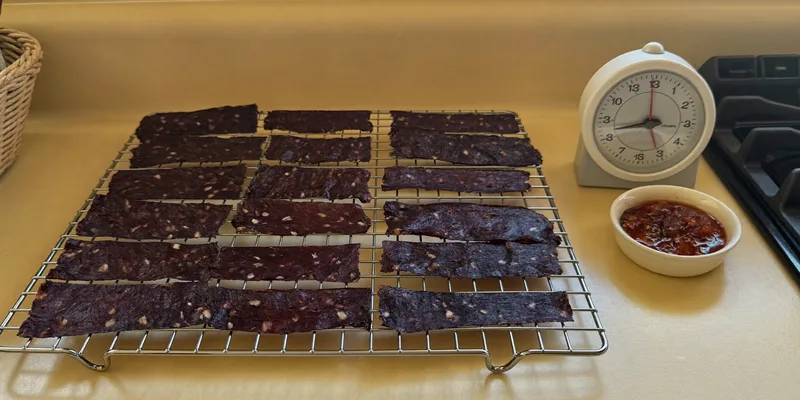
Judge by the meat, not the clock. Take a piece out, let it cool to room temperature, then bend it. Properly dried jerky cracks along the bend without breaking in two, and shows no soft, moist or shiny patches when you tear it open. Warm jerky always feels more pliable than it will be once cool, which is why the cooling step matters before you judge.
What makes a batch take longer
Thick or unevenly cut strips, overlapping pieces, a fully loaded machine, wet marinade that was not blotted off, high humidity, and a vertical airflow machine drying dense meat. Fixing the first three usually removes hours.
How to Do the Heat Step
FSIS describes heating the strips to temperature by steaming or roasting them before they go into the dehydrator, or applying the heat step after drying is complete. Either order satisfies the guidance, and both need a food thermometer to confirm rather than a timer.
Doing it first has a practical advantage: the strips go into the dehydrator already safe, and drying becomes purely a texture question. Doing it afterward keeps the raw texture during drying, which some people prefer, and adds a final oven stage before storage.
Marinating is not the heat step
A salty or acidic marinade, and a cure packet, are not substitutes for heat. Cure ingredients in commercial jerky seasoning kits come with their own manufacturer instructions for how much meat each packet treats, and those instructions are about the cure, not about eliminating the need to reach temperature.
Why Drying Alone Is Not Enough
FSIS explains the mechanism directly: in a dehydrator or a warm oven, most of the heat is absorbed by evaporating moisture, so the temperature of the meat does not begin to rise until most of that moisture is gone. Pathogens become more heat resistant as the meat dries, which is the worst possible sequence.
That is the reason the old approach of simply setting a dehydrator low and leaving it overnight is not considered adequate. The meat spends the whole run cool and wet, then finishes hot and dry, and never passes through a stage that reliably does the job.
Shortcuts to avoid
Drying without ever measuring the meat temperature, using a machine with no adjustable thermostat, propping a warm oven and hoping, and judging doneness on a warm piece straight off the shelf. Each of those replaces a measurement with an assumption.
Storing the Finished Batch
Cool the jerky completely before it goes anywhere, because trapped warmth becomes condensation in a sealed container and condensation becomes mold. Once cool, keep it airtight, dark and as cool as your storage allows.
Vacuum sealing in jars or bags slows the fats from turning, and the refrigerator or freezer is the right home for anything you are keeping beyond the near term. See storing dehydrated food for the conditioning and container side.
Frequently Asked Questions
What temperature should a dehydrator be for jerky? USDA FSIS guidance says the dehydrator should maintain 130F to 140F throughout drying, and that the meat should separately be heated to 160F, or poultry to 165F, before or after that drying.
How long does jerky take in a dehydrator? There is no fixed answer, and FSIS does not publish one. It depends on thickness, load, airflow and humidity. Use the bend test on a fully cooled piece instead of a timer.
Can I skip the heat step if I dry it longer? No. FSIS is explicit that pathogens can survive drying, because the meat stays cool while moisture evaporates. Longer drying makes the jerky harder, not safer.
Is 165F needed for beef? FSIS gives 160F for meat and 165F for poultry. If you are drying wild birds, use the poultry figure.
Does a cure packet replace the heat step? No. Follow the cure manufacturer’s instructions for the weight of meat, and still reach the FSIS temperature. They address different risks.
My machine has no numbered thermostat. What now? Put an oven thermometer on a middle shelf to see what it is actually holding, and consider a machine with a numbered setting if you dry meat often. Our dehydrator for jerky guide covers which models make this easy.
Can I use this chart for fish? No. The USDA jerky guidance behind this chart is written for beef, other red meat and poultry, and fish is a separate process with different handling. Alaska Sea Grant and several university extension services publish tested methods for dried and smoked fish. Use one of those rather than adapting a beef time and temperature to salmon.
The Bottom Line
Treat the temperatures as fixed and the time as variable. USDA FSIS gives 160F for meat and 165F for poultry as the heat step, and 130F to 140F as the dehydrator range, and the rest of the process is judged on a cooled piece of jerky rather than a clock. If your machine cannot hold a number you can read, that is the thing to fix first: see our dehydrator for jerky guide and the wider food dehydrator buying guide.