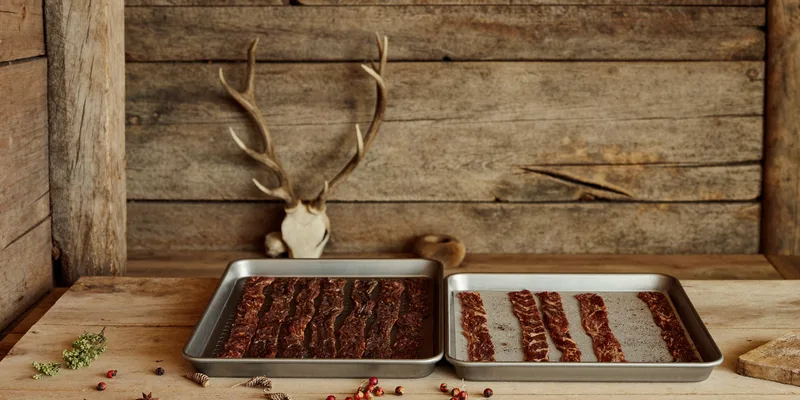
Last updated: August 23, 2026
A deer comes home all at once. The freezer fills in an afternoon, the roasts and the burger get wrapped, and then there are the odd cuts, the round, the flank, the trim that nobody wants as a steak. That is jerky meat, and it usually arrives in a quantity that a kitchen counter dehydrator was never designed for.
Venison also behaves differently from store bought beef in the machine. It is leaner, it dries faster, and the flavor of a bad batch is unmistakable. Sizing the dehydrator for a season, not a snack, is most of the decision, and the safety steps for wild game are the part worth not improvising.
This article contains affiliate links. If you buy through them, we may earn a commission at no extra cost to you. Learn more.
Quick Answer
Which dehydrator suits deer jerky?
- A rear fan box machine with square shelves, sized for the pounds a season produces.
- An adjustable, accurate thermostat, because the USDA drying guidance is a number, not a dial position.
- Nine or more shelves if you process a whole deer’s worth of trim.
- Trays that come out and go in the dishwasher, since venison marinade stains.
Bottom line: buy for the season’s volume, and treat the pre drying heat step as non negotiable.
Wild Game and the USDA Heat Step
USDA FSIS jerky guidance covers wild game as well as beef and poultry, and the recommendation is the same: heat the meat to 160F, measured with a food thermometer, before drying, then dry in a dehydrator that maintains 130F to 140F throughout. Poultry, including wild birds, goes to 165F.
FSIS explains the reason plainly. In a dehydrator, most of the heat is spent evaporating moisture, so the meat itself stays cool until it is already dry, and pathogens can survive that. Steaming or roasting the strips to temperature first, or applying the heat step after drying, is what makes the batch safe.
Handling before the kitchen
Field care matters more with game than with meat that arrived in a package: cooling the carcass quickly, keeping the meat clean, and trimming away anything shot damaged. For questions about disease testing or local handling rules, your state wildlife agency or extension service is the source, not a gear site.
Sizing the Machine for a Deer
Plan by pounds of trim, not by household. A single deer routinely yields more jerky meat than a five tray machine can dry in one go, and running four sequential overnight batches is how a promising November project quietly dies. Nine square shelves is the practical floor for a whole animal.
Strips cannot overlap and need air on both faces, so shelf area is the real capacity number. Manufacturers publish square inches per shelf on most box machines, and comparing that beats comparing tray counts across different tray shapes.
Best for a whole deer in one session
Ten and eleven shelf stainless cabinets are built for exactly this volume. They take real space in a kitchen, which is why many hunters run them in a garage or basement instead.

Best proven box machine for hunters
Excalibur’s nine tray horizontal airflow machines have been the standard recommendation in hunting circles for years, with a full width rear fan that dries a loaded cabinet evenly.
Best budget option for a few pounds at a time
If you take one deer every few seasons and share the meat out, an expandable stackable will get you there with lighter loads and a tray rotation partway through.

Whole Muscle or Ground Venison
Whole muscle strips give the classic chew and are the easier of the two to handle safely, since the surface is where contamination sits. Ground venison jerky is softer, easier on the teeth, and uses trim that would otherwise go to burger, but grinding distributes surface bacteria through the whole mix.
Either way the FSIS heat step applies. Ground jerky is also where a jerky gun changes the work, pressing even strips or sticks straight onto the shelf instead of rolling and cutting a slab by hand.
Best for pressing ground venison strips
A jerky gun with a flat nozzle and a stick nozzle covers both formats, and consistency of thickness is what keeps a batch finishing at the same time. Keep the meat cold while you work.

Venison Specifics Worth Knowing
Lean meat dries faster and burns easier than beef, and the fat that is present goes rancid quickly, which is why trimming is not optional. Slicing partially frozen meat across the grain gives an even strip that breaks cleanly rather than pulling apart in strings.
| Step | Whole muscle venison | Ground venison | Why it matters |
|---|---|---|---|
| Trim | Remove all fat and silverskin | Grind lean trim only | Fat turns rancid in storage |
| Slice or press | Partially freeze, cut across the grain | Press with a jerky gun | Even thickness dries evenly |
| Heat step | To 160F per USDA FSIS guidance | To 160F per USDA FSIS guidance | Drying alone may not do it |
| Dry | Dehydrator held at 130F to 140F | Dehydrator held at 130F to 140F | FSIS drying range |
Temperature figures in this table are USDA FSIS jerky guidance; the handling steps are general practice among home processors.
Seasoning and Cure for Game
Commercial jerky kits sold for wild game include a seasoning and a separate cure packet, and the packet is measured for a stated weight of meat. Follow the manufacturer’s instructions on quantity exactly rather than estimating, because cure is the one ingredient where more is not better.
Flavor wise, venison takes assertive seasoning well, since the meat itself is stronger than beef. Our jerky seasoning guide compares the common kits and explains what the cure packet is doing.
Frequently Asked Questions
Does the USDA heat step apply to venison too? Yes. FSIS jerky guidance covers wild game and calls for heating meat to 160F before drying, with the dehydrator maintaining 130F to 140F during the process.
How much jerky does one deer make? Far less than the raw weight suggests, because meat loses most of its water. Plan tray space around the raw pounds you are loading, and expect the finished result to fit in a fraction of the containers you set out.
Should I use ground venison or whole muscle? Whole muscle for classic chewy jerky, ground for a softer product and for using trim. Ground needs the same heat step and benefits from a jerky gun for even strips.
Why did my deer jerky taste off after a month? Almost always residual fat. Venison fat goes rancid faster than beef fat, so trim aggressively, and store the finished jerky cool, dark and airtight.
Can I dry jerky in the oven instead? You can, and FSIS describes oven drying, but home ovens often cannot hold a low temperature steadily and the door has to be propped for airflow. A dehydrator with a real thermostat makes the guidance easier to follow.
Do I need a bigger machine if I hunt every year? Probably. Most hunters who start with a small stackable end up buying a nine shelf box machine after their first full season of sequential batches.
The Bottom Line
Deer jerky rewards a machine bought for the season rather than the snack: rear fan, square shelves, a thermostat you can trust, and enough area to take a day’s trim in one load. The safety half is the FSIS heat step, and it happens outside the dehydrator whichever machine you own. For the general buying decision see our dehydrator for jerky guide, and for the sequence itself, the jerky time and temperature guide.