Last updated: August 23, 2026
The jar question usually arrives at the wrong moment. You have a head of cabbage shredded on the board, a bowl of it already salted and weeping, and you are standing in front of a cupboard trying to work out whether it all fits in the quart jar or whether you needed the big one. Guessing wrong means either a jar packed so full there is no room for brine, or a half empty vessel with a lot of air above the ferment.
There is a published rule of thumb for this, and it is easier than eyeballing it. This guide covers what size to use for how much vegetable, where glass beats stoneware and where it does not, and which containers to keep out of the fermenting rotation entirely.
This article contains affiliate links. If you buy through them, we may earn a commission at no extra cost to you. Learn more.
Quick Answer
What size fermentation jar do you need?
- NCHFP gives the rule directly: a one gallon container for every five pounds of fresh vegetables.
- By that measure a quart jar suits a little over a pound of cabbage, which is roughly half a small head.
- Glass and food grade plastic are both listed by NCHFP as good substitutes for a stone crock.
- Wide mouth is worth insisting on, because weights, lids and your hand all have to get in and out.
Bottom line: size the jar to the vegetables using the one gallon per five pounds rule, and buy wide mouth so the rest of your gear fits.
Sizing the Jar to the Batch
NCHFP publishes the ratio plainly in its fermenting instructions: a one gallon container is needed for each five pounds of fresh vegetables, and a five gallon stone crock is ideal for fermenting about twenty five pounds of fresh cabbage or cucumbers. Scale that down and a quart jar handles a little over a pound of prepared vegetable comfortably.
That allowance is not padding. The vegetables need to sit under brine, and NCHFP asks for one to two inches of brine above them, plus room for the foam an active ferment throws up in the first days. A jar packed to the shoulder has nowhere to put any of that.
Weigh the Vegetables, Not the Jar
Prepared weight is what counts: cabbage after coring and shredding, cucumbers after trimming. A large head of cabbage can lose a surprising amount to the core and the outer leaves, so weighing after prep rather than at the store keeps the sizing honest and makes the salt calculation work out too.
Glass, Stoneware and Plastic
NCHFP lists food grade plastic and glass containers as excellent substitutes for stone crocks, and it accepts other one to three gallon non food grade plastic containers if they are lined inside with a clean food grade plastic bag. In other words, all three materials are on the approved list; the differences are practical rather than a safety ranking.
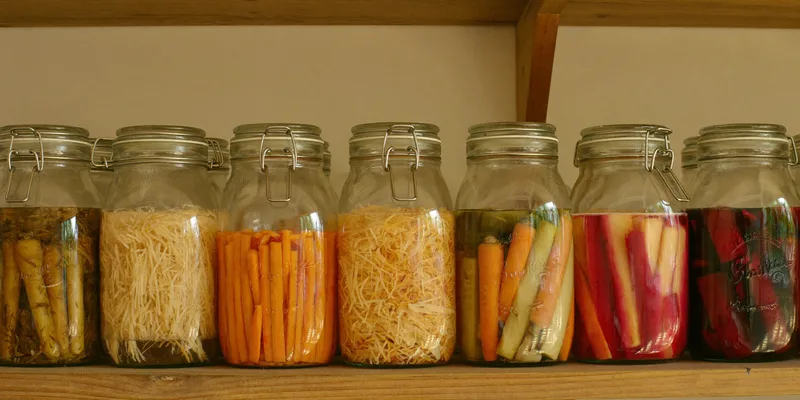
Glass wins on visibility, which matters more than it sounds. You can see the brine level, see whether anything has floated, and see a film forming before you open the jar. Stoneware wins on volume and on keeping light off the ferment, and it holds temperature more steadily in a room that swings.
What Not to Ferment In
NCHFP is direct about materials that react with a salty acidic brine, warning against brass, copper and zinc utensils and noting that pickles should not be used if those were involved. Chipped enamelware and unglazed or damaged pottery are also out, since a compromised surface is impossible to clean properly. Stick to glass, unchipped stoneware, food grade plastic and stainless steel.
Fermentation Jars by Situation
The Everyday Test Batch Size
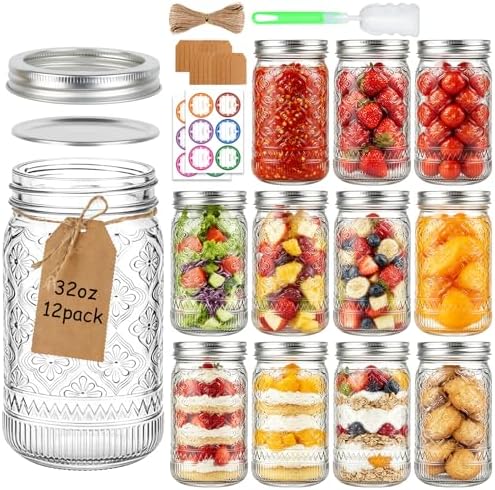
Wide mouth quarts are the workhorse. They take standard fermentation lids and weights, they hold roughly a pound of prepared vegetable with proper brine coverage, and a row of four lets you run several experiments at once. If you buy one size, buy this one.
When a Quart Is Not Enough
Half gallon jars take about double the batch and still fit standard wide mouth lids and weights, which makes them the natural step up. They are noticeably taller, so measure your shelf before ordering a case, especially if you plan to run three piece airlocks on top.

For a Full Gallon Batch With an Airlock Built In
Purpose made gallon fermenting jars come with a matched lid and airlock and a mouth wide enough to reach into. By the NCHFP ratio a gallon vessel handles about five pounds of vegetables, which is a real batch of kraut rather than a sample. Check that the lid and gasket are sold as replaceable parts before buying.

For Twenty Pounds and Up
At crock volumes the vessel changes character. A water seal stoneware crock keeps light out, holds temperature steadily and vents through a water moat instead of an airlock. NCHFP names a five gallon stone crock as ideal for about twenty five pounds of cabbage or cucumbers, which is one serious harvest day.

Comparing Vessel Sizes
| Vessel | Fresh vegetables it suits | Best for | Watch out for |
|---|---|---|---|
| Quart jar | About a pound of prepared vegetable | Test batches, several flavors at once | Fills fast; leave room for brine |
| Half gallon jar | Roughly double a quart | A household batch of kraut or pickles | Shelf height with an airlock fitted |
| One gallon vessel | About five pounds, per NCHFP | A full cabbage batch, brined pickles | Heavy when full; check lid parts availability |
| Five gallon crock | About twenty five pounds, per NCHFP | Harvest day volume | Very heavy; needs matched weights |
The one gallon and five gallon figures come straight from the NCHFP guidance on suitable containers for fermenting; the jar rows scale the same ratio down.
Mouth Size, Shape and Cleaning
Wide mouth is not a style preference in fermenting, it is a functional requirement. A weight has to go in and come back out, a lid has to seat, and at the end you have to get a hand and a brush inside. Regular mouth jars work if that is all you own, but every accessory decision gets narrower along with the neck.
Shoulders matter too. A straight sided jar lets a flat weight sit anywhere in the pack, while a shouldered jar traps shreds above the widest point where a disc cannot reach them. If you are buying new for fermenting specifically, straight sided is the better shape.
Cleaning Between Batches
Hot soapy water and a bottle brush is the routine, with particular attention to threads and any gasket groove where brine dries. Fermenting jars do not need the sterilization step that canning jars get, because the process relies on salt and acidity rather than a sealed sterile jar, but a jar going into long storage should be genuinely clean and dry.
Frequently Asked Questions
How much cabbage fits in a quart jar? A little over a pound of prepared, shredded cabbage. NCHFP’s ratio is one gallon of container per five pounds of fresh vegetables, and a quart is a quarter of a gallon, so a quart jar lands just above a pound with room for brine on top.
My kombucha or kefir keeps picking up off flavors and film, is the jar the problem? Often it is the vessel and its cover rather than the culture. Use a dedicated wide mouth glass jar for brewing, keep it away from vegetable ferments so the cultures do not cross contaminate, and cover it with a tight woven cloth or a proper brewing lid rather than a loose piece of fabric that fruit flies can get past.
Can I ferment in a plastic bucket? NCHFP accepts food grade plastic containers, and allows one to three gallon non food grade plastic containers when lined with a clean food grade plastic bag. What it does not accept is reactive metal, and it advises against using pickles at all if brass, copper or zinc utensils were involved.
Glass or ceramic, which is better? Neither is safer. Glass shows you the brine level and any surface film, ceramic holds bigger batches, blocks light and keeps temperature steadier. Most people run glass jars and add a crock only when batch size demands it.
Do fermentation jars need to be sterilized? No, they need to be clean. Sterilizing belongs to canning, where the seal has to hold a sterile environment. A fermenting jar relies on salt concentration and the acid the bacteria produce.
Can I use old commercial pickle jars? For a small batch, yes, if the glass is sound and the jar is genuinely clean. The catch is that the mouth diameter rarely matches standard fermentation lids and weights, so you end up improvising both.
The Bottom Line
Size the vessel to the vegetables rather than the other way around, using the NCHFP figure of one gallon per five pounds, and leave real room above the pack for brine and foam. Wide mouth, straight sided glass covers almost everything a home fermenter does, with a crock reserved for harvest scale batches. Once the jar is chosen, the fermentation weights guide and the fermentation lids guide cover the two accessories that decide whether the batch behaves.