Last updated: August 23, 2026
Salt is the only part of sauerkraut that you cannot improvise. Everything else in the process forgives you: the shred can be coarse, the cabbage can be a day old, the jar can be the wrong shape. Get the salt wrong in either direction and you either end up with a mushy, slippery batch or something so salty nobody eats it.
The awkward part for beginners is that every source gives the ratio in a different unit. Extension recipes use tablespoons per pound, fermenting blogs use a percentage by weight, and the two do not line up neatly because a tablespoon of coarse salt and a tablespoon of fine salt are different amounts of salt. Here is what the published guidance actually says, and how to work with it reliably.
This article contains affiliate links. If you buy through them, we may earn a commission at no extra cost to you. Learn more.
Quick Answer
What is the right salt ratio for sauerkraut?
- NCHFP’s tested sauerkraut recipe calls for 3 tablespoons of canning or pickling salt per 5 pounds of shredded cabbage.
- If the cabbage does not release enough juice to cover itself, NCHFP says to add boiled and cooled brine made with 1 and 1/2 tablespoons of salt per quart of water.
- Use canning or pickling salt. NCHFP notes that potassium chloride salt substitutes make the result bitter.
- Keep everything one to two inches under the brine, which NCHFP states as a requirement for cabbage and cucumbers.
Bottom line: follow the published tablespoons per pound rather than a percentage you found online, and weigh the cabbage rather than counting heads.
The Published Ratio
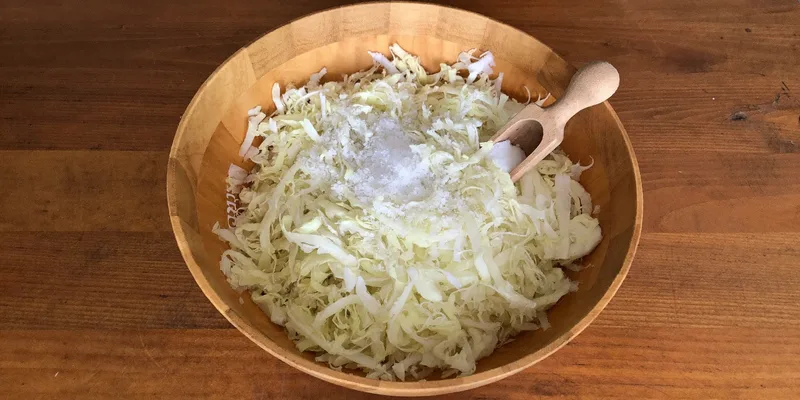
The National Center for Home Food Preservation publishes sauerkraut as 3 tablespoons of canning or pickling salt per 5 pounds of shredded cabbage, mixed thoroughly and packed firmly until the salt draws the juices out. University of New Hampshire Extension publishes the same recipe scaled up, at 3/4 cup of canning or pickling salt for 25 pounds of cabbage.
That is the whole ratio. It is not a starting point to be adjusted to taste, because the salt is doing safety work as well as flavor work. UNH Extension’s version of the recipe makes the reason explicit, noting that there must be a minimum uniform level of acid throughout the product to prevent the growth of Clostridium botulinum, and the salt is what lets the right bacteria produce that acid.
The Top Up Brine Is a Different Ratio
The salt you mix into the cabbage and the brine you add later are not the same strength. NCHFP’s instruction is that if the juice does not cover the cabbage, you add boiled and cooled brine made with 1 and 1/2 tablespoons of salt per quart of water. Mixing those two ratios up is a common beginner error.
Why Percentages and Tablespoons Disagree
Extension recipes are published in volume measures, so any salt percentage you see quoted online is somebody’s conversion of those measures, not a separately tested figure. The conversion is where it gets slippery: coarse flake salt and fine granulated salt fill a tablespoon very differently, so the same spoon can hold noticeably different amounts of actual salt.
If you prefer working on a scale, the reliable approach is to weigh what your own tablespoon of your own salt actually holds, then use that weight against the published recipe. That keeps you on the tested ratio while giving you the repeatability of a scale. What it does not do is licence a different ratio than the one that was tested.
Salt Type Matters More Than Brand
NCHFP calls for canning or pickling salt, which is plain sodium chloride without iodine and without anti caking agents. Iodine can darken a ferment, and the anti caking additives in table salt are what produce the cloudy brine and white sediment people worry about. NCHFP lists salt substitutes containing potassium chloride as a cause of bitterness.
The Salt Reference
| Batch of shredded cabbage | Salt to mix in | Container size | Notes |
|---|---|---|---|
| 5 pounds | 3 tablespoons canning or pickling salt | 1 gallon | The base NCHFP ratio |
| 25 pounds | 3/4 cup canning or pickling salt | 5 gallon crock | The same recipe scaled, per UNH Extension |
| Top up brine | 1 and 1/2 tablespoons salt per quart of water | Boiled and cooled first | Only if the cabbage juice does not cover |
| Coverage target | Not a salt figure | Any | Vegetables 1 to 2 inches under brine |
Every figure in this table comes from the NCHFP sauerkraut and fermenting guidance, with the 25 pound row as published by University of New Hampshire Extension.
Weighing the Cabbage Is the Real Skill
The ratio only works if the pounds are right, and cabbage heads vary enormously. Weigh after coring and shredding, not at the store, because the core and the outer leaves can be a meaningful share of a large head. This is the single change that turns sauerkraut from a lottery into something repeatable.
Work in the same unit throughout. If you weigh the cabbage in pounds, keep the salt in the published tablespoons. If you switch to grams, convert both sides, and write the numbers on the jar so the next batch can be compared to this one.
A Scale With a Tare Button
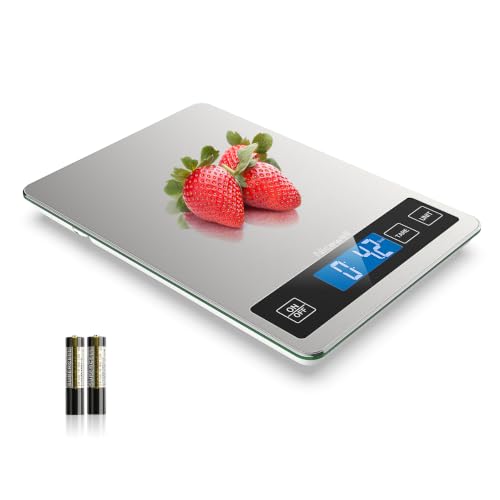
A flat kitchen scale that reads grams and zeroes with a bowl on it is all this needs. Put the bowl on, tare, shred straight into it, and you have the prepared weight without arithmetic. Nothing fancy is required, and a scale that struggles to read small salt amounts is worth replacing.
The Right Salt on the Shelf
Keep a box of canning and pickling salt separate from the table salt, because they are visually identical in a bowl and only one of them belongs in a ferment. It is also the salt you want for pickling and brining generally, so it does not sit idle.

What Goes Wrong at Each End
Too little salt is the dangerous direction, not just the disappointing one. NCHFP lists a weak salt brine first among the causes of soft or slippery pickles, and its fix is to maintain the salt concentration specified in the recipe. A weak ferment gives wild yeasts and unwanted bacteria more room, which is also how a batch ends up with a film on top.
Too much salt mostly slows the ferment down and makes the result unpleasant to eat. The fermentation stalls because the lactic acid bacteria are inhibited along with everything else, so you get a batch that never really sours and tastes only of salt. Rinsing finished kraut before serving takes the edge off, but the fix is measuring properly next time.
Temperature Changes the Timeline, Not the Ratio
NCHFP publishes sauerkraut fermenting at 70 to 75 degrees F as taking about 3 to 4 weeks, and at 60 to 65 degrees F as taking 5 to 6 weeks, and it notes that below 60 degrees F kraut may not ferment and above 75 degrees F it may become soft. None of that is a reason to change the salt; it is a reason to move the crock.
Frequently Asked Questions
I am a beginner and have no idea how much salt to use, where do I start? Use NCHFP’s tested figure: 3 tablespoons of canning or pickling salt per 5 pounds of shredded cabbage. Weigh the cabbage after shredding, mix the salt in thoroughly, and pack firmly until the juices come out. That is the whole starting point.
My sauerkraut came out far too salty, can I fix it? Rinsing the finished kraut before serving reduces the saltiness, and using it in cooked dishes rather than straight from the jar helps. The batch is not ruined, but check your measuring next time, since over salting usually means a heaped spoon or the wrong salt type rather than a bad recipe.
Can I use less salt for a low sodium version? The published ratios are the ones that were tested, and UNH Extension ties the salt directly to producing a uniform level of acid that prevents Clostridium botulinum growth. Reducing the salt is not a flavor preference in a ferment, so stay on the tested figure.
Do I need to add brine, or will the cabbage make its own? Firm fresh cabbage packed hard usually makes enough. NCHFP’s instruction covers the case where it does not: add boiled and cooled brine made with 1 and 1/2 tablespoons of salt per quart of water until the cabbage is covered.
Can I use sea salt or kosher salt? NCHFP specifies canning or pickling salt. Other plain salts without iodine or anti caking additives are chemically similar, but the crystal size differs, so a spoon of one is not a spoon of another. Weighing is the way around that.
Why did my brine go cloudy? NCHFP lists white sediment in fermented pickles as either the bacteria doing their normal work, which needs no prevention, or additives in table salt. If you used canning or pickling salt and the smell is clean, cloudiness on its own is not a warning sign.
How long does sauerkraut take to ferment? NCHFP puts fermenting at 70 to 75 degrees F at about 3 to 4 weeks, and at 60 to 65 degrees F at 5 to 6 weeks. Temperature sets the timeline, not the salt. The practical tell is that the bubbling has stopped and the smell is cleanly sour, so taste it weekly from the second week and refrigerate when it tastes right to you.
The Bottom Line
Use the ratio that was tested: 3 tablespoons of canning or pickling salt to 5 pounds of shredded cabbage, with a separate 1 and 1/2 tablespoons per quart of water for any brine you add on top. Weigh the cabbage after prep, use plain canning salt, and keep everything one to two inches under the brine. A scale and the right box of salt cover most of the difference between a reliable batch and a lottery. From here, the fermentation weights guide handles the submersion and the kahm yeast versus mold guide covers what to do if something appears on top anyway.