Last updated: August 23, 2026
Magic Mill is one of those brands that seems to appear from nowhere the moment you start shopping for a dehydrator with metal trays. It is not a legacy name like Nesco or a specialist name like Excalibur, and the listings lean hard on tray count and stainless steel, which makes it genuinely hard to tell what you are comparing.
What the brand actually sells is a small family of front loading, rear fan cabinets with stainless trays, running from a seven tray model up to a ten tray version. This is a look at what the manufacturer and the listings state, where that specification matters in a real batch, and where owners run into the limits.
This article contains affiliate links. If you buy through them, we may earn a commission at no extra cost to you. Learn more.
Quick Answer
Is a Magic Mill dehydrator worth buying?
- It is a front loading cabinet with stainless trays and a rear mounted fan, which is the layout that dries evenly without tray rotation.
- Magic Mill lists the MFD-7100 with 7 stainless steel trays, 480 watts, a temperature range of 95 to 165 degrees F and a timer running from 30 minutes to 24 hours.
- The 10 tray Premium listing states 700 watts, 10 extra large stainless trays, a 48 hour digital timer and a range of 95 to 167 degrees F.
- Buy it for tray area and metal shelves. Buy something else if you want a compact unit that lives on the counter.
Bottom line: the tray count is the decision, and most people who regret their choice bought too few.
What Magic Mill Lists
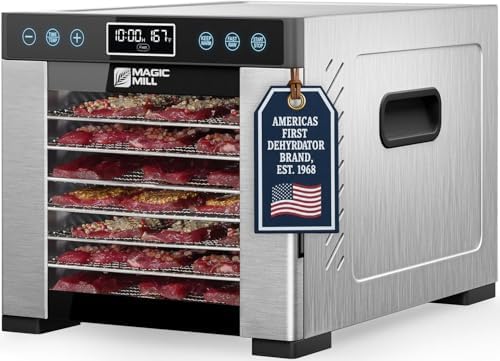
The MFD-7100 is the model most buyers land on first. Magic Mill lists it with 7 removable, height adjustable stainless steel racks measuring 13 by 12 inches, 480 watts, a temperature range of 95 to 165 degrees F, a countdown timer from 30 minutes to 24 hours in half hour steps, and a rear mounted fan pushing air from back to front.
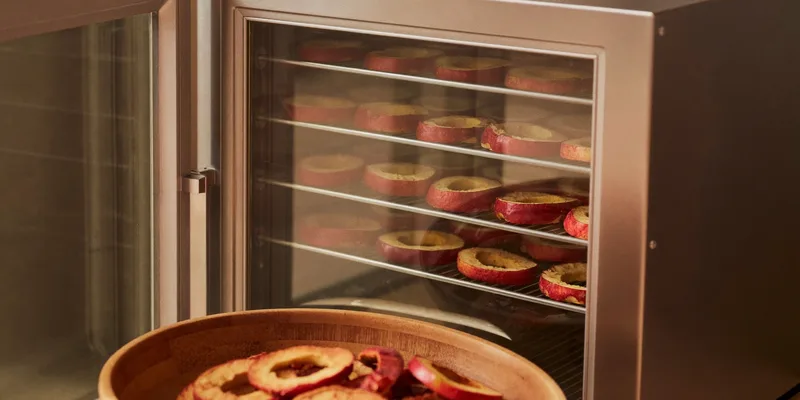
The same listing adds a keep warm function, overheat protection, a transparent door for checking progress without opening it, dishwasher safe trays, plus two fine mesh sheets and two fruit leather trays in the box. Those two accessories are the ones people otherwise buy within a month, so their inclusion is worth more than it sounds.
The Rear Fan Is the Real Selling Point
Horizontal airflow from a rear mounted fan is what separates a cabinet dehydrator from a stack of round trays with a heater in the base. Air crosses each shelf at roughly the same speed, so the bottom tray does not finish while the top one is still leathery. Magic Mill states that its airflow reaches all trays with no need to rotate shelves.
Take the no rotation claim as a design intent rather than a physical law. Load nine trays of wet tomato slices unevenly and you will still find slow corners, but the difference against a vertical stacker is real and it shows up most on long, full batches. We compare the two layouts in vertical against horizontal airflow.
Seven Trays or Ten
Tray area, not wattage, is what limits a harvest day. The 10 tray Premium listing states 700 watts, 10 extra large stainless steel trays measuring 12 by 13 inches, a 48 hour digital timer and a range of 95 to 167 degrees F. The extra shelves are the difference between one run and two for a bushel of apples.
Who Should Take the Smaller One
If your drying is herbs, a weekly tray of fruit and the occasional batch of jerky, seven trays is plenty and the machine takes up less counter and cupboard. The MFD-7100 also carries the shorter 24 hour timer, which is only a limitation on the very longest fruit runs.
Who Should Take the Ten
Gardeners and hunters. If a single September evening produces more tomatoes than seven trays hold, you will run the smaller machine twice and wish you had not. The 48 hour timer on the larger unit also covers fruit that runs past a day, which CSU Extension notes can be the case for berries.
If you want the seven tray cabinet
If you dry harvest sized loads

Stainless Trays and What They Change
Metal trays are the reason most people shop this brand. They do not warp at the top of the temperature range, they do not stain from turmeric or tomato, and they go in the dishwasher, which matters more than any feature on the control panel when you are cleaning up at midnight.
The trade off is that bare metal grids let small pieces through, so herbs, shredded vegetables and sliced fruit still need mesh liners or fruit leather sheets. Magic Mill includes two of each with the seven tray model, and sells stainless replacement trays separately for owners who want to run extra shelves through the wash between batches.
If you want spare shelves in rotation

Model and Accessory Comparison
Everything below comes from the manufacturer listing for the MFD-7100 and the retail listing for the 10 tray Premium. Use it to decide capacity first, then accessories.
| Item | What the listing states | Why it matters | Who it suits |
|---|---|---|---|
| MFD-7100 | 7 stainless trays, 480 watts, 95 to 165 degrees F, timer to 24 hours | Enough shelf area for weekly drying | Herbs, fruit, occasional jerky |
| 10 tray Premium | 10 stainless trays, 700 watts, 95 to 167 degrees F, 48 hour timer | One run instead of two on a harvest day | Gardeners, hunters, bulk snack makers |
| Replacement stainless trays | Sold separately for the dehydrator range | Keeps a clean set ready mid batch | Anyone drying several loads back to back |
| Mesh sheets and leather trays | Two of each included with the MFD-7100 | Stops small pieces falling through the grid | Herb, shred and fruit leather makers |
Check the model number on the listing before ordering trays, since Magic Mill sells tray sets that fit several model numbers and the sizes differ between the cabinets.
Where Owners Run Into Trouble
Three complaints come up repeatedly in owner reviews across the range. The door seal and the fit of the clear panel draw the most comment, with some owners reporting a gap that lets warm air escape at the hinge. Fan noise is the second, and it is the ordinary noise of a cabinet fan running for a full day rather than a defect.
The third is expectation. Owners who bought for jerky sometimes find the temperature ceiling lower than they assumed, and the safe handling of jerky is a temperature question with its own published guidance rather than a machine setting you can eyeball. We keep those numbers, with the sources, in the jerky time and temperature chart.
Frequently Asked Questions
What temperature range does the Magic Mill dehydrator cover? Magic Mill lists 95 to 165 degrees F for the MFD-7100, and the 10 tray Premium listing states 95 to 167 degrees F. The low end is there for herbs and the keep warm function, the top end for meat and dense vegetables.
Do I need to rotate the trays? Magic Mill states its airflow reaches all trays with no need to rotate shelves, which is what the rear fan layout is designed to deliver. On very full, very wet loads it is still worth checking the corners nearest the fan, because those finish first.
Are the trays dishwasher safe? The manufacturer listing says the stainless trays and liners are dishwasher safe and BPA free. In practice most owners rinse immediately after unloading, because dried fruit sugar is far easier to remove before it sets.
How does it compare with Cosori, Nesco and Excalibur? Magic Mill competes on stainless trays and tray area rather than on brand history or app features. We line the four up in the dehydrator brands comparison, and cover the individual machines in the Cosori and Nesco reviews.
Is it worth paying more for stainless over plastic trays? If you dry acidic or strongly colored foods, or you want shelves that survive the dishwasher for years, yes. If you mostly dry herbs at low temperatures, plastic trays hold up fine. Our stainless steel dehydrator guide works through the difference.
The Bottom Line
Magic Mill sells a straightforward proposition: a rear fan cabinet with stainless trays at a size most kitchens can justify. Decide on tray area first, because the 7 tray MFD-7100 and the 10 tray Premium differ mainly in shelf count, wattage and timer length, and the shelf count is what you notice on a harvest day. If you are still comparing across brands, start with our food dehydrator buying guide, and if jerky is the main reason you are buying, read the jerky dehydrator guide before you choose a model.