Last updated: August 23, 2026
September is when this project finds people. The pepper plants that produced nothing all summer suddenly hand you two pounds of jalapenos in a week, the freezer is full, and there are only so many jars of pickled rings a household needs. Fermenting them is the answer that turns a glut into something you will still be reaching for in March.
Fermented hot sauce also tastes like nothing you can make by blending fresh peppers with vinegar. The three weeks in the jar build a depth that a same day sauce never gets. This page covers the gear that keeps a pepper mash under the brine, how the ferment runs, and the acidity question that decides whether your finished bottle belongs in the refrigerator or on a shelf.
This article contains affiliate links. If you buy through them, we may earn a commission at no extra cost to you. Learn more.
Quick Answer
How do you make fermented hot sauce?
- Peppers in a salt brine, everything under the surface, for a few weeks at room temperature.
- Take the salt amount from a tested extension or NCHFP source rather than from a video.
- Blend the finished ferment, add vinegar to taste, strain if you want it smooth.
- Keep it in the refrigerator unless you are following a tested recipe with verified acidity.
Bottom line: a jar, a weight and an airlock lid make the sauce. A pH meter and a tested recipe decide whether it can leave the refrigerator.
Why Ferment Peppers Instead of Blending Them
Because fermentation changes the flavor rather than just preserving it. Lactic acid bacteria convert sugars in the peppers into acid, and along the way they produce the savory, slightly funky depth that separates a fermented sauce from fresh peppers in vinegar. The heat softens and rounds out too.
It also handles volume better than any other pepper project. A half gallon jar takes a lot of peppers, needs no oven time and no canner, and it holds while you keep adding to the harvest. If drying is your other option, our pepper drying guide covers that route.
Mash or Brine
Two common approaches. A brine ferment puts whole or chopped peppers in salt water, which is easier to keep submerged and gives a cleaner flavor. A mash ferment blends or crushes the peppers with salt and ferments the paste, which is more concentrated and more prone to trapping gas. Beginners should start with a brine.
Salt Is the Control, Not the Seasoning
Take the salt amount from a tested source. Extension services and the National Center for Home Food Preservation publish salt concentrations for brined vegetable ferments, and those numbers exist because the salt level is what keeps lactic acid bacteria ahead of spoilage organisms. This is not a ratio to adjust to taste.
Use canning or pickling salt as well. NCHFP notes that iodized table salt can cloud a brine and darken the vegetables, and the anti caking agents add sediment you will taste in a blended sauce. Our salt comparison covers which ones are interchangeable.
The Gear That Makes or Breaks It
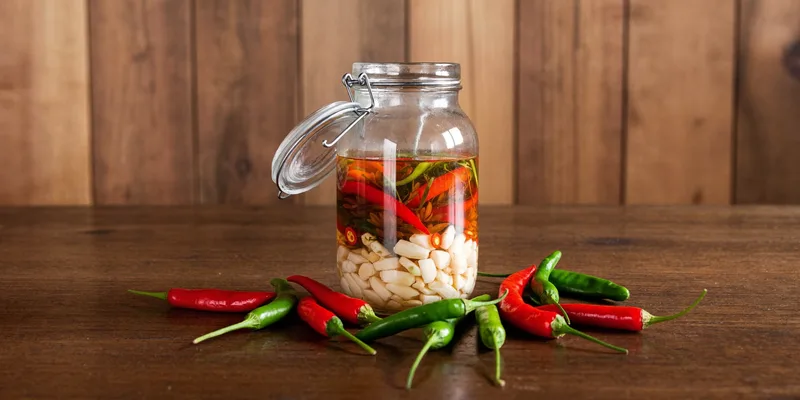
Three items, and each one prevents a specific failure. A wide mouth jar with real headroom, because pepper ferments are vigorous and brine climbs. A weight, because floating peppers above the brine are where mold starts. An airlock lid, because a sealed jar of fermenting peppers builds genuine pressure.
Half gallon wide mouth jars are the sweet spot for a household batch. They take a serious pile of peppers, the mouth is wide enough to fit a weight and get everything out again, and the glass lets you watch the brine level without opening anything.
Best vessel and lid combination
A wide mouth jar with a fitted airlock lid vents carbon dioxide continuously and keeps fruit flies out, which matters in late summer when they are already circling the kitchen. Our fermentation lids guide compares the silicone valve and three piece airlock styles.

Best weight for a pepper ferment
Pepper pieces float harder than almost anything else because of the air trapped inside them. A heavy glass weight sized to a wide mouth jar holds them down, and a whole outer cabbage leaf tucked under the weight catches the small bits. See fermentation weights for the shapes.

Running the Ferment
Pack the jar, cover with brine, weight it down and fit the lid. In the first few days you will see bubbles and the brine will turn cloudy, which is the population getting to work. Keep the jar out of direct sun, somewhere with a stable room temperature, and check the brine level rather than the calendar.
It is ready when the bubbling has slowed, the peppers have lost their bright raw color, and the brine tastes sour rather than merely salty. Most household batches run a few weeks, with warm rooms faster and cool rooms slower. Taste is the test, not a date.
What to Watch For
A flat white film on the surface is usually kahm yeast, which is unpleasant rather than dangerous, and our kahm yeast page shows how to tell it from mold. Fuzzy colored growth is mold, and NCHFP guidance on brined vegetables is to discard a moldy batch rather than skim and continue.
Blending, Straining and the Acidity Question
Blend the drained peppers with some of their own brine until it is as thick as you want, then add vinegar to taste. Straining through a fine sieve gives the smooth commercial texture, and the pulp left behind dries into a good chili powder rather than going in the bin.
The acidity decision comes next and is the one genuine safety question here. NCHFP classifies acid foods as those with a pH of 4.6 or lower, and a home fermented sauce that has not been measured or made to a tested recipe should be treated as a refrigerator product. A pH meter is the only way to know rather than assume.
Measuring rather than guessing
A digital pH meter with automatic temperature compensation and calibration solutions is the tool for this. Test strips are hard to read against a red sauce. Our pH meter guide covers calibration and what the readings do and do not tell you.

Bottling Is Its Own Problem
A sauce that is still fermenting will build pressure in a sealed bottle, and that is how people end up cleaning hot sauce off a ceiling. Our page on bottling fermented hot sauce covers stopping the ferment, choosing bottles and leaving headspace.
Three Routes Compared
The same peppers can go three ways, and the right answer depends on how much time you have and how you plan to store the result.
| Route | Time | Flavor | Storage |
|---|---|---|---|
| Brine ferment | Weeks | Sour, deep, savory | Refrigerator unless a tested recipe says otherwise |
| Mash ferment | Weeks to months | Most concentrated, funkiest | Refrigerator, watch pressure while it works |
| Fresh vinegar sauce | An afternoon | Bright, sharp, pepper forward | Follows the tested canning recipe you used |
Storage guidance here follows the general NCHFP position that shelf stability depends on a tested, acidified recipe rather than on taste or appearance.
Frequently Asked Questions
How long does fermented hot sauce need? Most household batches run a few weeks, and the finish is judged by taste and by the bubbling slowing down rather than by a date. Warmer rooms move faster. Longer ferments taste deeper and less sharp, which is why some people run a mash for months.
Can I put my fermented hot sauce on the shelf? Only if you are following a tested recipe with verified acidity. NCHFP classifies acid foods as those with a pH of 4.6 or lower, and an unmeasured home sauce should be kept in the refrigerator. Our pH meter page explains how to check properly.
My bottle fizzed over. What happened? Live fermentation continuing in a sealed bottle. The sauce was still active when it was bottled, and carbon dioxide had nowhere to go. Our bottling guide covers how to stop the ferment first, and why swing top bottles behave differently from screw caps.
Do I need to add vinegar? Not for flavor, since the ferment produces its own acid. Many recipes add vinegar afterward for taste and for acidity, but adding vinegar does not by itself make a sauce shelf stable. That still depends on a tested recipe and a measured pH.
Can I ferment dried peppers? Rehydrated dried peppers can be added to a ferment for flavor, but fresh peppers carry the bacteria that start the process, so build the batch around fresh ones. If your peppers are already dried, our pepper drying page covers what else to do with them.
What is the white sediment at the bottom? Settled yeast and pepper solids, which is normal in an active ferment. It stirs back in when you blend. A flat white film on the surface is a different thing, and our kahm yeast page covers telling that apart from mold.
The Bottom Line
Fermented hot sauce is the best return on a pepper harvest and needs almost no equipment: a wide mouth jar, a weight that actually holds peppers down, and an airlock lid so the jar does not become a pressure vessel. Take the salt amount from a tested source, judge the finish by taste, and be honest about the last step. Unless you have followed a tested recipe and measured the acidity, the finished bottle belongs in the refrigerator. Next: bottling without explosions, and other things worth fermenting while the jar is working.