Last updated: August 23, 2026
Pepper plants do not ration themselves. One jalapeno bush produces steadily from July until the first frost warning in October, and then it hands you everything at once. Bells go soft in the crisper within a week, hot peppers hang on longer but eventually wrinkle, and there is a limit to how much salsa one household can eat.
Drying handles the whole spread, sweet and hot, with one machine and one afternoon of prep. The two kinds are not the same project though. Bell peppers get blanched and dried like any other vegetable, while hot peppers need no blanching, gloves, and some thought about where the dehydrator sits while it runs.
This article contains affiliate links. If you buy through them, we may earn a commission at no extra cost to you. Learn more.
Quick Answer
How do you dehydrate peppers?
- Colorado State University Extension lists washing and stemming peppers, removing the core and seeds, and cutting them into 1/4 to 1/2 inch strips or rings.
- For sweet peppers and pimentos, CSU Extension lists a 4 minute blanch before drying.
- CSU Extension lists a drying time of 8 to 12 hours with a dryness test of tough to brittle.
- Wear gloves for hot varieties and run the machine somewhere ventilated, because the drying air carries capsaicin.
Bottom line: sweet peppers get blanched, hot peppers get gloves, and both get dried until they are brittle enough to crumble.
Sweet or Hot Changes the Prep
Sweet peppers are a standard vegetable drying job. They have thick, watery walls, they benefit from a blanch, and they come out as strips you rehydrate into soups and skillet meals. CSU Extension lists a 4 minute blanch for peppers and pimentos, along with removing the core and seeds.
Hot peppers are treated more like a seasoning crop. They have thinner walls, less water and far more concentrated flavor, so most people dry them whole or halved and grind them afterward. The handling precautions, not the blanching, are what you plan around.
Bell Peppers: Blanch, Strip, Dry
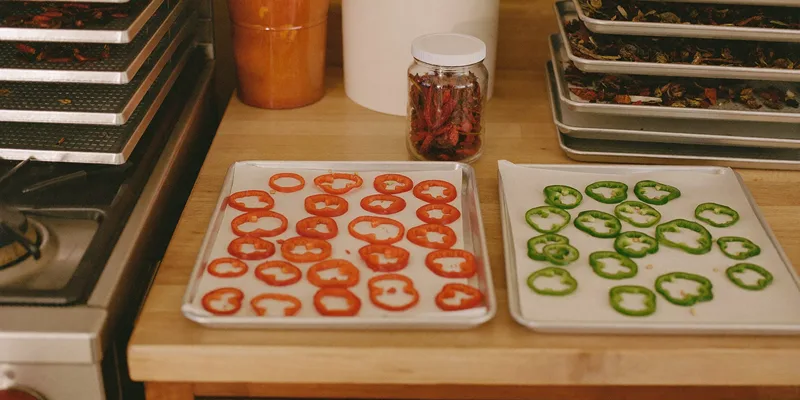
Wash, stem, core and seed, then cut into 1/4 to 1/2 inch strips or rings as CSU Extension lists. Blanch for the listed 4 minutes, cool, drain well, and lay the strips in a single layer with space between them. Skin side down keeps them from curling into tubes that trap moisture.
Expect serious shrinkage. A tray that looks generously loaded turns into a thin scatter of red and green curls, which is why bells are usually a whole machine project rather than a shelf here and there. Dry them until they are tough to brittle, the dryness test CSU Extension gives for peppers.
If you need capacity for a whole harvest at once

Hot Peppers: Gloves, Airflow and Where the Machine Runs
Capsaicin transfers to everything, and it survives on skin far longer than people expect. Wear disposable gloves from the first cut, keep your hands away from your face, and wash the board and knife separately from the rest of the dishes. Skipping gloves is the mistake nearly everyone makes exactly once.
The drying air matters too. A dehydrator full of hot peppers pushes pepper laden air into the room for hours, and in a closed kitchen that will have everyone coughing. Run the machine in a garage, a covered porch or a room with a window open and a door closed to the rest of the house.
Jalapenos and Cayennes
Halve jalapenos lengthwise so the moisture can escape from the cavity, and dry them until they are brittle enough to snap. Cayennes and other thin walled peppers can be dried whole, though slitting them shortens the process considerably. Whole peppers that still feel leathery in the shoulder need more time, because that is where the wall is thickest.
Seeds In or Out
CSU Extension lists removing the core and seeds as part of the preparation. For hot peppers headed for flakes, many home dryers leave the seeds in, and that is a heat and texture preference rather than a safety question. Either way, get the stems off, because they never dry evenly.
Flakes, Powder and Storage
Grinding only works on genuinely brittle peppers. A piece with any flex left in it gums up the grinder and turns the batch into paste, so test on a cooled piece before you start. Pulse in short bursts, let the dust settle before opening the lid, and sieve for flakes or keep grinding for powder.
Powder draws moisture fast, so store it in the smallest jar that holds it. CSU Extension notes properly stored dried vegetables keep well for six to 12 months, and that window shortens for anything ground, so make powder in batches you will actually use before next season.
If small pieces keep dropping through the trays

The Common Varieties, Side by Side
Wall thickness is what decides prep and time. The table sorts the peppers most gardens actually produce in quantity, with the prep CSU Extension lists for peppers and what each type is best used for once it is dry.
| Pepper | Prep | Drying notes | Best use later |
|---|---|---|---|
| Bell and pimento | Core, seed, 1/4 to 1/2 inch strips, 4 minute blanch | Thick walls, longest of the group | Soups, skillet meals, camp food |
| Jalapeno | Gloves, halve lengthwise, seeds optional | Medium walls, dry until brittle | Flakes, chili, dry rubs |
| Cayenne and thin walled hot | Gloves, whole or slit | Fastest, easy to overdry into dust | Powder, infused seasoning blends |
| Poblano and anaheim | Core, seed, cut into strips | Moderate, skin can toughen | Rehydrated strips, sauces |
The blanching time, cut sizes and the tough to brittle dryness test come from the CSU Extension drying vegetables fact sheet. Times for hot varieties vary with wall thickness, so use the brittle test rather than a fixed clock.
Conditioning Before You Seal
Condition peppers the same way as any dried vegetable. CSU Extension has you place the cooled pieces loosely in containers about two thirds full, keep them in a warm, dry, well ventilated place for four to 10 days, and stir or shake daily. Condensation on the glass sends the batch back to the machine.
It is tempting to skip this with hot peppers because they feel bone dry, but thick shouldered jalapenos routinely hide moisture. One damp pepper in a sealed jar of flakes will find every other piece in there.
Frequently Asked Questions
Do I need to blanch peppers before dehydrating? CSU Extension lists a 4 minute blanch for peppers and pimentos in its drying vegetables guidance. In practice most people blanch sweet peppers and dry hot peppers without blanching, since hot peppers are used as a seasoning rather than rehydrated as a vegetable.
Should I take the seeds out of hot peppers? CSU Extension lists removing the core and seeds in its preparation for peppers. Leaving seeds in changes heat and texture in the finished flakes, which is a preference rather than a safety issue. Stems always come off.
Why does drying hot peppers make everyone cough? The airflow carries capsaicin out of the machine along with the moisture. Run the dehydrator in a garage, on a porch or in a ventilated room away from the living space, and keep the door to the rest of the house closed.
How do I know when peppers are done? CSU Extension gives tough to brittle as the dryness test for peppers, over a drying window of 8 to 12 hours. Cool a piece first, because warm peppers always feel more flexible than they are, then try to snap it.
Can I use dried peppers to make hot sauce? You can rehydrate them for a cooked sauce. A fermented sauce is a different process with its own safety steps around acidity and bottling, and we cover those in bottling fermented hot sauce.
The Bottom Line
Sweet peppers get the CSU Extension treatment of coring, 1/4 to 1/2 inch strips and a 4 minute blanch, hot peppers get gloves and ventilation, and both get dried into the 8 to 12 hour window until they are tough to brittle. Condition, then seal, then grind what you want as flakes. For the machine itself, start with our food dehydrator buying guide, and if you dry herbs from the same garden, the herb drying setup uses the same trays with finer screens.