Last updated: August 23, 2026
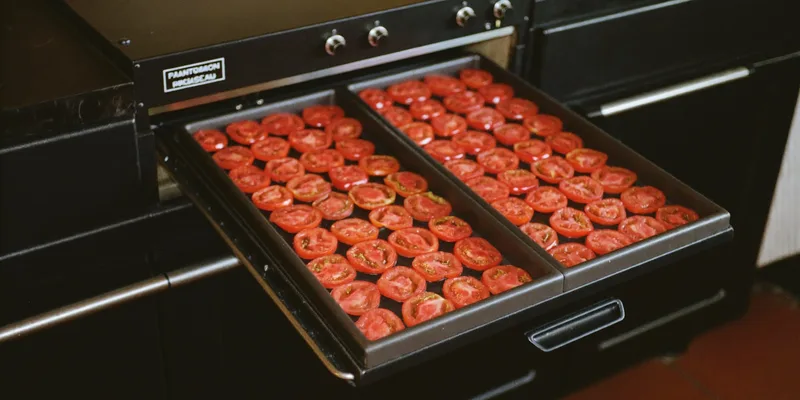
Excalibur is the black box on the counter in every serious drying photo, and the reason is the layout rather than the badge. The fan, the heating element and the thermostat all sit at the back, so heated air travels horizontally across every shelf at once. That is why owners talk about not rotating trays, which is the chore that makes people give up on a round stacking dehydrator.
The line runs from a small four tray unit to the nine tray machine most people picture, and the gap between them is larger than the tray count suggests. This guide sorts the models by what Excalibur publishes for each one, so you buy the size your harvest actually justifies.
This article contains affiliate links. If you buy through them, we may earn a commission at no extra cost to you. Learn more.
Quick Answer
Which Excalibur dehydrator size should you buy?
- The nine tray 3926TB is the classic: Excalibur lists 15 square feet of drying space, 600 watts and a 26 hour timer.
- A five tray model covers a normal household without dominating the counter.
- The four tray 2400 is the starter unit, with a thermostat but no timer.
- All of them use the same rear fan horizontal airflow, so the difference is capacity and controls.
Bottom line: nine trays if you process garden or hunting volume, five for a household, four only if you dry occasionally.
What Makes an Excalibur an Excalibur
Every model in the range is a square box with a removable door and trays that slide in like drawers. The fan and heating element live in the back wall, and Excalibur calls the resulting flow Parallexx horizontal airflow. Cool air is drawn in, heated, then pushed across the shelves rather than up through them.
The result is fewer cold spots and less need to shuffle trays halfway through a run. It also means you can pull out every second tray for tall items, or remove all but one and dry a single sheet of fruit leather in the space of a small oven. Our explainer on vertical against horizontal airflow covers why the fan position matters more than the wattage.
The Nine Tray Machine Most People Mean
When someone says Excalibur they usually mean the 3926TB. Excalibur lists it with nine trays, 15 square feet of drying space, 600 watts, a 26 hour timer with automatic shut off and an adjustable thermostat running from 105 to 165 degrees F. That is a lot of surface for one countertop footprint.
It is the right buy if you dry in seasons rather than in afternoons: a hunting freezer to turn into jerky, an orchard picking, a herb bed that all comes ready at once. It is a serious appliance in a kitchen, roughly the bulk of a small microwave, and worth measuring for before it arrives.
The Timer Is Not a Luxury
Drying runs long, often overnight, and a machine that keeps going after the food is done bakes it hard. The 26 hour timer with automatic shut off on the bigger models is the feature that turns a dehydrator into something you can start and go to bed on.
The Five Tray Middle Ground
Five tray Excaliburs are the household size, and the digital 3548CDB is the interesting one. Excalibur lists it with five trays and 8 square feet of drying space, a clear door, a 48 hour digital timer with two time and temperature settings, and a thermostat range from 95 to 165 degrees F.
Two staged settings matter more than they sound. Plenty of drying advice starts a load warm to get moisture moving and finishes cooler to avoid case hardening, and a two stage timer does that without you setting an alarm. The clear door earns its keep too, since checking a load without opening it costs you nothing in heat.

The Four Tray Starter
The 2400 is the entry model. Excalibur lists it with four trays, 4 square feet of drying space, 250 watts and an adjustable thermostat, and it has no timer, so you are the timer. For someone drying a tray of apple rings or a batch of herbs now and then, that is genuinely enough machine.
Be honest with yourself about volume before buying it. Four square feet fills up with two pounds of sliced tomatoes, and the most common regret in this category is buying small and then running six loads instead of one. If a garden is involved, skip to five trays or nine.
The Range Side by Side
Specifications below are Excalibur’s published figures for each model. Airflow is the same design across the line.
| Model | Trays and space | Controls | Suits you if |
|---|---|---|---|
| 3926TB | 9 trays, 15 square feet, 600 watts | 26 hour timer, 105 to 165 degrees F | Garden or hunting volume, jerky in batches |
| 3548CDB | 5 trays, 8 square feet | 48 hour digital timer, two stages, 95 to 165 degrees F | Household drying with staged runs |
| 3526TB | 5 trays | 26 hour timer, adjustable thermostat | Household volume, simpler controls |
| 2400 | 4 trays, 4 square feet, 250 watts | Thermostat only, no timer | Occasional small loads, tight budget |
Sheets, Screens and the Accessories You Will Want
Excalibur trays are open mesh frames, which is right for slices and wrong for anything small or wet. Fruit leather runs straight through, herbs blow around, and marinade drips onto the tray below. Non stick sheets and finer mesh screens fix all three, and they are the accessory owners buy within a month of the machine.
Buy enough for at least half your trays rather than one of each, since a leather run wants sheets on every shelf. Our guide to dehydrator trays and sheets covers what goes on what.

Where to Buy, and the Honest Version
Excalibur sells through a mix of channels. The core models turn up on Amazon consistently, including the nine tray 3926 family, the five tray units and the four tray 2400. Colors, door variants and some bundles are easier to find through the brand’s own store and specialist dealers, so check availability per model rather than assuming the whole catalog is in one place.
If a specific configuration is scarce in one channel, that is a distribution quirk rather than a discontinued machine. Compare the tray count, drying area and timer against the table above and buy whichever listing carries the specification you want.
Frequently Asked Questions
Do I really not have to rotate the trays? Far less than on a stacking dehydrator, because the fan sits at the back and pushes air horizontally across every shelf. Even loading and not overlapping slices does more for evenness than rotation does on this design. Uneven drying that persists is covered in our dehydrator troubleshooting guide.
Is nine trays overkill for a family? If you dry a few trays at a time, yes. Nine trays earns its space when a harvest or a hunt arrives all at once and the alternative is running a small machine for three days. You can always run a nine tray unit half loaded, but you cannot make a four tray unit bigger.
Can I make jerky in an Excalibur? Yes, and the nine tray model is a favorite for it because a whole batch fits in one run. The safety step is separate from the machine: the NCHFP recommends heating meat to 160 degrees F, and poultry to 165 degrees F, before or after drying. Our jerky chart has the sourced numbers.
Does the 2400 have a timer? No. Excalibur lists it with an adjustable thermostat and no timer, so you check it yourself. That is the main functional difference between the entry unit and the models above it.
How loud is it? It is a box fan running steadily, noticeable in a quiet room and easy to ignore in a kitchen. Owners who dry overnight generally set it up somewhere with a door.
Excalibur or Cosori or Nesco? Excalibur for the biggest horizontal airflow boxes, Cosori for stainless trays and a quieter motor, Nesco for expandable stacking capacity at a lower entry point. Head to head in the three brands compared.
The Bottom Line
Excalibur’s advantage is the rear fan and the square trays, and it applies across the whole range. Choose on capacity and controls: nine trays for harvest and hunting volume, five for a household that dries regularly, four only for occasional loads. Add non stick sheets with the machine, not later. Read next: the three brands compared, and the dehydrator buying guide for the wider field.