Last updated: August 23, 2026
Most people go looking for a commercial dehydrator after one specific evening. The garden gave up forty pounds of tomatoes in a week, or a deer came home, or the apple tree finally produced, and the four tray machine on the counter turned into a bottleneck that ran for three days straight. At that point the question stops being which dehydrator dries best and starts being how much food can go in at once.
The word commercial does a lot of work in these listings and not all of it is honest. Some of these machines really are restaurant equipment with stainless housings, sealed doors and NSF listings. Others are a plastic home unit with more trays stacked on top. The difference shows up the first time you load ten trays of wet fruit and want them all done in the same overnight run.
This article contains affiliate links. If you buy through them, we may earn a commission at no extra cost to you. Learn more.
Quick Answer
Do you actually need a commercial food dehydrator?
- Yes if you dry in harvest sized batches, run jerky for a hunting season, or sell at a farmers market and need trays that wash easily.
- Yes if you already run a nine tray home unit to its limit several times a month.
- No if the machine will run six weekends a year. A large home dehydrator does that job for far less money and less counter space.
- Look at square feet of tray area, not tray count. Ten small trays can hold less than six large ones.
Bottom line: buy on tray area, airflow direction and how the trays clean. Everything else on the spec sheet is secondary.
What Makes a Dehydrator Commercial
Three things separate a genuine commercial unit from a large home model: a stainless steel cabinet and trays instead of plastic, a rear mounted fan pushing air horizontally across every shelf, and a heater sized to recover temperature quickly when you open the door. Timers and digital panels are common on both.
The NSF listing that some of these machines carry is a sanitation standard for foodservice equipment, not a performance rating and not a food safety guarantee for what comes out. It matters if a health inspector will see the machine. In a home kitchen it mostly tells you the surfaces are designed to be washed down rather than wiped around.
Where the Extra Money Goes
You are buying cabinet volume, a bigger motor and metal that survives daily washing. You are not buying faster drying. The physics of removing water from fruit does not change with the badge on the front, and a large home unit at the same temperature finishes the same tray of apple slices in roughly the same time.
Tray Count Is Not the Same as Drying Capacity
Tray count is the number in the title and the least useful figure on the page. What decides how much of the harvest fits is total tray area in square feet, plus the height between shelves. A ten tray unit with small shelves can hold less than a nine tray home machine with large ones.
Shelf spacing is the figure nobody lists prominently and the one that bites. Whole strawberry halves, thick jerky strips and stuffed mushroom caps all need vertical clearance. If the shelves sit close together, half your tray area is unusable for anything but thin slices.
How to Compare Two Listings Honestly
Multiply tray width by depth, multiply by the number of trays, and divide by one hundred forty four to get square feet. Do it for both machines. Manufacturers quote drying area in square feet inconsistently, and some count the mesh insert rather than the usable surface, so the arithmetic from the stated tray dimensions is the honest number.
Airflow Direction Decides Whether You Rotate Trays
Horizontal airflow is the reason to move up to a cabinet machine. The National Center for Home Food Preservation notes that with a horizontal flow design all trays receive equal heat penetration and juices do not drip down into the heating element, while vertical flow units let flavors mix and liquids reach the element.
In practice that is the difference between loading ten trays and walking away, and loading ten trays and setting an alarm to rotate them. With a big batch that rotation is not a minor chore, because opening a full cabinet drops the temperature and every rotation adds to the run.
Fan Noise Is Real at This Size
Bigger cabinet, bigger fan. Owners of large units commonly move them to a garage, a basement or a utility room, and the ones who keep them in the kitchen tend to mention the noise in reviews rather than the drying. Plan a location before the box arrives. Our guide to vertical against horizontal airflow covers what changes between the two layouts.
Picks by the Job You Are Doing
Match the machine to the volume you actually process, not the volume you imagine. Four situations cover almost every buyer at this size, and one of them is honestly answered by a large home dehydrator rather than a commercial cabinet.
Best If You Want Cabinet Capacity Without the Commercial Footprint
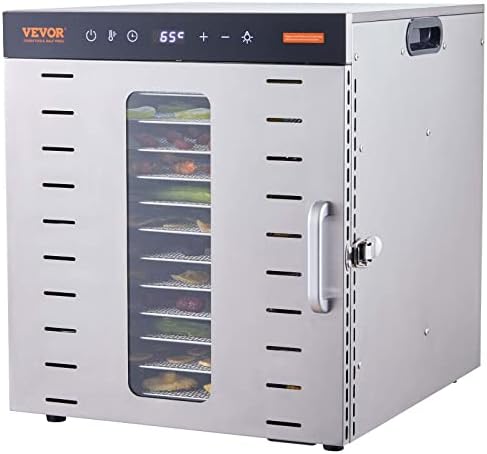
A ten tray stainless cabinet with a rear fan and a slide out door is the entry point to real capacity. Septree lists its ten tray machine with detachable stainless steel trays, a digital timer and horizontal airflow. It is the size most home preservers land on when the nine tray plastic unit stops keeping up.
Best If You Dry Every Week Through the Season
Sixteen trays is a different category of machine and belongs in a garage or a workroom rather than a kitchen. BioChef lists its sixteen tray unit as built for commercial kitchens, with stainless trays and a timer. Buy this only if you genuinely fill it, because a half empty cabinet wastes energy on every run.
Best If Jerky Is the Main Reason
Jerky needs even airflow, easy tray cleaning and a temperature you can trust, because the drying step follows a cooking step that has to hit a specific number. A stainless cabinet with removable racks handles marinade drips better than any plastic tray stack. See our jerky dehydrator guide for the models sized below this one.
Best If You Are One Step Below Commercial
Excalibur’s nine tray with the poly trays is still the machine most serious home preservers use, and it costs a great deal less to run and store than a stainless cabinet. If you fill it three or four times a month rather than three or four times a week, this is the honest answer.
What You Give Up and What You Gain
Moving up is a trade, not an upgrade in every direction. Bigger machines take floor space, draw more power per run, weigh enough that they stay where you put them, and take longer to wash. What you gain is the ability to finish a harvest day in one load instead of four.
| Machine class | Cabinet and trays | Airflow | Best suited to |
|---|---|---|---|
| Stackable home unit | Plastic, expandable | Vertical, tray rotation needed | Occasional small batches |
| Nine tray box unit | Plastic trays, plastic shell | Horizontal rear fan | Regular household preserving |
| Ten tray stainless | Stainless cabinet and trays | Horizontal rear fan | Harvest volume, jerky seasons |
| Sixteen tray stainless | Stainless, door hinged | Horizontal, larger blower | Market sellers, weekly bulk |
If your honest answer is the middle row, our general dehydrator guide and the stainless steel dehydrator comparison will get you there faster than this page.
The Mistakes That Follow a Big Machine Home
Two show up in reviews again and again. The first is buying for a peak week that happens once a year, which leaves a heavy cabinet occupying a corner for eleven months. The second is filling every tray with a different food on the first run, which makes it impossible to tell what finished when.
The third is skipping tray liners. Big stainless racks have wide mesh, and small items, sticky fruit and marinade all find their way through. A set of liners and sheets costs a fraction of the machine and saves the cleanup that makes people stop using it.
Frequently Asked Questions
Is a commercial dehydrator faster than a home one? Not meaningfully. At the same temperature, the same slice thickness dries in about the same time. What a commercial cabinet gives you is more food finishing in that same window, which is a capacity gain rather than a speed gain.
Does an NSF listing mean the food is safer? No. NSF listings cover the design and cleanability of foodservice equipment. Food safety comes from the process, which means the temperatures and steps published by the NCHFP and FSIS, not from the badge on the cabinet.
Can I run a commercial dehydrator on a normal household outlet? Most home rated stainless cabinets are built for a standard one hundred ten volt circuit, but they draw considerably more than a small unit. Check the wattage in the listing against what else shares that circuit, because a tripped breaker overnight ruins a full load.
Are stainless trays worth it over plastic? They are if you dry marinated meat or acidic fruit regularly, because they wash properly and do not stain or warp. For dry herbs and apple slices, plastic trays with liners perform the same. See the stainless comparison for the details.
How much tray area do I need for a bushel of apples? More than most people expect, since apples lose volume slowly during the first hours and cannot overlap. Plan on filling every tray in a ten tray cabinet for a single bushel, and expect a second load.
The Bottom Line
Buy a commercial dehydrator when volume, not quality, is the thing holding you back. Compare square feet of tray area rather than tray count, insist on horizontal airflow so you are not rotating shelves all night, and decide where the machine will live before you order it, because it is loud and it is heavy. If you fill a nine tray unit a few times a month rather than a few times a week, the honest upgrade is a better nine tray machine and a set of liners. Read next: how to choose a food dehydrator and which trays and sheets you actually need.