Last updated: August 23, 2026
There are two completely different reasons people dry sweet potatoes, and they want opposite results from the same machine. One group is preserving a harvest into slices and dice that go into soups and camp meals all winter. The other has a dog, has seen what a bag of sweet potato chews costs at the pet store, and has done the arithmetic.
Both jobs start the same way and diverge at thickness and dryness. This guide covers curing and storing the raw crop, whether blanching is needed, what the extension services specify for drying, the honest version of the dog chew angle, and how to store the finished slices so they stay hard.
This article contains affiliate links. If you buy through them, we may earn a commission at no extra cost to you. Learn more.
Quick Answer
How do you dehydrate sweet potatoes?
- Peel or scrub, then slice evenly. Thin for chips and dice, thick for dog chews.
- Penn State Extension recommends blanching for most vegetables before drying, and sweet potato is not on its no blanching list.
- Montana State University Extension puts the optimum drying temperature for food at 140 degrees F and warns that hotter cooks rather than dries.
- Dry until the pieces are tough, brittle or crunchy, then store sealed in a cool, dark place.
Bottom line: even slices and a proper dryness test. Thick chews are the batch most likely to mold, because they feel done long before they are.
Cure the Crop First If It Came From the Garden
Freshly dug sweet potatoes are not ready for anything, including drying. Curing converts starch and heals the skin, and it is why a cured sweet potato tastes sweet and an uncured one tastes like a bland potato. Iowa State University Extension gives curing at 85 degrees F and 80 to 90 percent relative humidity for 7 to 10 days, or alternatively air drying for 10 to 14 days in a warm, shady location.
After curing, Iowa State University Extension puts storage at 55 to 60 degrees F with 85 to 90 percent relative humidity and a storage life of 4 to 6 months. That is warmer than potatoes, which is worth noting: a sweet potato stored in the cold gets a hard core and an off flavor, so the two crops do not share a shelf.
Store Bought Ones Are Already Cured
Anything from a supermarket has been cured and can go straight to slicing. If you are drying because the last of a bag is starting to shrivel, that is exactly the right use for the machine and no curing step applies.
Prep: Peel, Slice, Blanch
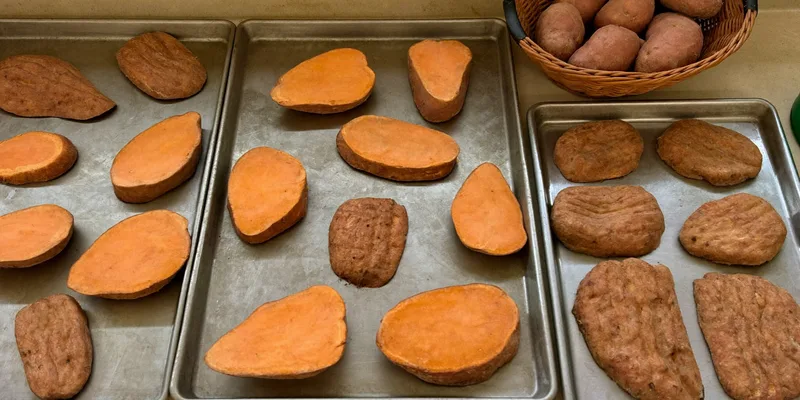
Peel for a clean finished product, or scrub well and leave the skin on for dog chews, where the skin adds chew resistance. Then slice, and slice evenly, because sweet potato is dense and a thick piece in a load of thin ones will still be soft when everything else has finished.
Penn State Extension recommends blanching in a solution containing a quarter teaspoon of citric acid per quart of water for most vegetables, listing only onions, garlic, peppers and herbs as exceptions. Sweet potato is not among those exceptions, so blanch it. Blanching also softens the slices enough that they dry more evenly and hold their color better.
Thickness Decides the Product
Thin slices give you chips and rehydrate quickly. Thicker planks give you the leathery, bendable chew that dogs work at. Dice is the most useful format for soup and backpacking meals because it rehydrates fastest. Pick one per load rather than mixing them.
Heat and the Dryness Test
Montana State University Extension puts the optimum drying temperature for food at 140 degrees F, warning that higher temperatures cook the food instead of drying it, which raises the likelihood of molding. Sweet potato is high in sugar, so it scorches at the edges before the center is finished if you push the heat.
The same guidance describes dried vegetables as tough, brittle or crunchy when done. Let a piece cool before you judge it. This is where thick chews catch people out: the outside goes firm and leathery and feels finished, while the center is still soft. Cut one in half and look.
The Dog Chew Version, Honestly
Sweet potato chews are the most popular home dehydrator project that has nothing to do with human food, and the cost comparison against a pet store bag is genuinely favorable. They are also the batch most likely to spoil, because a thick, sugary, partly dried plank sitting in a bag at room temperature is close to ideal conditions for mold.
Dry them harder than feels necessary, store them in the refrigerator or freezer rather than a pantry jar if they are on the chewy side, and make small batches you will get through. Anything with a soft center goes in the fridge. Our guide to dehydrators for dog treats covers capacity and tray choice for this specific job.

Ask Your Vet, Not the Internet
What is appropriate for a particular dog depends on the dog, and treats of any kind change the calorie picture. Portion, frequency and whether sweet potato suits your animal at all are questions for a veterinarian rather than a gear site. We can tell you how to dry it, not how much of it your dog should have.
Which Cut for Which Use
The same sweet potato produces four fairly different products depending on how it is cut and how far it is dried. The table is the short guide to picking before you start.
| Cut | Blanch? | Dry until | Best for |
|---|---|---|---|
| Thin rounds | Yes | Crisp and snappable | Chips and snacking |
| Small dice | Yes | Hard, rattles in the jar | Soups, stews, backpacking meals |
| Thick planks | Optional, skin on adds chew | Leathery with no soft center | Dog chews, refrigerate if pliable |
| Cooked and pureed | Cooked, not blanched | Dry sheet that snaps | Powder for thickening and camp meals |
Storing the Finished Batch
Montana State University Extension gives storage for most dried vegetables in a dark, dry, cool place at 1 year at 60 degrees F, or 6 months at 80 degrees F. Those two figures are the same food in two different cupboards, which is the clearest argument there is for keeping dried goods away from the stove.
Fully brittle dice and chips do well in sealed jars, and for a large harvest, mylar with an oxygen absorber holds a bulk quantity far longer than a jar you open weekly. Anything that stayed pliable belongs in the fridge or freezer. Our guide to storing dehydrated food covers conditioning and container choice, and the food dehydrator buying guide covers picking a machine that can take a whole crop in one load.
Frequently Asked Questions
Do sweet potatoes need blanching before dehydrating? Yes. Penn State Extension recommends blanching for most vegetables and lists only onions, garlic, peppers and herbs as exceptions. Blanching also improves color and evenness in the finished slices.
What temperature should I dry sweet potatoes at? Montana State University Extension puts the optimum drying temperature for food at 140 degrees F, warning that higher temperatures cook rather than dry and increase the chance of molding.
How do I know when sweet potato chews are done? Cut one in half and look at the center. Montana State University Extension describes dried vegetables as tough, brittle or crunchy when done, and thick pieces feel finished on the outside long before the middle is.
How long do homemade sweet potato dog chews keep? Fully dried and sealed, they behave like any other dried vegetable. Anything still pliable belongs in the refrigerator or freezer and should be made in small batches you will use quickly.
Can I store raw sweet potatoes with regular potatoes? No. Iowa State University Extension puts sweet potato storage at 55 to 60 degrees F and regular potatoes at 40 degrees F. Sweet potatoes held too cold develop a hard core and off flavors.
Do I need to peel them first? For chips and dice, peeling gives a cleaner result. For dog chews, scrubbed skin on adds chew resistance and is commonly left. Either way, scrub thoroughly.
The Bottom Line
Cure a garden crop before you do anything with it, blanch before drying, cut to one thickness per load, and test the center of the thickest piece rather than the surface. Fully brittle pieces live in jars, pliable chews live in the fridge. For the machine, our food dehydrator buying guide covers capacity, and the dog treat dehydrator guide covers the trays and tray count that suit thick chews.