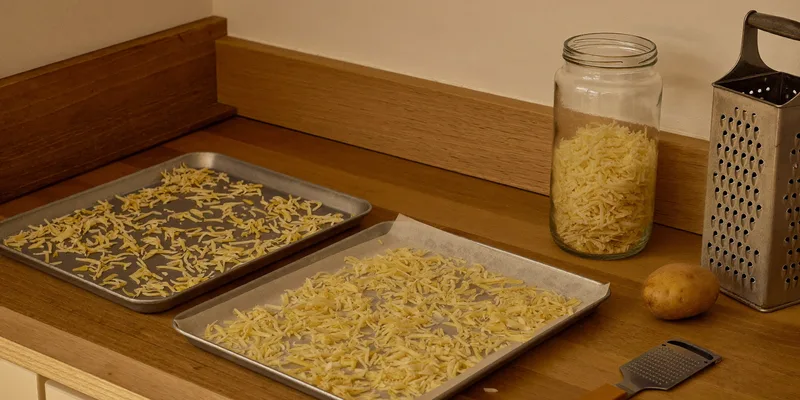
Last updated: August 23, 2026
A fifty pound sack of potatoes from the farm stand is a bargain right up to the week they start sprouting in the corner of the pantry. The freezer is already full of venison and beans, the root cellar is a crawl space that never gets cold enough, and nobody in the house wants to peel potatoes on a Tuesday. Drying them into hash browns solves all of it at once, because dried shreds take a shelf instead of a bin and rehydrate in a skillet in minutes.
The catch is that potatoes are the one vegetable that punishes shortcuts. Load raw shreds straight onto the trays and you get gray, faintly sweet chips that smell like a basement. The fix is one extra pot on the stove, and it is the difference between a jar you actually cook from and a jar you quietly throw out in March.
This article contains affiliate links. If you buy through them, we may earn a commission at no extra cost to you. Learn more.
Quick Answer
How do you dehydrate hash browns?
- Shred or cut the potatoes, then blanch them. Colorado State University Extension lists a 7 minute blanch for potatoes cut into 1/4 inch shoestring strips or 1/8 inch slices.
- Rinse off the surface starch and drain hard, because wet shreds mat together on the tray.
- Dry at the temperature CSU Extension gives for potatoes and other vegetables, 140 degrees F, until the pieces are brittle.
- Condition the cooled batch in a jar for four to 10 days before you seal it away, which is the CSU Extension conditioning window for dried vegetables.
Bottom line: the blanch is not optional, and it is the step nearly every gray batch skipped.
Why Raw Shredded Potatoes Turn Gray
Potatoes carry enzymes that keep working after the shredding is done, and in a warm dehydrator those enzymes have hours to darken the flesh and flatten the flavor. Blanching is what stops them. The National Center for Home Food Preservation describes blanching as slowing or stopping the enzyme action that causes loss of flavor, color and texture.
That is why a blanched shred dries to a pale cream color and a raw one dries to something between putty and rust. The gray is not dangerous, it is just permanent, and no amount of rinsing after the fact brings the color back.
Shred, Blanch, Rinse, Drain
Work in the order that keeps the potatoes moving. Wash and peel, shred or cut, blanch immediately, cool in cold water, then rinse and drain until the shreds stop dripping. Potatoes oxidize fast once they are cut, so the gap between the shredder and the pot should be measured in minutes rather than in coffee breaks.
How Long to Blanch
CSU Extension lists 7 minutes of blanching for potatoes prepared as 1/4 inch shoestring strips or 1/8 inch slices. The NCHFP guidance for drying potatoes gives a steam blanch of 6 to 8 minutes or a water blanch of 5 to 6 minutes for the same cuts. Shreds are thinner than shoestrings, so watch them and pull them the moment they turn translucent at the edges rather than running a timer past done.
Why the Rinse Matters
Blanched potato gives up a lot of surface starch, and that starch is glue. Rinse it off under cold running water, then spread the shreds on a towel and press. A batch that goes onto the tray damp dries into one large potato pancake, which then has to be broken apart by hand and never dries evenly in the middle.
The Machine and the Trays
Any dehydrator with a thermostat will dry potatoes, but shreds are small, light and prone to falling through standard tray grids. A unit with a rear mounted fan pushes air horizontally across the shelves so the bottom tray does not finish hours before the top, which matters when a single batch fills every shelf you own.
Mesh liners are the cheap part of the setup and the part that saves the batch. They keep shreds out of the fan housing and let you lift a whole tray of finished potato into a bowl without picking pieces off the grid.
If you want horizontal airflow and stainless trays

If your shreds keep falling through the grid

Temperature, Time and the Brittle Test
CSU Extension gives 140 degrees F for drying and lists 6 to 10 hours for potatoes, with brittle as the dryness test. The NCHFP drying guidance for potatoes plans on 8 to 12 hours in a dehydrator and up to twice as long in an oven, depending on circulation. Treat both as a window, not a promise, because load size and humidity move the finish line.
Test the way the extension services do, on cooled pieces. A warm shred always feels softer than it is, so pull a few, let them sit five minutes on the counter, and then try to bend one. It should snap rather than fold. Anything that folds goes back on the tray.
Cut Style Changes the Whole Batch
Shred, shoestring, slice and dice all dry, but they behave differently in the pan afterward. Shreds rehydrate fastest and brown best, slices hold their shape for scalloped dishes, and dice disappear into soup. Pick the cut for the meal you actually make, then follow the prep the extension sheet gives for that cut.
| Cut | Prep before drying | Dryness test | Best use later |
|---|---|---|---|
| Shredded | Blanch, rinse starch, press dry on a towel | Snaps when bent, no leathery centers | Skillet hash browns and breakfast patties |
| Shoestring, 1/4 inch | CSU Extension lists a 7 minute blanch | Brittle | Camp fries, casseroles with a longer soak |
| Slices, 1/8 inch | CSU Extension lists a 7 minute blanch | Brittle | Scalloped potatoes, gratins |
| Diced | Blanch, spread in a single layer | Hard, rattles on the tray | Soups, stews, freeze dried style pantry meals |
Blanching times and the brittle test above come from the CSU Extension drying vegetables fact sheet, which is also the source for the temperature. Where a cut is not listed there, match it to the closest listed cut rather than guessing a shorter time.
Conditioning and Storage
Conditioning is the step that catches the one shred that was not quite done. CSU Extension has you place the cooled, dried pieces loosely in large glass or plastic containers about two thirds full, keep them in a warm, dry, well ventilated place for four to 10 days, and stir or shake daily. Condensation on the glass means the batch goes back in the dehydrator.
After conditioning, move the potatoes into something that actually excludes air. CSU Extension notes that properly stored dried vegetables keep well for six to 12 months, and the fastest way to lose that window is a jar opened twice a week. Our guide to storing dehydrated food covers jars against bags, and mylar bags are the route for anything you are putting away for the year.
Cooking Them Back
Dried hash browns want hot water and patience, in that order. Cover the shreds with boiling water, let them sit until they are pliable and no longer crunch in the middle, then drain hard and press. Water left in the shred steams in the skillet and you never get the crust.
For camp cooking, put the measured shreds in the bag the night before and add water in the morning. The soak happens while you break camp, and the pan work is the same three minutes it would be at home.
Frequently Asked Questions
Do I really have to blanch potatoes before drying them? Yes. The NCHFP describes blanching as slowing or stopping the enzyme action responsible for loss of flavor, color and texture, and potatoes are among the most reactive vegetables in that respect. Skipping it is the single most common reason a batch comes out gray.
Can I dehydrate store bought frozen shredded potatoes? Yes, and it is the shortcut most people land on eventually, because commercially frozen shreds have already been blanched. Thaw, press out the water, spread in a single layer and dry to brittle the same way. Check the bag for added oil, which slows drying and shortens storage life.
Why did my potatoes darken even though I blanched them? Usually the gap between shredding and blanching was too long, or the blanch was short for the thickness of the cut. Shred straight into cold water, work in small batches, and get each batch into the pot quickly.
How long will dried hash browns keep? CSU Extension states that properly stored dried vegetables keep well for six to 12 months in cool, dark, dry conditions. Repackaging into smaller jars so the working jar is the only one you open regularly is what gets you to the far end of that range.
Can I do this in the oven instead? You can. The NCHFP notes that oven drying can take up to twice as long as a dehydrator depending on circulation, and most home ovens will not hold a low temperature steadily. If potatoes are going to be a regular project, a thermostat controlled machine pays for itself in batches that finish.
The Bottom Line
Dried hash browns are one of the highest value things you can do with a cheap sack of potatoes, and the entire method comes down to blanch, rinse, dry to brittle, condition. Follow the extension numbers rather than a timer you invented, and store the finished shreds somewhere air cannot reach them. If you are still choosing a machine, our food dehydrator buying guide covers airflow and tray count, and tray liners and sheets is the accessory page that matters most for small cuts like these. If the sack is still whole, storing potatoes fresh may buy you the time to work through them slowly.