Last updated: August 23, 2026
A pressure canner is the piece of equipment that decides what you are allowed to put on a shelf. Jam and pickles can be handled in boiling water; green beans, carrots, broth, chili, and everything that came out of the deer camp cannot. Buying one is where home canning stops being a summer hobby and starts being a way to feed a household.
It is also the purchase people agonize over the longest, because the price gap between models is wide and the specifications sound technical. In practice the decision comes down to four questions: how many jars per load, weighted gauge or dial, gasket or metal to metal, and what your stove can carry. This guide answers them in that order.
This article contains affiliate links. If you buy through them, we may earn a commission at no extra cost to you. Learn more.
Quick Answer
Which pressure canner should you buy?
- Big enough to matter. The NCHFP says a pressure canner must hold at least four quart jars upright, and most people who buy the smaller size wish they had gone larger.
- Weighted gauge if you never want to think about calibration; dial gauge if you want to watch the pressure climb, and are willing to have it tested each year as the USDA guide advises.
- Gasket models are lighter and cheaper to buy; metal to metal models have no gasket to replace and last decades.
- Check your cooktop manual before buying for a glass or induction top, since a loaded canner is one of the heaviest things a home kitchen puts on a stove.
Bottom line: pick the largest canner your stove and your arms can handle, then choose the gauge type you will actually maintain.
What Makes a Canner a Canner
A pressure canner traps steam so the temperature inside rises above the boiling point, which the NCHFP states is what is required to safely process low acid foods. A pressure cooker, an Instant Pot, or a small pressure saucepan may reach pressure, but they are not built or tested as canners, and the NCHFP says a pressure canner must be able to hold at least four quart jars upright.
That definition rules out most of what sits on kitchen counters. Our article on pressure canners versus pressure cookers goes through the difference in detail, and Instant Pot canning explains why multicookers are not a substitute.
Weighted Gauge or Dial Gauge
A weighted gauge is a metal piece that sits on the vent pipe and jiggles or rocks when the canner reaches its set pressure, so the sound tells you the pressure is right. A dial gauge is a needle on a face that shows pressure continuously, which lets you hold an exact figure but relies on the gauge being accurate.
The maintenance difference is the real decision. The USDA Complete Guide to Home Canning advises having dial gauges tested for accuracy each year, which usually means a trip to a county extension office, while a weighted gauge has nothing to drift out of calibration. Many canners buy dial gauge models and then add a weight anyway.
What the Gauge Reading Has to Match
Pressure requirements are set by the recipe and by your elevation, not by the canner. USDA’s Complete Guide to Home Canning lists 10 pounds of pressure for a weighted gauge canner at sea level and 15 pounds above 1,000 feet, with dial gauge figures that step up in smaller increments as elevation rises. Look up your elevation once and use the chart in your tested recipe every time. The steps are covered in our pressure canning guide.
Size: 16 Quart or 23 Quart
The two common sizes in the mainstream lineup hold roughly seven quart jars or roughly a double layer of pints in the larger version. The bigger canner does not take longer to process, only slightly longer to come up to pressure, so the extra capacity is close to free time once you are canning in volume.
The most frequent regret in owner reviews is a canner that fits one layer of pints when the garden delivered forty pounds of beans. The counterargument is real too: a large canner is heavy and tall enough to hit the range hood on some stoves. Measure the clearance above your burner before you order.
Gasket or Metal to Metal
Gasket sealed canners use a rubber ring that compresses when the lid locks, which makes the lid easy to close and the canner lighter. The ring is a wear part: it hardens, cracks, and eventually leaks steam, and replacing it is routine maintenance rather than a defect. Our article on gaskets and replacement parts covers which part fits which model.
Metal to metal canners seal by clamping two machined surfaces together with wing nuts, so there is nothing to perish. They cost more, weigh more, and last long enough that they show up in estate sales still working. Which one is right depends on whether you would rather buy a ring every few seasons or carry a heavier lid every session, a trade our Presto versus All American comparison works through.
Glass Top Stoves and Heavy Canners
Glass and ceramic cooktop manuals commonly limit the weight and the diameter of cookware, and a loaded canner exceeds what some of them allow. Canner manufacturers generally defer to the range maker on this, so the cooktop manual is the document that decides, not the canner box.
If your manual allows it, a flat bottomed canner is the one to choose, since a ridged or warped base makes poor contact and heats unevenly on a smooth top. Owners who cannot use a stovetop canner at all usually end up either canning outdoors on a dedicated burner or looking at an electric pressure canner, which carries its own caveats.
Pressure Canners by Situation
The Standard Household Canner
The large aluminum Presto is the canner most American kitchens end up with: light enough to lift, big enough for a full load of quarts, and supported by replacement parts in every hardware store. It uses a gasket and comes with a dial gauge on some versions and a weight on others.

Smaller Kitchens and Lighter Loads
The smaller version of the same canner holds a single layer of quarts, stores in a normal cabinet, and weighs noticeably less when full. It is the right buy for one or two person households and for anyone who cans a few pints at a time rather than a harvest.

Buy Once, Hand It Down
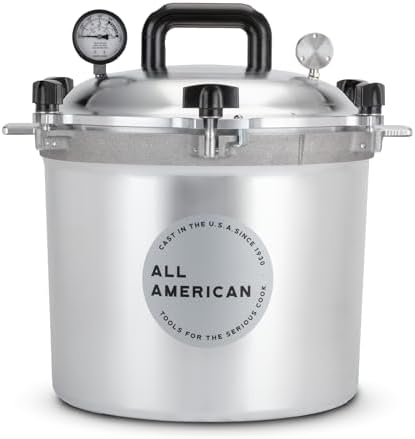
All American canners seal metal to metal with wing nuts, so there is no gasket to replace, and they are built from heavy cast aluminum. They cost substantially more and weigh substantially more, and owners who have them rarely buy another canner.
No Usable Stovetop
An electric pressure canner sits on the counter and runs its own program, which solves the glass cooktop problem. It also comes with a caveat worth understanding before buying: USDA processing recommendations were developed on stovetop canners, so an electric unit should only be used with the recipes and processes its own manufacturer supplies and has validated.

The Four Options Compared
| Option | Seal type | Gauge | Suits |
|---|---|---|---|
| Large aluminum canner | Gasket | Dial, weight optional | Full quart loads, most kitchens |
| Compact aluminum canner | Gasket | Dial or weight | Small batches, easy storage |
| Cast aluminum, metal to metal | Wing nut clamp | Dial plus weight | Decades of heavy use |
| Electric countertop canner | Gasket | Built in program | Kitchens with no usable stovetop |
Whatever the row, the canner has to be able to hold at least four quart jars upright to count as a canner under the NCHFP definition.
What Owners Complain About
The most common frustration is a canner that will not build pressure, and it is almost always a gasket that has hardened, a vent pipe with debris in it, or a lid that was not seated squarely. All three are fixable at home, which our pressure canner troubleshooting article covers in the order a manual would.
The second is trust in the dial. A gauge that has been dropped or sat in a damp basement can read low, which is exactly the failure you cannot see from the outside. Have it tested annually as the USDA guide advises, or fit a weight and rely on the sound instead.
Frequently Asked Questions
Can I use a pressure cooker or an Instant Pot for canning? No. The NCHFP states that a pressure canner must be able to hold at least four quart jars upright, and USDA processes were developed for standard pressure canners rather than for multicookers or pressure saucepans. Our Instant Pot canning article explains why in detail.
Which is better, Presto or All American? They solve the same problem differently. Presto is lighter and cheaper with a gasket that gets replaced periodically; All American is heavier with a metal to metal seal and no gasket at all. Our side by side comparison lays out who each one suits.
I only have room for small batches. Is a big canner pointless? Not necessarily, since a large canner will process a half load, but it takes longer to heat and is heavier to move. If small batches are your normal, the compact canner is the more pleasant tool, and pint jars are your friend.
How often does the dial gauge need testing? The USDA Complete Guide to Home Canning advises testing dial gauges for accuracy each year, and county extension offices commonly offer the service. A weighted gauge does not need testing.
Will a pressure canner work on my glass cooktop? Check your cooktop manual first, since many set weight or diameter guidance that a loaded canner can exceed. If it is allowed, choose a flat bottomed model and consider canning pints to keep the weight down.
Do I still need a water bath canner if I have a pressure canner? Not strictly, since a pressure canner can be used as a boiling water canner with the lid unlocked for high acid foods, following your tested recipe. Many people keep both anyway because a light pot is nicer for jam.
The Bottom Line
Buy the largest canner your stove and your back can handle, choose weighted gauge if you would rather not manage annual testing, and treat the gasket as a consumable rather than a flaw. The canner is a long term purchase in a way that almost nothing else in the canning kitchen is. Read next: the pressure canning process from vent to cool down, and Presto versus All American if you are stuck between the two.