Last updated: August 23, 2026
The canner is loaded, the jars are hot, the burner has been on for twenty minutes and nothing is happening. Or steam is whistling out from under the rim instead of the vent. Or the batch is done and the lid will not come off. Every one of these turns up in August, usually at nine at night, usually with somebody standing in the kitchen wondering whether the whole thing is about to go wrong.
Almost all of it is one of six causes, and most of them cost nothing to fix. Work through them in order, from the free checks to the parts that genuinely wear out. The one thing not to do is force anything, because a pressure canner that is behaving oddly is a pressure canner you stop and diagnose rather than push through.
This article contains affiliate links. If you buy through them, we may earn a commission at no extra cost to you. Learn more.
Quick Answer
Why will my pressure canner not build pressure?
- The vent is still open. Pressure only starts building once the vent pipe is covered by the weight or the petcock is closed, and USDA’s Complete Guide to Home Canning has you vent steam for ten minutes first.
- The lid is not fully seated, or the sealing ring is dry, dirty or hardened.
- Not enough water in the canner, or a burner that cannot keep up with the pot.
- Steam escaping from the rim rather than the vent, which is a gasket or a seating problem, not a heat problem.
Bottom line: check the vent, the seating and the ring before you change anything. Parts come after the free checks.
Start With the Free Checks
Turn the burner off and go through five things before you touch a tool. Is the vent pipe or petcock actually closed. Is the lid rotated fully home. Is there water in the canner and is it hot. Is the sealing ring seated all the way around. Is the burner big enough for the base of the canner.
That list resolves the majority of no pressure calls, and none of it costs anything. Only after all five check out is it worth suspecting a worn part, and only then does buying something make sense.
Water and Burner
Follow the water amount in your canner manual rather than filling by eye, because too little boils dry and too much interferes with the process. On the burner side, a large canner on a small back burner will heat forever and never get there. Move it to the biggest burner you have, and note that Presto states its 23 quart canner is designed for household range burners of 12,000 BTUs or less.
Steam Leaking From the Rim
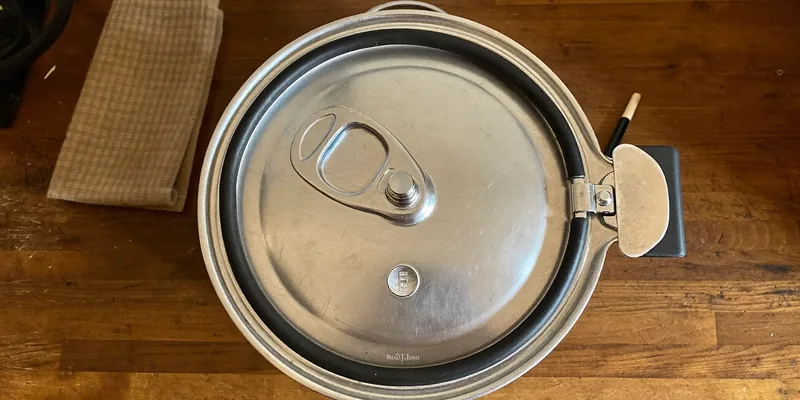
Steam should come out of the vent pipe and nowhere else. Steam hissing from under the lid edge means the seal is not doing its job, and that has three usual causes: the lid is not rotated fully into position, food or sugar residue is sitting on the sealing surface, or the sealing ring has hardened and lost its squeeze.
Take the canner off the heat, let the pressure go down on its own, and check all three. Wipe the rim and the underside of the lid, and run a finger around the ring feeling for flat spots, cracks or a glassy hard surface. A ring that has gone stiff will not spring back when you pinch it.
When the Ring Is the Answer
Sealing rings are consumables. They compress, dry out and harden with heat cycles, and the day they stop sealing is not usually dramatic, it just leaks a little more each batch. Presto sells a canner sealing ring and overpressure plug pack, part 09985, listed for its 16, 18 and 23 quart canners, and replacing both together is sensible since the plug ages the same way.

The Lid Will Not Come Off
This is normal and it is a safety feature. Canners with an air vent and cover lock will not open while there is pressure inside, and the lock has to drop before the lid rotates. If yours will not budge, there is still pressure in the pot, no matter what the gauge says.
Let it cool naturally on the counter. Do not run it under cold water, do not lever it, and do not lift the weight to speed things up, since that drops the pressure suddenly and siphons liquid out of the jars. Our guide to siphoning in canning covers what a rushed cool down does to your jars.
A Gauge You Cannot Trust
A dial gauge is a mechanical instrument and it drifts. The NCHFP recommends having dial gauges tested for accuracy each year, and many county extension offices run that test, often free or for a small charge. A gauge reading low means you are underprocessing without knowing it, which is the reason the recommendation exists.
Weighted gauge canners have no dial to drift. The weight either jiggles or rocks at its rated pressure or it does not, which is why the NCHFP treats them as not needing annual testing. If your dial fails the test or the needle does not rest at zero when cold, replace the gauge rather than guessing at a correction.

Reading the Jiggle
Weighted gauges are meant to move in a specific pattern, and your manual describes it for your model. Continuous violent rocking means the heat is too high, and a weight that has gone silent means the pressure has dropped below the setting. Both change the process, and NCHFP guidance is that if pressure drops below the required level, you bring it back up and start the processing time over from the beginning.
Symptom, Cause, Fix
The table maps the complaints owners describe most against the usual cause and the first move. Processing decisions in the last column follow NCHFP guidance rather than our own judgment.
| Symptom | Usual cause | First move | Does the batch survive |
|---|---|---|---|
| No pressure builds | Vent open, lid unseated, low water | Turn off, check all three, restart | Yes, restart the process |
| Steam from the rim | Lid seating or a hardened ring | Clean the rim, inspect the ring | Yes if caught early |
| Pressure drops mid process | Heat too low or a slow leak | Bring pressure back up | NCHFP says restart the timing in full |
| Lid will not open | Pressure still inside, cover lock engaged | Let it cool naturally | Yes, do not force it |
| Liquid lost from the jars | Rapid cooling or fluctuating pressure | Slower cool down next batch | Usually yes, see the siphoning guide |
| Dial gauge reads oddly | Gauge drift | Extension office test, then replace | Depends on how far off it was |
The Parts That Wear
Four parts age on a stovetop canner: the sealing ring, the overpressure plug, the gauge and the vent pipe. The first two are rubber and harden with heat, the gauge drifts, and the vent pipe blocks with food residue. None of them is expensive and all of them are model specific, which is why the model number stamped on the canner matters more than the brand.
Clean the vent pipe every season by holding the lid up to the light and looking through it. A blocked vent is dangerous because it stops the canner venting properly, and a pipe cleaner or a straightened paperclip clears it in seconds. Our guide to pressure canner gaskets and parts works through which part fits which model.

Frequently Asked Questions
My canner is venting steam but the pressure will not rise. Why? Venting is the stage before pressurizing. You vent a steady stream of steam first, and USDA’s Complete Guide to Home Canning directs venting for ten minutes, then you close the petcock or put the weight on the vent pipe. Pressure only climbs after the vent is covered.
Do I have to get my dial gauge tested every year? The NCHFP recommends annual testing for dial gauges, and county extension offices commonly provide it. A gauge that reads low means underprocessed low acid food, which is the whole reason to check. Weighted gauge canners do not need this test.
The pressure dropped for a minute. Do I start over? Yes. NCHFP guidance is to bring the canner back up to pressure and start the full processing time again from the beginning. It is a hard rule to accept with a long process, and it is the difference between a tested process and a guess.
How do I know the sealing ring needs replacing? Pinch it. A good ring is supple and springs back. A ring that is hard, glassy, flattened on one side or cracked will not hold a seal, and steam escaping from the rim is the practical sign. Replace the overpressure plug at the same time.
Can I cool the canner down faster with cold water? No. Rapid cooling drops the internal pressure faster than the jars can equalize, which siphons liquid out and can break jars or unseat lids. Take it off the heat and leave it alone until the lock drops.
The Bottom Line
Work the free checks first: vent closed, lid seated, water level, clean rim, big enough burner. Then look at the ring and the plug, which are the parts that actually wear out, and get a dial gauge tested each year as the NCHFP recommends. Never force a lid and never cool the canner with water. Read next: pressure canner gaskets and parts for the right part for your model, and the pressure canning guide for the process itself.