Last updated: August 23, 2026
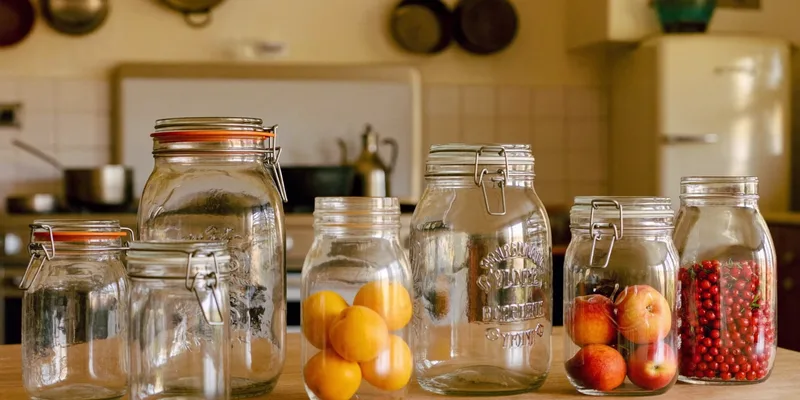
A mason jar is one of the few objects in an American kitchen that has not changed much in a century and a half. The same jar holds last summer’s peaches, this week’s overnight oats, a batch of sauerkraut, a candle, and the drink somebody was served at a wedding. That versatility is exactly why the buying advice gets muddled.
This guide separates the parts of the mason jar world that matter: what the jar actually is, which mouth and size to buy for which job, which of the many lookalike jars are safe to process, and where the specialist jar articles pick up the detail.
This article contains affiliate links. If you buy through them, we may earn a commission at no extra cost to you. Learn more.
Quick Answer
What do you actually need to know about mason jars?
- Two mouth sizes, regular and wide, and they take different lids. Everything else follows from that choice.
- Capacities run from four ounces up to half gallon, and tested canning recipes are written per size.
- The two piece lid is the system: a flat single use lid plus a reusable band.
- Not every jar shaped object is a canning jar. Craft and drinkware jars are for storage, not for processing.
Bottom line: pick the mouth size you prefer, buy pints and quarts, and keep the decorative jars out of the canner.
What a Mason Jar Is
A mason jar is a glass jar with a threaded neck, designed to be sealed by a flat metal lid held in place by a screw band while the contents cool and pull a vacuum. The name comes from the nineteenth century patent that introduced the threaded closure, and the design has stayed close to the original because it works.
The glass is made to handle the temperature swings of canning, which is what separates it from a decorative jar of the same shape. That is also why the same jars get reused for decades, while the flat lids are replaced every batch.
Regular Mouth and Wide Mouth
Regular mouth jars have a narrower opening with a shoulder below it; wide mouth jars are straight sided with an opening as wide as the jar. Ball lists both as standard lines, and each takes its own lid size, which is the detail that trips up first time buyers ordering lids separately.
Wide mouth is easier to fill with anything chunky and much easier to clean, and it is the size most people prefer for pickles, whole fruit, meat, and dry storage. Regular mouth packs more tightly on a shelf and suits jam, jelly, juice, and sauces. Our comparison of the two goes food by food.
Sizes and What They Are For
The common capacities are four ounce, half pint, twelve ounce, pint, pint and a half, quart, and half gallon. Small jars suit jam, condiments, and gifts; pints handle most vegetables, pickles, and salsa; quarts carry tomatoes, beans, and broth for a family.
Size is not cosmetic when you are canning. Tested processing times are published per jar size, and the NCHFP directs using the size the recipe specifies rather than substituting a larger one. Our jar size guide sets out the full range, and the four ounce jar article covers the smallest end.

The Lid System
Standard modern mason jars use a two piece closure: a flat lid with a sealing compound around the underside, and a screw band that holds it during processing. The lid is single use by the manufacturer’s own instructions; the band is reusable until it rusts or deforms, and it comes off once the jar has sealed and cooled.
Reusable lid systems exist as an alternative, with a rigid lid and a separate rubber ring, and they follow a different tightening routine than metal lids. Our guides to canning lids and reusable canning lids cover both, including why bands should not be stored tight on a sealed jar.
Brands You Will See
Ball and Kerr are the mainstream American brands and are produced by the same manufacturer, with Kerr historically associated with wide mouth jars. Golden Harvest and various store brands appear seasonally, and imported European jars such as Weck and Le Parfait use entirely different closure systems with their own instructions.
For canning purposes, the practical rule is that jars using the standard two piece system are interchangeable with tested recipes, while a different closure system means following the guidance published for that system. Mixing a European glass lid with an American processing time is not a substitution the tested processes cover.
Mason Jars Beyond Canning
| Use | Which jar | What you add | Watch out for |
|---|---|---|---|
| Canning | Any true canning jar | New flat lid and band | Recipe specifies the jar size |
| Dry pantry storage | Wide mouth, quart and up | Storage cap or vacuum sealed lid | Not a substitute for canning |
| Fermenting | Wide mouth, quart or half gallon | Airlock lid and a weight | Headspace for active bubbling |
| Freezing | Straight sided jars only | Extra headspace for expansion | Shouldered jars crack as contents expand |
Vacuum sealing a jar of dry goods is a storage method, not a canning method, and it does not make wet food shelf stable. Our mason jar vacuum sealer guide is explicit about that boundary, and fermentation lids covers the airlock side.
Jars That Should Not Be Processed
Decorative jars sold as drinkware, craft containers, or storage may be made from glass that is not manufactured for repeated heating, and the listing often says nothing at all. If the product is not described as a canning or mason jar, treat it as storage. The same goes for commercial food jars, which the NCHFP advises against reusing for home canning.
Old jars with wire bail closures and glass lids are a common family heirloom and a common question. They are attractive on a shelf and they are not part of the tested two piece system, so keep them for dry goods rather than processing.
Caring for Jars So They Last
Wash jars in hot soapy water or the dishwasher, inspect the rim by touch before every fill, and retire any jar with a chip or a nick to non canning duty. Chips are the most common single jar failure and they are easy to miss by eye.
Store jars empty with bands off so nothing traps moisture, and stack them upright rather than nesting them rim to rim. If you store sealed jars, take the bands off first, since a band left on can hold a failed lid in place and hide the fact that the seal has gone.
Frequently Asked Questions
Are all mason jars safe for canning? Jars sold as canning or mason jars are; decorative jars, drinkware jars, and reused commercial food jars are not. The NCHFP advises against using commercial food jars for home canning.
Can I put mason jars in the freezer? Straight sided jars, yes, with extra headspace so the contents can expand. Shouldered jars are much more likely to crack as frozen food pushes outward, which is why freezer use is usually recommended in straight sided wide mouth jars.
What is the difference between Ball and Kerr? Very little. They are made by the same manufacturer to the same standard and take the same lids for a given mouth size, so choose on availability and price.
Can I reuse the flat lids? No. Standard flat metal lids are single use by the manufacturer’s own instructions. If you want a reusable option, buy a system designed for it and follow that system’s directions.
Do wide mouth and regular mouth lids interchange? No, and this is the most common ordering error. Check the mouth size of your jars before buying lids or attachments in bulk.
Does vacuum sealing a mason jar replace canning? No. Vacuum sealing a jar removes air, but it does not heat process the contents, so it does not make low acid or wet food shelf stable. Use it for dry goods, refrigerator storage, and freezer storage.
Are mason jars airtight? With a flat lid and a band screwed down, a mason jar is airtight enough for everyday pantry storage, and it keeps out dust, humidity and pantry moths. It is not airtight in the sense preservation needs, because a hand tightened band still lets air move as temperatures change. Only a processed or vacuum sealed jar holds a real seal.
The Bottom Line
Choose a mouth size, buy pints and quarts from a mainstream canning brand, keep new flat lids in stock, and reserve the pretty jars for dry storage. The jar itself is the most durable thing in the canning kitchen, and almost every problem people blame on it traces back to a chipped rim or the wrong lid size. Read next: which canning jars to buy and how many and the full size breakdown.