Last updated: August 23, 2026
Onions are the crop that makes people think they are bad at storage. They come out of the garden looking indestructible, sit in a bowl on the counter for three weeks, and then one of them is soft at the neck and the whole bowl smells. Meanwhile the same variety in a mesh bag in a cold hallway is still firm in March.
The difference is almost entirely curing and humidity. Onions want the opposite conditions to potatoes, which is why the two crops so often ruin each other in a shared bin. This guide covers curing, the conditions the extension services actually specify, what to hang them in, which onions are simply not built to keep, and where a dehydrator takes over when the last of the crop starts to turn.
This article contains affiliate links. If you buy through them, we may earn a commission at no extra cost to you. Learn more.
Quick Answer
How should you store onions?
- Cure them first so the necks and outer skins dry down and seal.
- Iowa State University Extension lists drying onions in a warm, well ventilated location for 2 to 3 weeks, then storing at 32 to 40 degrees F and 65 to 70 percent relative humidity, for a storage life of 5 to 8 months.
- Cold and dry, with air moving through: mesh bags, slatted crates or braids, never a sealed container.
- Sweet onions are the exception and do not keep. Use them first or refrigerate them.
Bottom line: dry air and airflow are what keep onions. Never store them in the same bin as potatoes, which need the opposite.
Curing Is Not Optional
An uncured onion has a soft, open neck, and that neck is the way rot gets in. Curing dries the neck shut and hardens the outer papery layers into a barrier. Iowa State University Extension puts onion curing at 2 to 3 weeks in a warm, well ventilated location before the bulbs go into storage.
Spread them in a single layer on a screen, a rack or a slatted shelf somewhere out of direct sun with air moving. Leave the tops attached while they cure if you plan to braid them. They are ready when the neck is tight and dry and the outer skins rustle rather than bend.
Never Wash Them First
Ohio State University Extension guidance on Ohio onions is direct on this point: do not wash onions before storing them, and handle them gently to avoid bruising. Brush off dry soil, trim the roots, and leave it at that. A washed onion goes into storage with water in exactly the place you spent three weeks drying out.
Cold, Dry and Moving Air
Once cured, onions want cold with low humidity. Iowa State University Extension gives storage at 32 to 40 degrees F with 65 to 70 percent relative humidity and a storage life of 5 to 8 months. That humidity figure is the important half, and it is where kitchen storage falls down, because a kitchen is both warm and damp.
An unheated hallway, a cold pantry, a garage that stays above freezing or an unheated spare room all get closer than anywhere near the stove. Ohio State University Extension summarizes the goal as a cool, dry, dark place, which prevents both sprouting and decay.
Air Has to Reach Every Bulb
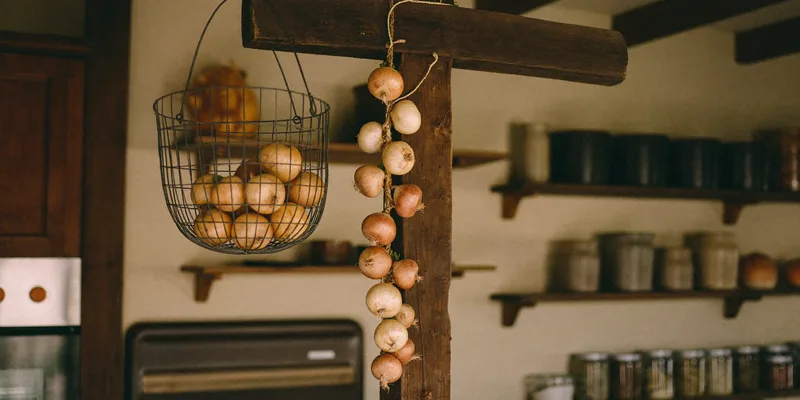
Onions stored in a solid bowl or a closed drawer are sitting in their own trapped moisture. Use something open: a mesh bag, a loosely woven sack, a slatted crate, a wire basket, or the old trick of a pair of pantyhose with a knot tied between each onion. Keep the layers shallow enough that you can see the bottom ones without unpacking everything.

Not All Onions Keep
Storage life is decided partly by variety, and no amount of good technique will make a sweet onion behave like a storage onion. Sweet varieties have higher water content and thinner skins, which is exactly why they taste the way they do and exactly why they turn first. Plan the eating order around this rather than fighting it.
Yellow storage onions and most red onions are the long keepers. Shallots keep well under the same conditions. The table below sorts the common types by how you should treat them.
| Type | Where it goes | Rough keeping order | Watch for |
|---|---|---|---|
| Yellow storage onion | Mesh bag, cold and dry | The long keeper, eat last | Soft necks, sprouting if too warm |
| Red onion | Mesh bag, cold and dry | Keeps well, slightly behind yellow | Mold between outer layers |
| Sweet onion | Refrigerator, wrapped individually | Eat first, does not store | Bruising and rapid softening |
| Shallot | Mesh bag or open basket | Keeps with the storage onions | Drying out if humidity is very low |
For sweet onions specifically, Ohio State University Extension suggests wrapping individual bulbs in dry paper towels and refrigerating them in a crisper drawer to extend their life, which is the opposite of what you would do with a storage onion.
Cut Onions and Leftover Halves
Once an onion is cut it becomes a refrigerator item, not a pantry item. Ohio State University Extension advises sealing the unused portion and refrigerating at 40 degrees F or below, where sliced or diced onion keeps for several days, or freezing at 0 degrees F or below where it keeps for several months.
The practical version of that is a sealed container rather than a plate with plastic wrap, because a cut onion will scent everything in the fridge within a day. A vacuum sealed jar or a well gasketed container solves both the smell and the drying out. Our guide to airtight food storage containers covers which lid designs actually hold a seal after a year of use.

Keep Them Away From the Potatoes
This is the single most common storage mistake in a home pantry, and it is a conditions clash rather than a myth. Iowa State University Extension puts potatoes at 90 to 95 percent relative humidity and onions at 65 to 70 percent. One bin cannot deliver both, so whichever crop loses that argument spoils faster.
Separate containers on separate shelves is enough. If your only cold spot is small, prioritize keeping the potatoes dark and humid and give the onions the airier, drier end. Our guide to storing potatoes lays out the other side of that split.
When the Crop Starts to Turn, Dehydrate
Every stored crop reaches a week where several bulbs sprout at once. Rather than losing them, dry them. Dehydrated onion keeps on a shelf for far longer than any fresh bulb, and ground into powder it takes up almost no space at all.
Montana State University Extension notes that onions need no blanching, are sliced 1/8 to 1/4 inch thick, and take an estimated 3 to 9 hours in a dehydrator, with the optimum drying temperature for food given as 140 degrees F. Our full walkthrough on dehydrating onions covers slicing, the smell problem and grinding to powder, and the food dehydrator buying guide covers which machines handle a whole crop in one load.
Frequently Asked Questions
How long do onions last in storage? Iowa State University Extension gives 5 to 8 months for cured onions held at 32 to 40 degrees F and 65 to 70 percent relative humidity. Warmer and damper than that and expect weeks rather than months.
Can onions be stored in the refrigerator? Whole storage onions do better in a cold, dry, airy spot than in a fridge, which is humid. Sweet onions and cut onions are the exceptions, and Ohio State University Extension recommends refrigerating both.
Why are my onions sprouting? Almost always too warm. Sprouting is the bulb responding to storage temperatures it reads as spring. Move them somewhere colder and use the sprouted ones first, since they are still fine to eat.
Should I cut the tops off before storing? Cure with the tops on if you want to braid them. Otherwise trim the dried tops to a short stub once curing is finished, leaving the neck sealed rather than cutting into green tissue.
Can I store onions with garlic? Yes. Iowa State University Extension gives both the same conditions, 32 to 40 degrees F at 65 to 70 percent relative humidity, so they share a shelf comfortably. Potatoes are the crop to keep separate.
What do I do with the ones that start to go? Trim, then dehydrate or freeze the good tissue. Dried onion and onion powder store on a shelf for a long time, and it costs you nothing but a dehydrator run.
The Bottom Line
Cure the necks shut, then keep onions cold, dry and open to the air, in mesh rather than in plastic. Sweet onions get eaten first, cut onions live in the fridge, and the potatoes live somewhere else entirely. When the last of the crop starts to sprout, dry it: our food dehydrator buying guide covers the machine and storing dehydrated food covers keeping the result crisp.