Last updated: August 23, 2026
Dehydrating onions is the most useful thing a beginner can do with a new machine and the one job that will get the machine banished to the garage. It is useful because a sack of onions that is starting to sprout becomes two jars of dried flakes and a small jar of powder that will outlast the winter. It gets banished because the whole house smells of onion for a day and a half.
Both of those facts are worth planning around. This guide covers slicing, whether blanching is needed, what the extension services specify for heat and time, where to put the machine while it runs, and how to turn dried flakes into powder that does not set into a brick in the jar.
This article contains affiliate links. If you buy through them, we may earn a commission at no extra cost to you. Learn more.
Quick Answer
How do you dehydrate onions?
- Montana State University Extension gives slices of 1/8 to 1/4 inch thick, with no blanching needed for onions.
- Montana State University Extension also puts the optimum drying temperature for food at 140 degrees F and estimates 3 to 9 hours in a dehydrator.
- Run the machine in a garage, a porch or a utility room, because the smell travels.
- Dry until brittle, then store sealed, and grind to powder only when you need it.
Bottom line: no blanching, even slices, and somewhere to put the machine that is not your kitchen.
Prep: Slicing and Nothing Else
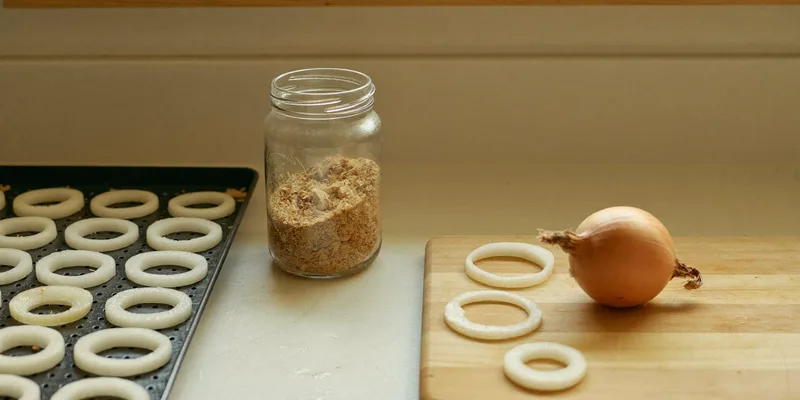
Onions are one of the easy vegetables because they skip the step that makes everything else tedious. Montana State University Extension describes the preparation as washing, removing the outer paper shells, cutting off the tops and root ends and slicing 1/8 to 1/4 inch thick, with no blanching needed. Penn State Extension likewise lists onions, garlic, peppers and herbs as vegetables that do not need blanching.
Slice thickness is the one thing to be careful about. Consistency matters more than which end of that range you pick. Rings, half moons or diced all work, and diced is the most useful format if the end goal is soup and chili rather than crispy fried onion.
Rings Fall Apart, and That Is Fine
Onion rings separate into individual arcs as they dry and shed through the slots of a standard tray. Either dice instead, or use a fine mesh liner over the tray. The liner also stops the small pieces from ending up in the fan housing, which is a smell you will be dealing with for a while.

Heat, Time and How to Tell It Is Done
Montana State University Extension puts the optimum temperature for drying food at 140 degrees F, warning that higher temperatures cook the food rather than dry it and raise the likelihood of molding, and gives an estimated dehydrator time for onions of 3 to 9 hours. That is a wide range because slice thickness and load size move it enormously.
The dryness test is the reliable part. The same guidance describes dried vegetables as tough, brittle or crunchy when done. Let a piece cool before you judge it, because warm onion feels leathery even when it is finished. A properly dried flake snaps rather than bends.
Do Not Rush It With Heat
Onions are high in sugar for a vegetable and they scorch. Pieces that come out brown and taste bitter were run hot, not run long. If the batch is taking longer than you hoped, load fewer trays next time rather than turning the dial up.
The Smell Problem, Honestly
This is the complaint that dominates owner reviews of any dehydrator used for onions and garlic, and there is no product that solves it. A dehydrator works by pushing warm air through the food and out into the room, so the room gets the smell. That is the machine working correctly.
The workable answers are all about location. Run it in an attached garage, on a covered porch, in a utility room with the door shut, or in a basement. Start it in the evening so the worst of it happens overnight. Nothing you can buy will scrub the air, and a machine advertised as sealed or odor free is making a marketing claim rather than describing physics.
The Trays Keep the Smell Too
Plastic trays absorb onion and garlic and hand it back to the next batch of apple rings. Wash them promptly with warm soapy water rather than letting them sit. If you dry a lot of alliums, stainless steel trays are genuinely worth it, and our guide to stainless steel dehydrators covers which machines come with them and which sell them as an upgrade.
Flakes, Minced or Powder
Dried onion has three useful forms and they are not interchangeable in cooking. Decide which one you want before you slice, because the cut determines the product. The table below is the short version.
| Form | How to cut it | What it is for | Watch for |
|---|---|---|---|
| Flakes | Rings or half moons, then break up dried | Soups, stews, camp meals | Falls through open trays, use a liner |
| Minced | Diced small before drying | Spice blends, rubs, quick cooking | Dries fast, easy to scorch |
| Powder | Grind fully dried flakes | Seasoning, gravy, dry mixes | Clumps badly if any moisture remains |
| Fried style crisp | Thin rings, dried to brittle | Topping, not a substitute for fried | Will not taste like the store bought fried kind |
That last row is worth stating plainly. Store bought crispy fried onions are fried, and a dehydrator does not fry. Dried onion rings are crunchy and sweet, but they are a different product and anyone expecting the tin from the supermarket will be disappointed.
Grinding Powder Without the Brick
Onion powder is hygroscopic, which is a technical way of saying it pulls water out of the air and turns into a solid lump in the jar. This is the single most common complaint about home made onion powder, and it has two causes: the flakes were not fully dry, or the powder is being stored in a humid kitchen.
Grind only what you will use in the next few months and leave the rest as flakes, since flakes handle humidity far better. Store the powder in a small sealed jar with a desiccant packet, away from the stove. Our guide to storing dehydrated food covers conditioning, desiccants and why small jars beat one large one.

Storage Life and Rehydrating
Montana State University Extension gives storage for most dried vegetables in a dark, dry, cool place at 1 year at 60 degrees F, or 6 months at 80 degrees F. That temperature difference is the reason a jar in a cool cupboard outlasts the same jar on a shelf above the cooker by a wide margin.
To use them, most cooked dishes need nothing at all: dried onion rehydrates in the pot. For anything raw or lightly cooked, cover the flakes in warm water for a few minutes and drain. If the fresh onions in the pantry are what prompted all this, our guide to storing onions covers keeping the crop fresh for longer before it gets to the drying stage.
Frequently Asked Questions
Do onions need blanching before dehydrating? No. Penn State Extension lists onions, garlic, peppers and herbs as the vegetables that do not need blanching, and Montana State University Extension gives onion preparation as slicing 1/8 to 1/4 inch thick with no blanching.
What temperature should I dehydrate onions at? Montana State University Extension puts the optimum drying temperature for food at 140 degrees F and estimates 3 to 9 hours in a dehydrator for onions. Higher temperatures cook rather than dry.
How do I stop the whole house smelling of onion? Move the machine, not the recipe. A garage, porch, basement or utility room with the door shut is the only real fix, because a dehydrator vents warm air into the room by design.
How long do dried onions keep? Montana State University Extension gives most dried vegetables 1 year at 60 degrees F or 6 months at 80 degrees F in a dark, dry, cool place. Sealed jars in a cool cupboard are the practical version of that.
Why did my onion powder turn into a solid lump? Moisture. Either the flakes were not dried to brittle, or the jar is living somewhere humid. Grind small amounts, keep the rest as flakes, and add a desiccant packet.
Can I dry onions and apples in the same load? You can, and you will regret it. Onion perfumes everything drying alongside it, and it lingers in plastic trays. Keep alliums in their own runs.
The Bottom Line
Slice evenly, skip the blanching, dry at the temperature the extension guidance specifies until the pieces snap, and run the machine somewhere the smell can leave. Keep most of the batch as flakes and grind powder only as you need it. If you are choosing a machine for a crop of onions, our food dehydrator buying guide covers capacity, and the stainless steel dehydrator guide covers the tray material that does not hold the smell.