Last updated: August 23, 2026
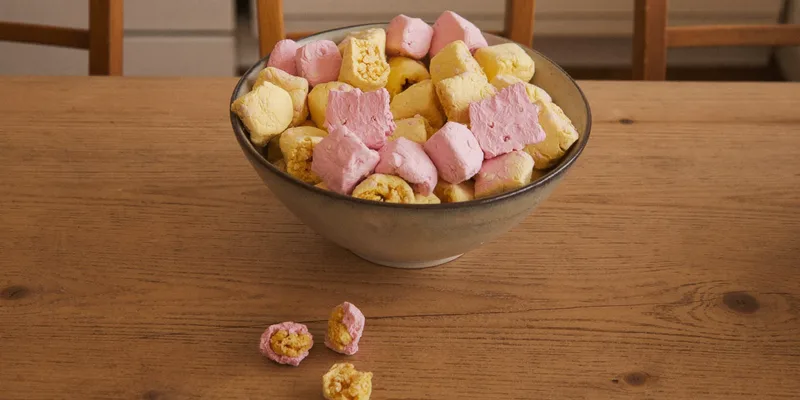
Freeze dried candy is the reason a lot of machines got bought. A Jolly Rancher that puffs into a crunchy shard, Skittles that turn into airy pillows, taffy that expands into something crisp and completely unlike taffy: it photographs well, kids love it, and it sells at fairs. It is also the batch beginners most often get wrong, because candy behaves nothing like strawberries.
The failures look the same every time. Pieces come out chewy in the middle, they weld into one sheet, they go soft again a day later in the bag, or the whole tray never really finished. All four have the same handful of causes, and none of them require a different machine. This is the setup, the settings the manufacturer actually publishes, and the candies that are worth your tray space.
This article contains affiliate links. If you buy through them, we may earn a commission at no extra cost to you. Learn more.
Quick Answer
How do you freeze dry candy without a sticky, chewy batch?
- Skip the freeze. Harvest Right’s candy mode goes straight to drying, which is exactly what sugar wants.
- Space it out. Pieces that touch expand into each other and come out as one sheet.
- Add dry time, not heat guesswork. The candy insert manual gives an adjustable drying range and extra dry time.
- Seal the same day. Candy pulls moisture out of the air faster than any other freeze dried food.
Bottom line: sugar, space and a sealed bag. Chocolate and anything fatty will not work at any setting.
Why Candy Behaves Differently From Food
Regular freeze drying starts with frozen food, and the ice sublimates away under vacuum. Candy has very little free water, so freezing it accomplishes almost nothing. What actually happens is that the trapped air and moisture inside sugar expands under vacuum, which is why a Jolly Rancher inflates instead of shrinking.
That is also why candy needs heat and time rather than a long freeze. Harvest Right added a candy mode for exactly this reason: the company’s candy insert documentation describes a mode that skips the freezing stage and lets you set the drying temperature and an extra dry time.
The Settings the Manufacturer Publishes
Harvest Right’s candy insert owner’s manual describes candy mode as going straight to dry, with the heat setting adjustable across a 125F to 150F range and an extra dry time you choose. Owners generally sit near the top of that range for hard candy and add a couple of hours of extra dry time. Use the manual for your software version rather than a number from a video, because the modes have changed across firmware updates.
Which Candy Works and Which Wastes a Tray
Sugar based candy works. Fat based candy does not. Hard candy, gummies, taffy, marshmallow and most chewy fruit candy all puff and crisp beautifully. Chocolate, caramels with a lot of butter, peanut butter centers and anything oily come out greasy and soft, because fat does not sublimate and there is no ice to remove.
Within the sugar group, the interesting variable is how much the piece expands. Taffy and marshmallow can triple in size and will fuse with a neighbor. Hard candy expands less but shatters if you crowd it. That single fact drives every loading decision below.
| Candy | What it does | How to load it | Watch out for |
|---|---|---|---|
| Hard candy | Puffs into a light, crunchy shard | Single layer, gaps between pieces | Sticks to bare stainless, use a liner |
| Coated chewy candy | Expands into airy pillows | Spread thin, do not pile | Colors transfer if crowded |
| Taffy | Expands dramatically, very crisp | Cut into pieces, wide spacing | Fuses into a sheet if pieces touch |
| Gummies | Crisp shell, sometimes chewy center | Cut large gummies in half | Thick centers need extra dry time |
| Chocolate and fatty candy | Stays soft, turns greasy | Do not bother | Fat does not sublimate |
The Tray Setup That Prevents Fused Sheets
Spacing is the whole game. Load a single layer with a finger width between pieces, and cut anything large into halves so the center is closer to the surface. A crowded tray does not just fuse, it also dries unevenly, because expanded candy blocks the path for vapor coming off the pieces beneath it.
Liners matter as much as spacing. Sugar sticks to bare stainless hard enough that people chip at trays with a spatula, which scratches the finish and ruins the next batch. A silicone liner or a set of dividers turns cleanup into peeling and rinsing.
If Your Candy Welds Itself to the Tray
Silicone liners sized for your tray are the fix, and they double as the answer for sticky fruit later. Dividers add the ability to run several candies at once without color and flavor migrating across the tray.


Why the Batch Went Soft Again
Because freeze dried candy is hygroscopic, meaning it pulls water straight out of room air. A tray that came out perfect at midnight and turned chewy by the next evening was not underdried, it was underpackaged. This is the single most common complaint from people selling at markets, and it is entirely a storage problem.
Bag it the day it comes out, with the sealing gear ready before the cycle ends rather than after. For anything you are keeping past a week, use mylar with an oxygen absorber. For a bag going to a school fair on Saturday, a heat sealed poly bag is fine.
Seal It the Same Day
Mylar plus an absorber is the storage standard for freeze dried food of any kind, and candy is the food that punishes you fastest for skipping it.

Seal a Whole Batch Without Fighting It
An impulse sealer closes a bag in a second with a consistent seam, which matters when a candy batch fills a dozen small bags.

Is Candy a Good Reason to Buy a Machine?
Honestly, on its own, no. A freeze dryer is a four figure purchase and candy is the cheapest thing you can put in it, so the payback math never works if novelty snacks are the only plan. It makes sense as one use among many, or as a small business input if you have actually costed the packaging and the market stall.
If candy is the whole appeal, the smarter path is to try it on a friend’s machine first, or to look hard at what else you would preserve in a year. Our cost breakdown works through the arithmetic, and the dehydrator comparison covers the jobs that do not need the expensive machine.
Frequently Asked Questions
Why is my freeze dried candy still chewy in the middle? The pieces were too thick, too crowded, or the cycle needed more dry time. Cut large pieces in half, load a single spaced layer, and add extra dry time in candy mode. A center that stays chewy while the shell is crisp is almost always a thickness problem rather than a machine problem.
Do I need a special candy tray? No, but liners and dividers make a real difference. Sugar bonds to bare stainless and expanded candy runs together, so a liner saves the tray finish and dividers keep flavors and colors separate when you run several candies at once.
Can I freeze dry chocolate? Not usefully. Fat does not sublimate, so chocolate and fatty centers come out soft and greasy rather than crisp. Stick to sugar based candy, which is where the dramatic texture change happens anyway.
How long does freeze dried candy keep? That depends entirely on packaging rather than on the candy. Sealed in mylar with an oxygen absorber and kept out of heat and light, it stores for a long time. Left in a zip bag on a counter, it can soften within a day, because it draws moisture from room air.
Can I sell freeze dried candy? People do, and the rules are local. Cottage food laws differ by state and some treat repackaged candy differently than baked goods, so check with your own state’s program rather than following advice from a group chat.
The Bottom Line
Freeze dried candy needs no pre freeze, plenty of space between pieces, a liner so it does not bond to the tray, extra dry time for anything thick, and a sealed bag the same day it comes out. Use your machine’s candy mode and the manufacturer’s published range rather than a number from a video, and leave chocolate out of it entirely. If you are still deciding whether the machine earns its space, read our cost breakdown, and the guide to extra trays and dividers if candy batches are becoming a weekly habit.