Last updated: August 23, 2026
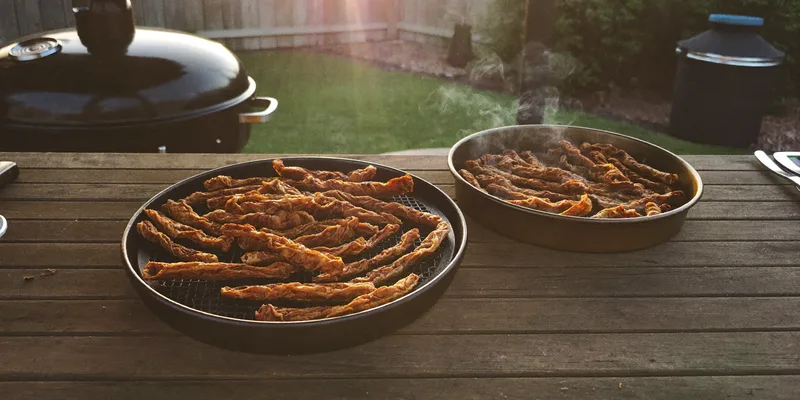
Ask this question in any hunting camp and you will get two confident answers. The dehydrator crowd points at even results and a machine that runs unattended overnight. The smoker crowd points at flavor you cannot get from a bottle of liquid smoke, and at the fact that a smoker running hot enough handles the safety step in the same appliance.
Both are right, because they are optimizing for different things. The useful version of this comparison is not which appliance is better in the abstract, but which one matches the volume you process, the flavor you want, and how much of a Saturday you are willing to spend tending a fire.
This article contains affiliate links. If you buy through them, we may earn a commission at no extra cost to you. Learn more.
Quick Answer
Dehydrator or smoker for jerky?
- Dehydrator: even results, unattended overnight runs, more tray space per dollar, no smoke flavor.
- Smoker: real smoke flavor, and a unit that holds a high enough temperature can also do the heat step.
- Volume favors the dehydrator; flavor favors the smoker; plenty of people smoke first and finish in the dehydrator.
- Whichever you use, the USDA temperature guidance for jerky does not change.
Bottom line: dehydrator for consistency and quantity, smoker for flavor, both together if you have them.
What Each Appliance Is Actually Doing
A dehydrator is a fan and a low wattage heater in an insulated box. It moves a lot of air at a modest temperature, which is exactly what removing water from thin strips requires, and it does that identically hour after hour without your attention.
A smoker is a low temperature oven with smoke in it. Most electric and pellet units are built to hold cooking temperatures, and the airflow is lower because the goal is to keep smoke in contact with the meat. That is great for flavor and less efficient at pulling moisture out.
Safety Is the Same in Both
USDA FSIS guidance for home jerky does not change with the appliance: the meat needs to reach 160F, or 165F for poultry, verified with a food thermometer, and drying should happen with the appliance maintaining 130F to 140F. Where the two differ is how easily each one delivers that.
A smoker that holds a genuine cooking temperature can bring the strips to the required internal temperature during the cook, so the heat step and the flavoring happen together. A dehydrator running in the FSIS drying range will not do that on its own, which is why the guidance describes steaming or roasting the strips before or after drying.
Verify rather than assume
Both appliances can be optimistic about their own temperature. A thermometer probe in the thickest strip and an oven thermometer on a shelf cost very little and settle the question for every batch you ever run.
Volume, Time and Attention
A nine shelf dehydrator takes a full jerky batch in one load and runs overnight while you sleep. A smoker of similar footprint typically holds fewer racks of thin strips, needs wood or pellets topped up on some designs, and asks you to be around while it runs.
That is the practical split for anyone processing a deer. If your November involves several rounds of five pounds at a time, the dehydrator wins on throughput alone. If jerky is an occasional weekend project, the smoker’s demands are part of the fun rather than a cost.
Best for unattended overnight volume
A box machine with square shelves and a rear fan dries a full load evenly without rotation, which is the single biggest time saver on a large batch.
Best budget dehydrator for occasional batches
An expandable stackable handles a couple of pounds at a time and costs a fraction of a box machine, which suits households that dry jerky a few times a year.

Flavor: the Honest Difference
Smoke from actual wood tastes different from smoke flavoring in a seasoning packet, and anybody who has eaten both knows it immediately. If that flavor is why you make jerky, no dehydrator setting will get you there, and liquid smoke is an approximation rather than a substitute.
The compromise most people land on is a short smoke for flavor followed by a finish in the dehydrator for even drying and unattended time. It uses both appliances for what each is good at, and it is why the two camps are less opposed than they sound.
Best if flavor is the point
A digital electric smoker holds a set temperature with far less tending than a stick burner, which makes it the practical choice for jerky rather than for competition barbecue.

Differences at a Glance
Sort by what you care about most. Almost nobody regrets owning a dehydrator; plenty of people buy a smoker for jerky and discover that they wanted the flavor rather than the process.
| Factor | Dehydrator | Smoker | Who should care |
|---|---|---|---|
| Flavor | Seasoning only | Real wood smoke | Anyone chasing traditional taste |
| Evenness | High, especially rear fan models | Varies by rack position | Large batches |
| Attention needed | Load it and leave it | Monitoring and fuel | Weeknight processors |
| Heat step | Separate step before or after | Can happen during the cook | Everyone, per USDA FSIS |
Temperature guidance referenced here is USDA FSIS jerky guidance; the rest reflects how the appliances are built.
Avoid This Mistake
The common error is buying a smoker to make jerky at scale and discovering that a rack of thin strips takes up the same room as a pork shoulder, so a deer’s worth of trim becomes four separate smokes. The second is running a dehydrator and assuming the low, long run made the meat safe.
Both mistakes have the same root: matching the appliance to the picture in your head rather than to the batch on your counter. Weigh the meat you actually process in a season and decide from there.
Frequently Asked Questions
Is jerky better in a smoker or a dehydrator? Flavor goes to the smoker, consistency and volume go to the dehydrator. Many people do both, smoking for flavor and finishing in the dehydrator for even drying.
Can a smoker replace the USDA heat step? A smoker that holds a genuine cooking temperature can bring the meat to 160F, or 165F for poultry, during the cook, which is what FSIS asks for. Verify with a food thermometer rather than trusting the dial.
Can I add smoke flavor in a dehydrator? Only through seasoning or liquid smoke in the marinade. It is a reasonable approximation and it is not the same as wood smoke.
Which is cheaper to run? A dehydrator, since it uses modest wattage and no fuel. Pellets and wood chips add a running cost to every smoker batch.
Do I still need a dehydrator if I own a smoker? If you dry fruit, herbs or vegetables at all, yes. A smoker is a poor tool for anything that is not meat. See our food dehydrator guide for what else the machine earns its space with.
What temperature should the dehydrator hold for jerky? FSIS guidance calls for 130F to 140F maintained throughout drying, in addition to the separate heat step. The full sequence is in our jerky time and temperature guide.
The Bottom Line
Choose the dehydrator if you process volume, want even results and prefer to load a machine and go to bed. Choose the smoker if wood smoke is the reason you make jerky at all, and accept the smaller batches and the extra attention. The temperature guidance is identical either way, so the decision is about workflow and flavor rather than safety. Start with our dehydrator for jerky guide, or the deer jerky guide if you are processing game.