Last updated: August 23, 2026
Nesco is the round one. If you grew up with a dehydrator on the counter in September, it was probably a stack of white or gray trays with a lid on top, humming away with apple rings in it. The brand has been doing the same thing for decades, and it still owns the part of the market where you want more capacity without buying a bigger machine.
That is the whole trick with Nesco: you buy a base with a few trays and add more when the harvest demands it. The two lines are the Snackmaster and the Gardenmaster, and the choice between them comes down to wattage, tray size and how far you plan to expand. Everything below uses Nesco’s published specifications.
This article contains affiliate links. If you buy through them, we may earn a commission at no extra cost to you. Learn more.
Quick Answer
Snackmaster or Gardenmaster: which Nesco fits you?
- The Snackmaster Pro FD-75A: 600 watts, 5 trays that expand to 12, per Nesco.
- The Gardenmaster Digital Pro FD-1040: 1000 watts, 4 large trays that expand to 20, with a 48 hour timer.
- Both use a top mounted fan and Nesco’s Converga Flow airflow, so trays stack rather than slide.
- Expansion trays are the point of the design, so budget for them with the machine.
Bottom line: Snackmaster for snacks and jerky in a normal kitchen, Gardenmaster when a garden is producing faster than you can dry it.
How the Nesco Design Works
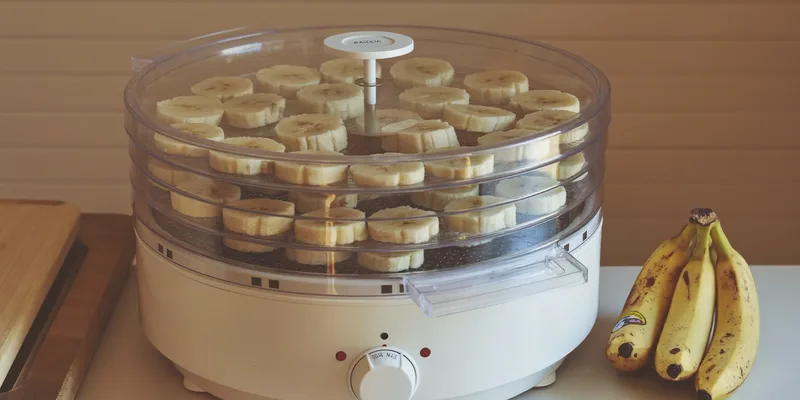
A Nesco is a stacking dehydrator. The motor, heating element and fan sit in the top lid, and trays stack on a base below it. Nesco calls the airflow Converga Flow, and states that the design dries evenly and rapidly without tray rotation, with air moving down the outer wall and inward across each tray.
That layout has a real advantage that box dehydrators cannot match. Because the trays are just rings, you add or remove them freely, so the machine grows with the season instead of sitting half empty in January. The trade is that everything you dry sits in a round tray with a hole in the middle, which is fine for slices and awkward for large flat items.
The Snackmaster Pro, for Jerky and Snacks
The FD-75A is the model most people mean by a Nesco. Nesco lists it at 600 watts with five trays included, expandable to twelve, and an adjustable thermostat covering 95 to 160 degrees F. That range covers herbs at the bottom end and meat at the top.
It is the fall machine: jerky, fruit leather, apple rings, dog treats. Five trays is a real household load and twelve is more surface than most kitchens have counter for. If jerky is the reason you are shopping, see our jerky dehydrator guide for how the models compare on that job specifically.

The Safety Step Jerky Needs
No home dehydrator makes jerky safe by drying alone. The NCHFP recommends heating meat to 160 degrees F, and poultry to 165 degrees F, before or after the drying process, which on a machine that tops out at 160 degrees F usually means a short oven step. The sourced numbers are in our jerky time and temperature chart.
The Gardenmaster, for Harvest Volume
The Gardenmaster line is the heavier version of the same idea. Nesco lists the FD-1040 Digital Pro at 1000 watts with four trays of roughly 15.5 inch diameter, expandable to twenty, a digital thermostat from 90 to 160 degrees F and a timer programmable up to 48 hours.
The extra wattage is what makes twenty trays plausible, since a 600 watt machine spread over that much surface would crawl. If you are drying tomatoes, corn, beans and herbs in the same week, this is the line that keeps up. There is also an eight tray Gardenmaster Pro for people who want the bigger trays without starting at four.

Expansion Trays Are Part of the Purchase
The reason to buy a Nesco instead of a box dehydrator is that you can keep adding trays, and the reason people are disappointed is that they never buy any. A five tray machine used as a five tray machine is just a small dehydrator with a hole in the middle of every load.
Buy trays in the same family as the base, because Snackmaster and Gardenmaster trays differ in diameter. Add mesh screens if you dry herbs or anything small, and non stick sheets if fruit leather is on the list, both of which are covered in our guide to dehydrator trays and sheets.

How Nesco Compares to a Presto Stacker
The other stacking dehydrator people cross shop is the Presto Dehydro. Presto lists its Dehydro at 600 watts with four trays expandable to eight, a bottom mounted fan and heating element, trays that nest for storage and are dishwasher safe, and a see through cover. The digital version adds a timer and temperature control.
The practical differences are fan position and how far each expands. Nesco puts the fan in the lid and goes to twelve or twenty trays depending on the line, while Presto puts it in the base and stops at eight. If maximum expandability matters, Nesco wins on paper. If you want the cheapest way into stacking with dishwasher safe trays, the Presto is the shorter route.

The Nesco Lines Side by Side
All figures below are the manufacturer’s published specifications for each model.
| Model | Power and trays | Controls | Suits you if |
|---|---|---|---|
| Snackmaster Pro FD-75A | 600 watts, 5 trays to 12 | 95 to 160 degrees F, no timer | Jerky, snacks, household batches |
| Gardenmaster Digital Pro FD-1040 | 1000 watts, 4 large trays to 20 | 90 to 160 degrees F, 48 hour timer | Garden volume, long unattended runs |
| Gardenmaster Pro FD-1018A | 8 trays, expandable | Thermostat, large tray format | You want the big trays from the start |
| Presto Dehydro | 600 watts, 4 trays to 8 | Digital version adds timer | Cheapest way into a stacking dehydrator |
What Owners Complain About
The recurring complaints are the ones the design implies. Stacking dehydrators dry a little unevenly when trays are loaded unevenly, so slices at different thicknesses finish at different times regardless of what the airflow does. Cut to a consistent thickness and most of that disappears.
The second is capacity creep. People buy five trays, discover drying is addictive, and end up with a tower that needs a taller shelf. That is a happy problem and it is exactly what the machine is designed for, but it does mean the base is only the start of the spend. Persistent uneven drying is worth working through in our dehydrator troubleshooting guide.
Frequently Asked Questions
How many trays can a Nesco take? Nesco lists the Snackmaster Pro as expandable to twelve trays and the Gardenmaster FD-1040 as expandable to twenty. Stay inside the stated limit, since airflow and wattage are matched to it.
Do I have to rotate the trays? Nesco states the Converga Flow design dries without rotation. In practice, uniform slice thickness and not overloading a tray matter more than rotation on a stacking machine.
Is a Nesco good for jerky? Yes, it is one of the most common jerky machines in American kitchens. The heat step is separate from the drying: the NCHFP recommends heating meat to 160 degrees F, and poultry to 165 degrees F, before or after drying.
Snackmaster or Gardenmaster? Snackmaster if you dry snacks and jerky in household quantities, Gardenmaster if a vegetable garden or an orchard sets the pace. The Gardenmaster’s higher wattage and timer are what make very large loads practical.
Are the trays dishwasher safe? Check the manual for your model rather than assuming. Nesco trays are generally hand wash friendly, and greasy jerky runs go easier if you use a liner sheet in the first place.
How does a stacking Nesco compare to a box dehydrator? Stacking gives you expandable capacity and a smaller starting footprint. A box with a rear fan gives you square trays and easier even drying without rotation. We compare the layouts in vertical against horizontal airflow.
The Bottom Line
Nesco sells expandability, so buy the line that matches your ceiling: Snackmaster for snacks and jerky up to twelve trays, Gardenmaster when a garden sets the pace and you need twenty. Budget for expansion trays and liner sheets at the same time as the base, because the base alone is only part of the machine. Read next: Cosori against Excalibur and Nesco, and the dehydrator buying guide.