Last updated: August 23, 2026
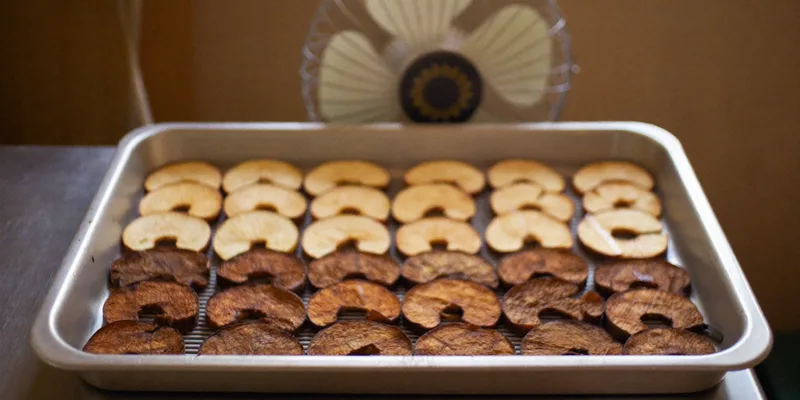
Three complaints turn up in dehydrator reviews more than anything else. It dries unevenly, it takes far longer than the recipe said, and it is loud enough that you cannot leave it running in the kitchen overnight. Owners usually assume they bought a weak machine.
Sometimes they did. More often the batch was loaded in a way no dehydrator could handle, or the dial and the actual air temperature disagree. This guide runs the checks in the order that finds the cause fastest, keeps the free ones first, and says where a part or a different machine genuinely is the fix.
This article contains affiliate links. If you buy through them, we may earn a commission at no extra cost to you. Learn more.
Quick Answer
Why is my dehydrator drying unevenly or taking so long?
- Check slice thickness first. Mixed thicknesses on one tray can never finish together.
- Unload the trays a little. Pieces touching each other block the airflow that does the work.
- Verify the real temperature with a separate thermometer before you trust the dial.
- Give the unit clear space on all sides, and expect longer runs in a humid room.
Bottom line: thickness, load density and airflow explain most of it. Noise is a design trait, not a fault.
Run the Free Checks in This Order
Start with the batch, not the machine. Cut every piece to the same thickness, leave a gap between pieces, load trays evenly, pull the unit away from the wall, and only then look at temperature and hardware. Four of those five cost nothing and they resolve the majority of complaints.
Doing it in order matters because the symptoms overlap. A slow batch and an uneven batch can both come from a single overloaded tray, and you will never see that if you jump straight to questioning the thermostat.
1. One Thickness, Every Piece
Drying time rises sharply with thickness, so a tray holding both thin and thick slices is a tray that cannot finish. Use a guide or a slicer for anything you are drying in quantity, especially tomatoes and potatoes, and accept that hand cut pieces will always vary a little more.
2. Load Lighter Than Feels Efficient
Air has to reach both faces of every piece. Slices that touch, overlap, or sit two deep create wet spots that stay wet, and packing a machine full is the fastest way to double a drying time. Leave a visible gap and dry a second batch rather than cramming one.
3. Give the Machine Room and Watch the Room Itself
A dehydrator pushes moist air out and needs somewhere to send it. Shoved into a corner or under a cabinet, it recycles its own humidity. A humid kitchen in August does the same thing on a larger scale, which is why the same recipe can take noticeably longer on a wet day than a dry one.
Problem: The Dial and the Real Temperature Disagree
Set the machine, wait for it to come up to heat, and check the air inside with a separate thermometer. Owners regularly find a gap between the dial and reality, and a machine running cool turns a normal batch into an all day job while one running hot case hardens the surface.
An oven or probe thermometer placed on a middle tray settles the question in twenty minutes and is worth owning regardless. If the machine is well off its setting and still under warranty, that is a manufacturer conversation. If it is a little off, note the offset and dial around it.
Best simple way to check what your trays are actually seeing

What the Setting Should Be
Penn State Extension suggests starting at 145 degrees F while there is surface moisture on the food, then reducing to 135 to 140 degrees F after one hour to finish drying. Meat follows a stricter rule: the USDA Meat and Poultry Hotline recommends cooking meat to 160 degrees F and poultry to 165 degrees F before dehydrating, because a dehydrator will not reach those temperatures during drying.
Problem: Food Sticks and Small Pieces Fall Through
Sticking is a tray problem rather than a drying problem. Fruit with high sugar welds itself to plastic mesh, herbs and seeds drop straight through the gaps, and fruit puree runs off the edge. The fix is the right liner for the food rather than a different machine.
Mesh screens keep small pieces on the tray while letting air through. Solid silicone sheets hold puree for fruit leather but block airflow underneath, so they belong on one tray at a time rather than the whole stack. Our guide to trays, screens and sheets covers which goes where.
Best for herbs, seeds and anything that falls through

Problem: It Is Too Loud to Run Overnight
Dehydrator noise is fan noise, and it is continuous for hours. There is no repair for it, because the fan is the machine working. What varies is how much noise a given design makes, and larger rear fan units with a bigger, slower fan generally hum rather than whine.
Two things help without buying anything. Put the unit on a solid surface rather than a hollow cabinet, since a resonating countertop adds a surprising amount, and move the machine to a utility room, basement or garage for overnight runs. If the noise is genuinely why you stopped using it, that is a reasonable reason to change machines, and our dehydrator buying guide notes which layouts run quieter.
Best if you want a unit you can leave running while you sleep

Symptom to Cause at a Glance
The table pairs each complaint with the first thing to change. Everything in the free fix column takes minutes, and it is worth exhausting that column before deciding the machine is at fault.
| Symptom | Most likely cause | Free fix | When to buy something |
|---|---|---|---|
| Some pieces done, others tacky | Mixed thickness or crowded trays | Cut to one thickness, spread out | Rear fan unit if it never evens out |
| Batch takes far longer than expected | Overloaded, humid room, or cool running | Lighter load, clear space, verify temperature | Thermometer to confirm the offset |
| Food glued to the tray | Sugary fruit on bare mesh | Turn pieces halfway through | Mesh screens or silicone sheets |
| Too loud in the kitchen | Fan noise plus a resonating surface | Solid surface, move it overnight | Quieter rear fan model |
Frequently Asked Questions
How do I know when food is actually dry? Penn State Extension describes fruit as dry when it is pliable and no beads of moisture appear when a piece is pressed between your fingers, while vegetables should be tough, brittle or crunchy. Always test a cooled piece, because warm food feels softer than it is.
Why did my dried fruit mold in the jar? Uneven moisture, and it is why conditioning exists. The NCHFP directs you to pack cooled dried fruit loosely in jars for seven to ten days, shaking daily, so moisture equalizes, and to return the fruit to the dehydrator if condensation appears.
Is it safe to leave a dehydrator running overnight? Manufacturers design these to run for long unattended cycles, which is the point of the appliance. Use a grounded outlet directly rather than a light duty extension cord, keep the unit clear of curtains and cabinets, and do not cover the vents.
My machine cuts out partway through a batch. What is wrong? Check that the vents are not blocked and that the unit has clear space around it, since thermal cutouts trip when a machine cannot shed heat. A fan that is silent while the unit still feels warm points to a failed fan and a warranty claim.
Can I dry different foods at the same time? Only foods with similar drying times and mild smells. Onions, garlic and hot peppers share their aroma with everything else in the machine, so dry them alone. Our guide to drying herbs covers the delicate end of the scale.
The Bottom Line
Even thickness, a lighter load and clear space around the machine solve most dehydrator complaints, and a separate thermometer settles the rest by telling you what the trays actually see. Noise is the one problem with no free fix, since the fan is the machine doing its job. Read next: our dehydrator buying guide for layouts and capacity, and storing dehydrated food so a good batch survives the pantry.