Last updated: August 23, 2026
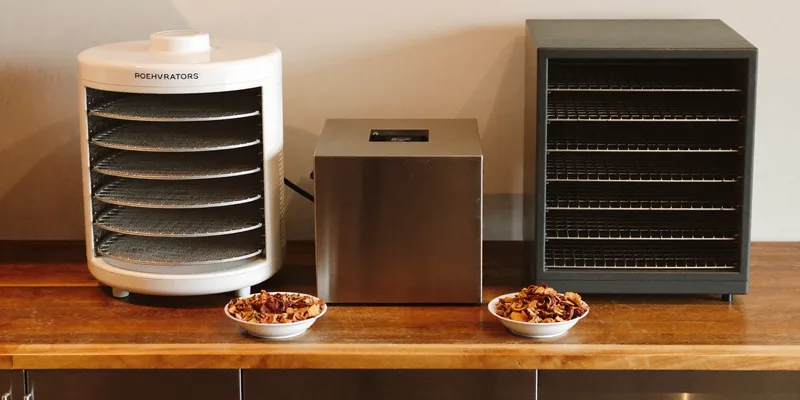
Three names come up in every dehydrator conversation, and they are not really competing for the same buyer. Cosori sells a quiet stainless box for a kitchen counter. Excalibur sells the big square workhorse people photograph full of jerky. Nesco sells a stack of round trays you can keep adding to until the tower reaches the cabinet above.
Picking between them is easier once you stop comparing wattage and start comparing layout, tray material and how much you dry at once. This guide sets the three side by side on those terms, using each maker’s published specifications, and says plainly which one suits which kitchen.
This article contains affiliate links. If you buy through them, we may earn a commission at no extra cost to you. Learn more.
Quick Answer
Cosori, Excalibur or Nesco: which dehydrator should you buy?
- Cosori if you want stainless trays, a glass door and a quiet machine on the counter.
- Excalibur if you dry harvest or hunting volume and want the biggest horizontal airflow box.
- Nesco if you want to start small and expand trays as the season demands.
- All three dry food well. The difference is layout, tray material and capacity ceiling.
Bottom line: box designs for even drying with less fuss, stacking designs for expandable capacity at a lower entry point.
The Real Dividing Line Is Layout
Two designs exist in home dehydrators. A box unit puts the fan and heating element at the back wall and pushes air horizontally across trays that slide in like drawers. A stacking unit puts the fan in the lid or the base and moves air vertically through a tower of round trays.
Cosori and Excalibur are boxes. Nesco is a stacker. That single fact explains most of the differences in the rest of this article, from tray shape to how often you shuffle a load. Our explainer on vertical against horizontal airflow covers the mechanics.
Cosori: Stainless Trays and a Quiet Motor
Cosori’s stainless model is the one that matters here. Cosori lists six stainless steel trays, 6.5 square feet of drying space, 600 watts, a range of 95 to 165 degrees F, a 48 hour timer and operation under 48 decibels with a brushless motor. The trays go in the dishwasher, which is the feature jerky makers notice first.
It is the best fit for a kitchen where the dehydrator stays visible and gets used year round. It is not the machine for turning a whole deer into jerky in one weekend, and six trays fill fast in September. Full detail in our Cosori dehydrator guide.

Excalibur: The Big Square Box
Excalibur’s nine tray 3926TB is the reference machine for volume. Excalibur lists nine trays, 15 square feet of drying space, 600 watts, a 26 hour timer with automatic shut off and an adjustable thermostat from 105 to 165 degrees F, with the fan and element at the back for horizontal airflow.
Square trays are the underrated part. Fruit leather, whole herb stems and large slices fit better on a square tray than on a round one with a hole in the middle, and you can pull trays out to make room for something tall. The cost is counter space, since a nine tray unit is roughly the bulk of a small microwave. See our Excalibur guide for the smaller four and five tray models.
Nesco: Start Small, Add Trays
Nesco’s advantage is the expandability. The maker lists the Snackmaster Pro FD-75A at 600 watts with five trays expandable to twelve, and the Gardenmaster FD-1040 at 1000 watts with four large trays expandable to twenty, plus a 48 hour timer. Both use a top mounted fan with the airflow design Nesco calls Converga Flow.
That makes Nesco the cheapest honest route into serious capacity, because you buy trays rather than a second machine. The compromises are round trays with a hole in the middle and a tower that gets tall when fully expanded. Full detail in our Nesco dehydrator guide.

The Three Brands Side by Side
Specifications are the makers’ published figures for the headline model in each range.
| Brand | Layout and trays | Signature feature | Suits you if |
|---|---|---|---|
| Cosori stainless | Box, 6 stainless trays, 6.5 square feet | Dishwasher safe trays, under 48 decibels | Year round kitchen use, jerky and fruit |
| Excalibur 3926TB | Box, 9 square trays, 15 square feet | Largest horizontal airflow surface | Harvest and hunting volume in one run |
| Nesco Snackmaster | Stack, 5 trays expandable to 12 | Buy capacity later, not up front | Starting out, growing into it |
| Nesco Gardenmaster | Stack, 4 large trays expandable to 20 | 1000 watts and a 48 hour timer | A garden that outpaces a small machine |
Choosing by What You Dry
Jerky favors a box with stainless or easily washed trays, because marinade drips and grease are the messiest thing any dehydrator handles. Both Cosori and Excalibur suit it, and Nesco does it well with liner sheets. Our jerky dehydrator guide compares them on that job alone.
Fruit leather and herbs favor square trays and low temperature control, which points to the boxes. Bulk vegetables from a garden favor sheer surface area, which points to a nine tray Excalibur or an expanded Gardenmaster. If tray material is the thing you care about most, our guide to stainless steel dehydrators covers that angle across brands.
The Safety Step That Applies to All Three
Brand makes no difference to jerky safety. The NCHFP recommends heating meat to 160 degrees F, and poultry to 165 degrees F, before or after the drying process, because drying at normal dehydrator temperatures is not the step that handles the bacteria of concern. The sourced figures are in our jerky time and temperature chart.
Frequently Asked Questions
Which brand dries most evenly? A rear fan box design needs less tray rotation than a stacking design, which is the practical evenness difference. Within either layout, uniform slice thickness and not overloading trays matter more than the badge on the front.
Is Excalibur worth the extra over a Nesco? It is if you need fifteen square feet in one run and want square trays. If you dry in smaller sessions and would rather spread the spend, a Nesco base plus trays over time gets you similar capacity for less at once.
Which is the quietest? Cosori publishes a noise figure, listing operation under 48 decibels with a brushless motor, which is the lowest published claim of the three. All of them are audible fans, so none is silent.
Do any of them come with stainless trays? Cosori’s premium model does, and it is the main reason people choose it. Excalibur and Nesco use polycarbonate and plastic trays in most models, with liner sheets and mesh screens as accessories.
Which is best for a first dehydrator? A five tray machine from any of the three. Buy on tray material and whether you want to expand later, and skip the four tray units unless you genuinely dry only occasionally. Our dehydrator buying guide works through the decision from scratch.
Can I expand a box dehydrator like a Nesco? No. Box units have a fixed number of shelf positions, so the size you buy is the size you keep. That is the trade for square trays and horizontal airflow.
The Bottom Line
Choose the layout first. A box with a rear fan, Cosori or Excalibur, gives you square trays and less fussing with a load. A Nesco stack gives you a lower entry point and a capacity ceiling you can raise later. Then choose on tray material and how much you dry in a single week. Read next: the Cosori, Excalibur and Nesco guides for the model level detail.