Last updated: August 23, 2026
You set an alarm to rotate the trays every two hours. The top tray is crisp, the bottom tray is still tacky, and the batch that was supposed to be done overnight needs another half day. Owners describe this in review after review, and it is the single most common reason a dehydrator ends up in a basement cupboard.
The cause is usually not the wattage or the thermostat. It is where the fan sits and which way the air moves. Stacked round units push air up a center column, box units blow it horizontally across every shelf, and that layout decides whether you spend the day rotating trays or leave the machine alone.
This article contains affiliate links. If you buy through them, we may earn a commission at no extra cost to you. Learn more.
Quick Answer
Vertical or horizontal airflow, which dehydrator dries evenly?
- Horizontal airflow, a rear fan blowing across square trays, dries most evenly and needs the least rotation.
- Vertical airflow, a fan in the base or lid of a round stacking unit, is cheaper and expandable but dries unevenly by tray.
- Before you buy anything, load trays less densely, cut pieces to one thickness and rotate once. That fixes a lot of unevenness for free.
- Flavor transfer is worse in vertical units, because all the air passes through one shared column.
Bottom line: light seasonal drying suits a vertical stacker. Regular jerky and big harvests justify a rear fan box.
How the Two Layouts Move Air
A dehydrator does two jobs at once. It warms the food gently and it carries away the moisture that comes off. The heating element is much the same in both designs, so the difference between them is entirely about how the moving air reaches each piece of food and where it goes afterward.
Understanding that also explains the fixes. Anything that blocks the path of the air, an overloaded tray, a solid liner without holes, or slices laid edge to edge, makes an uneven machine worse and can make an even one behave badly too.
Vertical Airflow: Up Through the Stack
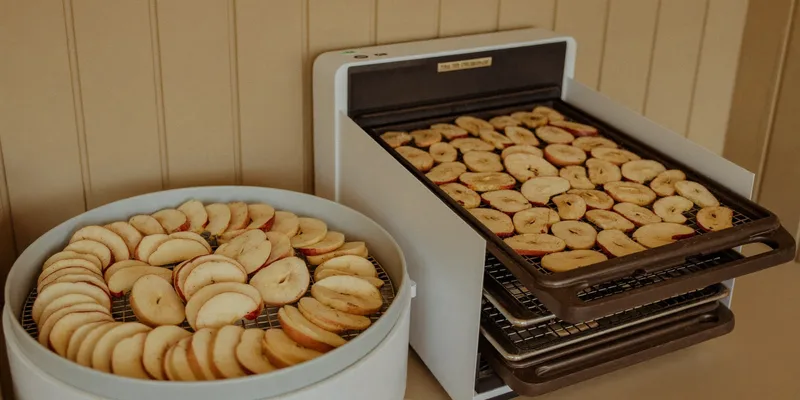
Round stacking dehydrators put the fan and element in the base or the lid, and the air travels up or down through a central column, then out through each tray. The tray closest to the fan gets the warmest, driest air. By the time the air reaches the far end it is cooler and already carrying moisture, which is exactly why the bottom or top tray finishes last.
Horizontal Airflow: Across Every Shelf
Box style units mount the fan and element in the back wall and blow air forward across the trays, more like a small convection oven. Every shelf sits in the same stream, so tray position matters far less. This is the layout that lets you dry a full load of jerky and pull it all at once.
Fix the Free Causes Before You Blame the Fan
Uneven drying is not always the machine. Four habits cause it on any layout: slices of different thickness, trays packed edge to edge, solid sheets used where mesh belongs, and a unit shoved against a wall so it cannot breathe. Correct those and judge the dehydrator afterward.
Thickness is the big one. A slice twice as thick takes far more than twice as long, so a tray with mixed thicknesses can never finish together. Cut to one thickness, leave a gap between pieces, and give the machine a hand width of clear space on every side.
One Rotation, Not Six
Even on a vertical unit, most unevenness is handled by a single swap partway through: move the tray nearest the fan to the far end and turn each tray a half turn. Rotating every hour rarely improves anything and it lets heat and moisture out each time you open the machine.
When a Rear Fan Machine Is Worth It
If you dry regularly rather than once a summer, the rear fan design pays for itself in attention rather than money. You load it, set it, and come back. Jerky is the clearest case, because a full load of strips needs consistent air on every shelf and marinated meat is the least forgiving thing to under dry.
Horizontal units are also the ones that tend to come with square trays, which fit more usable area into the same footprint than a round tray with a hole in the middle. That matters when a whole bush of tomatoes ripens at once. Our dehydrator buying guide compares capacities across both layouts.
Best if you dry big loads and want to stop rotating trays

Stainless Trays Change the Cleanup, Not the Airflow
A stainless steel tray does not dry more evenly than a plastic one, but it survives jerky marinade, scrubbing and the dishwasher for a lot longer. Owners of plastic tray units most often report warped or cracked trays after a few seasons of heavy use, which is a durability question rather than an airflow one. Our guide to stainless steel dehydrators covers that side.
Best mid size horizontal unit with steel trays

When a Vertical Stacker Is the Right Call
Vertical units earn their place on price, storage and expandability. They cost less, they nest down into a small cupboard, and most lines let you add trays as your batches grow. For herbs, apple rings and occasional fruit leather, the unevenness is a minor annoyance rather than a problem.
They also suit anyone testing whether they will actually use a dehydrator. Plenty of people buy a large box unit, use it twice, and discover the size was never the obstacle. Starting small and upgrading later is a reasonable path, and our guide to drying herbs covers the lightest use case of all.
Best expandable stacking unit for light seasonal drying

The Two Layouts Compared
Read the last column first. Neither design is wrong, they just fail in different places, and the failure that annoys you most should decide the purchase.
| Layout | Where the fan sits | Tray rotation needed | Suits |
|---|---|---|---|
| Vertical stacking | Base or lid, air up a center column | Yes, trays finish at different times | Herbs, fruit, occasional small batches |
| Horizontal box | Rear wall, air across every shelf | Rarely, one swap at most | Jerky, full harvests, regular use |
| Vertical with lid fan | Top, air pushed down | Yes, and the top tray runs hottest | Compact storage, low budget |
| Horizontal with steel trays | Rear wall, square trays | Rarely | Heavy marinade work and long term use |
Frequently Asked Questions
Why is my bottom tray still wet when the top is done? That is the signature of a vertical unit. The tray nearest the fan gets the driest air and the far tray gets air that is already carrying moisture. Swap the trays once partway through, and load every tray to the same density.
Does horizontal airflow dry faster? Not necessarily faster, but far more evenly, which usually means the whole load finishes sooner because you are not waiting on one lagging tray. Drying time is set mostly by slice thickness, load size and the moisture in the food.
What temperature should I be running? Penn State Extension suggests starting at 145 degrees F while there is surface moisture on the food, then dropping to 135 to 140 degrees F after one hour to finish drying. Meat is a separate case with its own rule, covered in our jerky dehydrator guide.
Do onions and garlic really flavor the whole batch? In a vertical unit they can, because all of the air passes through one shared column. In a rear fan box the effect is smaller but not zero. Either way, dry strong smelling foods on their own rather than alongside fruit.
Can I add trays to any dehydrator? Only where the manufacturer says so, and only up to the stated maximum. Many vertical lines are designed to expand, but adding trays beyond the limit puts the far tray outside what the fan can reach, which brings the unevenness back.
The Bottom Line
Airflow direction is the specification that decides how much attention a dehydrator demands. Horizontal rear fan units dry evenly and let you walk away, vertical stackers cost less and store smaller but ask you to rotate. Fix slice thickness and tray loading first, because those two account for a lot of what looks like a machine fault. Read next: our dehydrator buying guide for capacity, and the jerky dehydrator guide if meat is the reason you are shopping.