Last updated: August 23, 2026
The machine arrives, it goes on the kitchen counter because that is where there was room, and the first cycle teaches everyone in the house something new. It runs for a day or more at a time, the pump is not quiet, and the back of the unit puts out real heat. By batch three most owners have moved it.
None of that is a fault. A home freeze dryer is a refrigeration system and a vacuum pump running continuously for a long cycle, and it needs a spot chosen for that rather than a spot chosen for convenience. Deciding where it lives before it arrives saves a lot of shuffling.
This article contains affiliate links. If you buy through them, we may earn a commission at no extra cost to you. Learn more.
Quick Answer
Where should you put a home freeze dryer, and how loud is it?
- Owners describe the sound as a steady hum in the range of a dishwasher, running for the length of a whole cycle rather than an hour.
- Harvest Right calls for a stable, level surface with the unit raised so the drain hose can drop vertically, and warns against boxing it into a corner or a cabinet.
- Power matters. Harvest Right specifies a dedicated 15 amp circuit for small and medium units and a dedicated 20 amp circuit for the extra large.
- Harvest Right also says not to run the machine below freezing or above 90 degrees F, which rules out some garages in some seasons.
Bottom line: a heated garage, basement or utility room on a solid stand beats a kitchen counter every time.
What the Noise Actually Is
Two sources make the sound. The vacuum pump does most of it, a steady mechanical drone that continues for hours, and the refrigeration compressor and fans add a lower hum underneath. Harvest Right compares the overall level to common household appliances, and many owners run their machines overnight without complaint.
The reason it feels louder than the number suggests is duration. A dishwasher finishes. A freeze dryer cycle can run a day or longer, so a sound you would ignore for an hour becomes the background of the house. That is why placement, not soundproofing, is the real answer.
Oil Pumps and Oil Free Pumps Sound Different
An oil lubricated pump generally runs with a lower, steadier note, while oil free pumps tend to sound sharper. Neither is silent. If a quiet house matters more to you than pump maintenance, that is worth weighing before the order, and our guide to freeze dryer maintenance covers what each pump type asks of you.
Free Fixes Before You Buy Anything
Most noise complaints improve without spending. Move the machine off a hollow cabinet onto something solid, pull it away from walls so sound is not reflected back, close the door of the room, and start cycles in the evening so the loudest stretch happens while everyone is asleep.
Vibration through the floor or countertop is usually the part people can actually fix. A unit sitting on a resonant surface turns that surface into a speaker, and simply relocating it to a concrete floor stand or a heavy bench often does more than any accessory.
Do Not Box It In
Harvest Right specifically warns against putting the unit into a corner or an enclosed cabinet. Both the compressor and the pump shed heat, and an enclosure traps it, which costs performance and can shorten cycles into failures. Enclosing a machine to muffle it trades one problem for a worse one.
Get the Placement Right the First Time
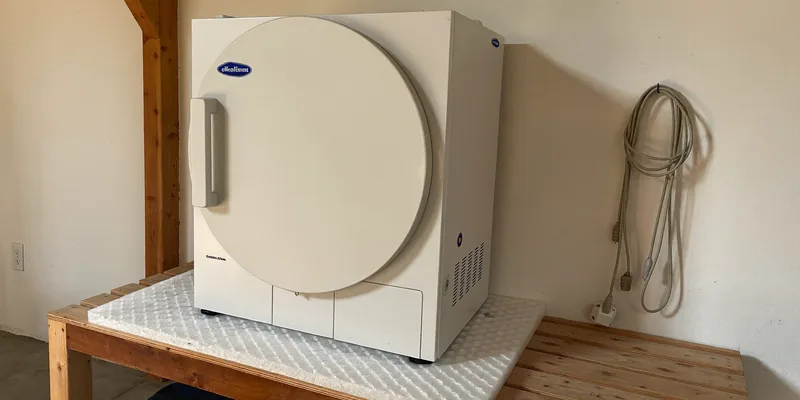
Harvest Right sets out the practical requirements: a stable, level surface, room to work around the machine, ventilation, the correct outlet, and enough height that the drain hose can drop vertically to a bucket or a drain. The company suggests the unit sit around three feet off the ground for that reason.
Height is the requirement people miss. A machine on the floor cannot drain properly, and a hose that runs uphill or kinks turns into a puddle during defrost. A sturdy rolling stand solves the height and lets you pull the unit out for pump service, which is the other job you will be doing regularly.
Best way to get the machine to drain height and still move it

Power and Temperature
Harvest Right specifies a dedicated 15 amp circuit for the small and medium machines and a dedicated 20 amp circuit with a NEMA 5-20 outlet for the extra large. Sharing a circuit with a freezer or a shop tool is how people discover their breaker trips at hour thirty of a cycle. Harvest Right also says not to operate the machine below freezing or above 90 degrees F, which is the real question to ask about an unheated garage.
Where People Actually Put Them
The table below covers the four common locations and the trade each one makes. There is no perfect room, only the one whose downside you can live with.
| Location | Works because | Watch out for | Suits |
|---|---|---|---|
| Heated garage | Noise and heat are out of the house | Winter and summer temperature limits | Most owners, in mild climates |
| Basement | Stable temperature, concrete floor | Drain routing and humidity | Year round use |
| Utility or laundry room | Drain access and a spare circuit | Space around the unit | Small and medium machines |
| Kitchen | Convenient for loading | Continuous noise and heat output | Occasional light use only |
Buying the Machine and the Accessories
Worth saying plainly: Harvest Right sells its machines mainly direct, so the freeze dryer itself is usually a purchase from the manufacturer rather than from a marketplace. What you can readily buy elsewhere is the surrounding kit, and that is where most of the setup budget actually goes.
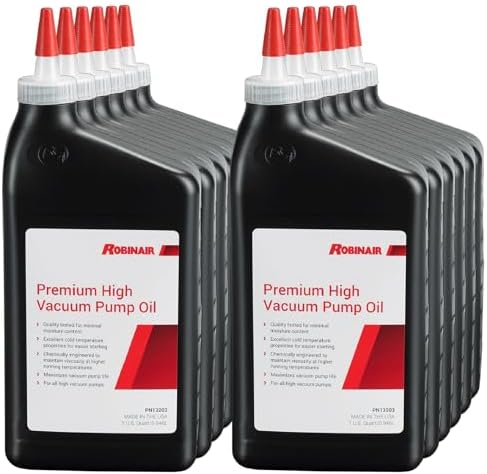
Pump oil, filters, extra trays, mylar and absorbers are all consumables you will keep buying, so it is worth setting up a supply before the first batch rather than pausing a cycle to order. Our guides to the Harvest Right range and freeze dryer trays cover what is worth stocking.
Best consumable to have on the shelf before the first cycle
Best simple way to cut vibration transfer from the stand

Frequently Asked Questions
How loud is a home freeze dryer really? Harvest Right likens it to a hum from a common household appliance such as a dishwasher, and plenty of owners run theirs overnight. The difficulty is not the level but the length, since a cycle runs far longer than a dish load.
Can I keep it in an unheated garage? Only if the garage stays inside the manufacturer’s range. Harvest Right says not to operate the unit below freezing or above 90 degrees F, so an uninsulated garage in a cold winter or a hot summer will take the machine out of service exactly when you want it.
Does it need its own circuit? Harvest Right specifies a dedicated 15 amp circuit for small and medium machines and a dedicated 20 amp NEMA 5-20 outlet for the extra large. Long extension cords are a bad idea on a load like this, so plan the outlet before delivery.
How much heat does it put out? Enough to notice in a small closed room, because the refrigeration system moves heat out of the chamber and into the space around it. That is the main argument against a pantry closet and in favor of a garage or basement.
Will a soundproof enclosure help? Not safely. Harvest Right warns against boxing the unit into a corner or a cabinet, since it needs airflow to shed heat. Distance and a solid, non resonant surface are the safe ways to reduce what you hear.
The Bottom Line
Pick the room before the machine arrives. A stable surface at drain height, clear space around the unit, a dedicated circuit and a temperature that stays inside the manufacturer’s range together solve the noise and heat complaints that fill owner reviews. The kitchen counter is the one place that almost never works. Read next: our guide to the Harvest Right range and freeze dryer maintenance for the pump routine.