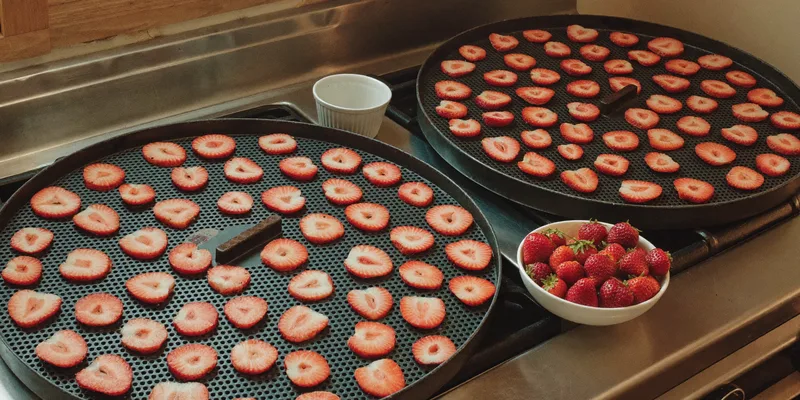
Last updated: August 23, 2026
Strawberries arrive all at once. You pick a flat at the u pick farm on Saturday, eat a quart standing over the sink, and by Wednesday the rest are going soft at the shoulders. Freezing them works, but frozen berries come out as pink slush, and the freezer is already carrying last year’s venison.
Dried strawberries solve the storage problem and turn into something the freezer never gives you: a snack that goes in a lunchbox, granola that does not need refrigeration, and a jar of berries that still tastes like June in February. The one thing that separates a good batch from a disappointing one is patience, because strawberries hold water in a way that fools people into pulling them off the trays too early.
This article contains affiliate links. If you buy through them, we may earn a commission at no extra cost to you. Learn more.
Quick Answer
How do you dehydrate strawberries?
- Hull and slice evenly. Thin slices give crisp chips, thicker slices give a chewy dried berry.
- Colorado State University Extension lists dipping strawberries in an ascorbic acid solution rather than blanching them, for 10 minutes.
- CSU Extension gives 140 degrees F for drying fruit in an oven or dehydrator.
- CSU Extension lists 24 to 36 hours of drying for strawberries, which is far longer than most first timers expect.
Bottom line: the chewy middle is underdrying, and the fix is time plus conditioning, not a hotter setting.
Pick the Berries That Dry Best
Ripe but firm is the target. Berries at peak ripeness carry the most sugar, which is what makes a dried slice worth eating, but berries that have gone soft collapse on the tray and stick to everything. Sort the flat as you hull, sending the softest ones to jam and the firm ones to the dehydrator.
Size matters less than uniformity. A tray of mixed giants and small berries finishes at three different times, and the small ones scorch while you wait for the rest. Sort by size first and slice each group to the same thickness.
Slice Thickness Decides Chip or Chew
Thin slices dry into crisp chips that snap. Thicker slices dry into a pliable, chewy berry closer to a raisin. Both are correct, they are just different products, and the mistake is aiming for chips and pulling the trays at chewy because the clock says it should be done.
Whatever you choose, cut consistently. A slicer or a steady hand and a sharp knife beat enthusiasm, because a slice that is twice as thick as its neighbor is still wet when the neighbor is finished, and that one wet slice is what spoils a sealed jar later.
Do Strawberries Need Pretreatment?
They benefit from it, and the extension guidance treats them differently from firm skinned fruit. CSU Extension lists dipping strawberries in an ascorbic acid solution for 10 minutes rather than putting them through the boiling water dip used on firm berries with waxy skins. The dip protects color and slows browning.
The mix CSU Extension gives for the ascorbic acid solution is 2 1/2 tablespoons stirred into one quart of cold water, with the fruit soaked for 10 minutes, removed with a slotted spoon and drained well before drying. A citric acid solution of 1 teaspoon per quart of water, or equal parts lemon juice and water, is the listed alternative.
If you want a fruit protector for the dip

Temperature and the Long Drying Window
CSU Extension gives 140 degrees F for drying fruit in an oven or dehydrator, and lists 24 to 36 hours for strawberries. That is the number that shocks people, because a tray of apple slices is done in a fraction of the time. Strawberries are mostly water and the sugar holds onto what is left.
Turning the dial up does not shorten it in a useful way. Higher heat sets the outside of the slice while the center stays wet, a problem called case hardening, and the sealed jar then grows mold around the one piece that was never really dry. Run the listed temperature and give it the hours.
Chips or Chewy, Side by Side
Deciding what you want before you slice saves a batch. The table lines up the two outcomes people actually aim for, plus the two mistakes that produce something nobody wanted.
| Outcome | Slice style | How it feels when done | Best use |
|---|---|---|---|
| Crisp chips | Thin, even slices, single layer | Snaps cleanly when cooled | Snacking, granola, powder |
| Chewy dried berries | Thicker slices or halved small berries | Pliable, no wet core, springs apart when squeezed | Baking, oatmeal, trail mix |
| Case hardened | Any, dried too hot | Hard shell, damp inside | Nothing, redry and condition |
| Sticky and soft | Underdried, pulled early | Tacky, clings together in the jar | Refrigerate and use quickly |
The dryness test CSU Extension gives is worth memorizing: cool the pieces first, then squeeze a handful, and if no moisture is left on your hand and the pieces spring apart when released, they are dry.
Conditioning, the Step Most People Skip
Conditioning equalizes the moisture that is left. CSU Extension has you place the dried fruit loosely in large plastic or glass containers about two thirds full, store them in a warm, dry, well ventilated place for four to 10 days, and stir or shake the containers daily. If condensation appears on the glass, the fruit goes back into the dehydrator.
Skipping it is why a jar that looked perfect in July has a fuzzy corner in September. One slightly damp slice shares its moisture with the whole jar over a few weeks, and conditioning is the cheap insurance against exactly that.
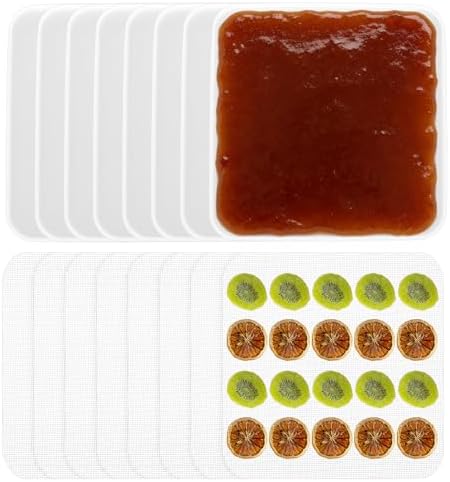
If your berries keep sticking to the tray grid
Storing the Finished Batch
Cool, dark and dry, in the smallest container that holds the batch. CSU Extension notes that properly stored dried fruits keep well for six to 12 months, and that refrigeration extends that. Air and light are what cost you color and flavor, so a full jar beats a half empty one.
Split the batch into a working jar and a storage jar. The working jar gets opened, the storage jar stays sealed until the first one runs out. Our guide to storing dehydrated food covers jars, bags and when oxygen absorbers are worth adding.
Frequently Asked Questions
How long do strawberries take in a dehydrator? CSU Extension lists 24 to 36 hours for strawberries at 140 degrees F. Thin slices land at the short end, thick slices and humid days at the long end, so plan on starting them in the morning and finishing the next day.
Why are my dried strawberries sticky? Almost always underdrying. Strawberry sugar stays tacky until the moisture is genuinely gone, and warm slices always feel softer than they are. Cool a handful, apply the CSU Extension squeeze test, and put them back on the trays if any moisture stays on your hand.
Do I have to pretreat them? Not for safety, but CSU Extension lists an ascorbic acid dip for strawberries to protect color. Untreated berries dry to a duller red and brown faster in the jar.
Can I dry whole small berries? You can, and they take considerably longer because the skin slows moisture from leaving. Halving them is the usual compromise, and it also lets you see whether the middle is really dry.
How do I turn them into strawberry powder? Dry them to a crisp chip, cool completely, then grind in a spice grinder and sieve. Powder reabsorbs moisture faster than slices, so keep it in a small sealed jar and make it in batches you will use.
The Bottom Line
Dried strawberries need three things: even slices, the ascorbic acid dip CSU Extension lists for this fruit, and the full 24 to 36 hours at 140 degrees F rather than a hotter shortcut. Condition the cooled batch for four to 10 days and it will still be red and loose in the jar next spring. If you are shopping for the machine that makes this easy, our food dehydrator buying guide starts with tray count and airflow, and trays and sheets covers the liners that keep sticky fruit off the grid.