Last updated: August 23, 2026
There is a moment in most canning kitchens where the phone stops being useful. Your hands are wet, the jars are hot, and the recipe you found this morning is buried under three tabs and a video that opens with two minutes of talking. A book stays open on the counter and does not lock its screen.
The harder question is which books. Canning is one of the few kitchen subjects where a badly sourced recipe is not just disappointing, it is a safety problem, and the shelf at the hardware store mixes tested references with picture books that were never tested at all. Here is how the four that matter differ, and which one belongs on your counter first.
This article contains affiliate links. If you buy through them, we may earn a commission at no extra cost to you. Learn more.
Quick Answer
Which canning book should you actually own?
- The USDA Complete Guide to Home Canning is the reference everything else is measured against, and the current 2015 edition is free to download from NCHFP.
- The Ball Blue Book Guide to Preserving is the counter book: cheap, compact, recipe first, replaced every few editions.
- So Easy to Preserve, sixth edition, from University of Georgia Extension is the deepest single volume and covers freezing and drying too.
- Ball’s larger hardcover recipe books are for variety once you already know the method.
Bottom line: one tested reference plus one recipe book. Anything that does not name its testing source is decoration.
Why the Source Behind the Recipe Matters
Because processing times are research results, not opinions. A canning recipe is a tested combination of food, jar size, acidity, pack style, method and altitude, and changing any one of those changes whether the process actually works. A recipe with no stated testing behind it is a guess dressed up in a nice photograph.
That is why this page keeps coming back to who tested it. The USDA guide and the university extension publications carry laboratory work behind their numbers, and Ball’s tested recipes come from the manufacturer’s own test kitchen. A general cookbook with a canning chapter usually carries neither.
The Era Problem
Plenty of family recipes describe methods current guidance calls unsafe, including open kettle canning and water bath processing of low acid food. The National Center for Home Food Preservation is explicit that low acid foods such as vegetables, meats and soups require pressure canning, and older books predate that consensus. Our water bath limits guide covers where the line falls.
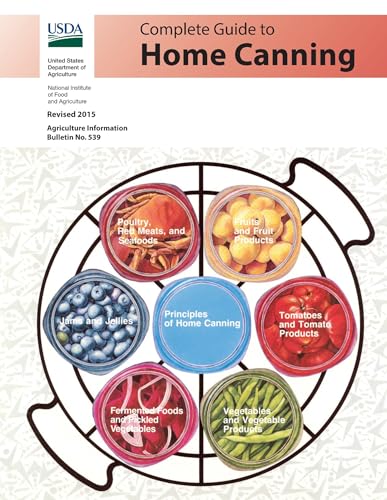
The USDA Complete Guide to Home Canning
This is the foundation document. It is the federal reference that extension services and manufacturers build on, organized by method and food rather than by menu, and the current edition dates from 2015. The National Center for Home Food Preservation hosts it as a free chapter by chapter download, which is the first thing every new canner should know.
The print situation is worth understanding before you order. NCHFP notes that the authentic spiral bound print copy is sold through Purdue Extension’s education store, and that other printed versions circulating online are third party reprints of the public domain text rather than official copies. Reprints are legal and often perfectly readable, but the quality of the printing and the binding varies, so check the listing details.
Best if you want the reference on the shelf rather than on a screen
A spiral or paperback print version of the guide lies flat on a counter, which is exactly what a PDF on a phone cannot do. Buy it as a working copy and keep the free download bookmarked as the authoritative version.
The Ball Blue Book Guide to Preserving
The little book with the blue cover next to the jars at every hardware store, and the one most American canners actually learn from. It is compact, inexpensive, recipe forward and revised across numbered editions, with recent editions in the high thirties. It covers water bath and pressure canning, pickles, jams and jellies, freezing and drying in a format built for the counter.
Its strength is also its limit. It is a recipe collection with a method section rather than a full technical reference, so it tells you what to do more than why. Paired with the USDA guide, that is a good division of labor: the guide explains the method, the Blue Book gives you something to make on Saturday.
Best if you are buying exactly one book
Start here. It is the cheapest way to get tested recipes and a jar in the canner this weekend, and the format survives a working kitchen better than a hardcover does.

So Easy to Preserve
The University of Georgia Cooperative Extension volume, in its sixth edition, reviewed and updated in 2020. At close to four hundred pages it is the deepest single book on this list, with chapters on canning, pickled products, sweet spreads and syrups, freezing and drying, and it explains the reasoning behind the processes in a way the recipe books do not.
One practical note trips people up: the extension publications store is the source for it, and listings elsewhere are often used copies or older editions, so check the edition number before buying secondhand. If your year includes canning in August, freezing in October and drying herbs in June, this is the one volume that treats all of them to the same standard.
The Ball Hardcovers and Where They Fit
Ball’s larger hardcover titles, including the Complete Book of Home Preserving and the All New Ball Book of Canning and Preserving, are variety books. They assume you already understand headspace, altitude adjustment and the difference between water bath and pressure canning, then give you several hundred recipes to spend that knowledge on. Bought as a first book they tempt a beginner into flipping straight to a recipe. Bought as a fourth book, they are the ones that get used.
Best if you have the method down and want range
A large tested recipe collection is what stops the third canning season from being a repeat of the first. Look for editions that state the recipes were tested rather than adapted.

Which Book For Which Canner
Match the book to where you are, not to the biggest table of contents. Most kitchens end up with two, one reference that answers method questions and one recipe book that gets splattered, and the table sorts the four by what each is genuinely for.
| Book | Who tested it | Strongest at | Best for |
|---|---|---|---|
| USDA Complete Guide to Home Canning | USDA, current edition 2015 | Methods, processing tables, altitude | The reference every kitchen should have access to |
| Ball Blue Book Guide to Preserving | Manufacturer test kitchen | Compact tested recipes, counter format | First book, and the one you actually cook from |
| So Easy to Preserve, sixth edition | University of Georgia Extension | Depth across canning, freezing and drying | The all methods household |
| Ball hardcover recipe collections | Manufacturer test kitchen | Recipe variety and inspiration | Experienced canners looking for range |
Edition details above come from the publishers and from the National Center for Home Food Preservation. Editions change, so check the number on the cover before buying secondhand.
Books to Be Careful With
Two categories deserve caution. General cookbooks with a preserving chapter often reproduce recipes without stating a tested source, and older reprints from before current guidance can describe practices now considered unsafe. Neither is malicious. Both put a number in front of you that nobody verified.
The tell is simple. A trustworthy canning recipe states the jar size, the headspace, the method, the processing time and the altitude adjustment, and points at where the process came from. If any of those are missing, treat the recipe as inspiration and take the process from a tested source. That is also how an inherited box of recipe cards survives: keep the seasoning, replace the method. Our canning mistakes guide covers the practices worth unlearning.
Frequently Asked Questions
Do I need a book at all if the USDA guide is free online? Not strictly, and a printed copy is still worth having. The free download is authoritative and searchable, but a screen locks, gets wet and interrupts you. Most canners use the PDF to check a process and a print book to work from.
Which Ball Blue Book edition should I buy? The most recent one you can find. Editions are numbered and revised over time, so a current copy reflects current guidance while a twenty year old one may not. When buying used, check the edition number in the listing rather than the cover art.
Is So Easy to Preserve worth it if I already own the Blue Book? Yes, if you preserve by more than one method. It goes considerably deeper on the why, and it treats freezing and drying as seriously as canning. If you only water bath jam once a year, the Blue Book is enough.
Are old canning books dangerous? Old recipes can describe methods current guidance rejects, including open kettle canning and water bath processing of low acid food. Read old books for history and flavor ideas, and take the process from a tested current source. Our safety guide explains why the distinction matters.
Which book covers pressure canning best? The USDA guide, because pressure canning is where processing tables and altitude adjustments do the heavy lifting and it carries the complete set. Use it alongside your canner’s own manual, and see our pressure canning walkthrough for the workflow.
The Bottom Line
Own one tested reference and one recipe book, and be picky about which. The USDA Complete Guide is free to download and is the document everything else defers to, the Ball Blue Book is the one that will end up sticky on your counter, and So Easy to Preserve is the upgrade if you preserve by several methods through the year. Skip anything that gives you a processing time without telling you who tested it. When you are ready to put the reading to work, start with our water bath walkthrough or, for low acid food, our pressure canning guide.