Last updated: August 23, 2026
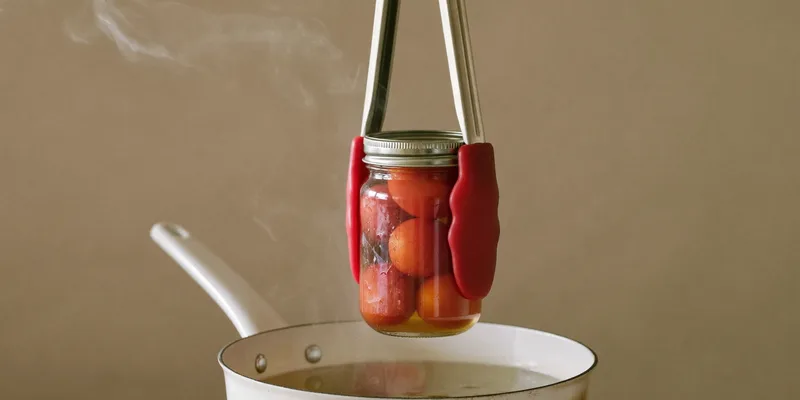
A full quart jar straight out of a boiling canner weighs a couple of pounds, is slick with water, and is hot enough that dropping it is not a small accident. Getting it out of the pot and onto a towel is the moment in a canning day where an ordinary kitchen tool is genuinely not good enough.
That is the whole reason the jar lifter exists. It is a strange looking pair of tongs with curved rubberized jaws, it does one job, and there is no honest substitute for it. The confusion is that canning tongs and jar lifters get sold under overlapping names, and only one of them is the tool that lifts jars.
This article contains affiliate links. If you buy through them, we may earn a commission at no extra cost to you. Learn more.
Quick Answer
What should you look for in a jar lifter?
- Curved jaws with a grippy coating that sit around the jar neck below the band, not on the glass shoulder.
- A strong spring, so the jaws stay closed without you clamping hard while holding a hot quart.
- Handles long enough to keep your knuckles above the steam line of the canner.
- Jaw width that fits both pints and quarts, and half gallons if you own them.
Bottom line: buy a proper jar lifter, and treat regular kitchen tongs as the thing that drops the jar.
Jar Lifter or Canning Tongs
They are not the same tool, though the names get used interchangeably online. A jar lifter has two curved arms with rubber or silicone coated jaws that wrap around the neck of a jar. Canning tongs, in the narrower sense, are straight tongs used for lifting lids, bands and small items out of hot water.
The distinction matters because a listing titled canning tongs sometimes ships straight tongs, and those cannot hold a full jar safely. Look at the picture for the curved jaws rather than trusting the title, and check that the coating is on the inside of the jaw where it grips the glass.
What Separates a Good Lifter From a Bad One
Three things, and none of them show up in a product name. The spring tension, because a weak spring means you are supplying all the grip force yourself while holding two pounds of hot glass at arm’s length. The jaw coating, because bare or slick coated metal walks on wet glass. And the jaw curvature, because a poorly shaped jaw contacts the jar in two points instead of wrapping it.
Owners who report a lifter slipping almost always describe the same combination: a light spring and a hard plastic coating that has gone shiny with use. That is worth knowing before you buy the cheapest one in the listing, since this is the tool where the failure mode is boiling liquid on a kitchen floor.
Where the Jaws Should Sit
Around the neck of the jar, just under the screw band, where the glass narrows. That is the strongest and most gripable part of the jar and it keeps the lifter clear of the lid. Gripping lower on the body of the jar means the jar can pivot, and gripping the band itself means you are trusting a band that is only fingertip tight.
Jar Lifters by Situation
The Standard Choice
A one piece steel lifter with vinyl or silicone coated jaws and coated handles, the shape that has been in canning kitchens for decades. It is simple, there is nothing to break, and the good ones have enough spring that the jaws hold themselves closed. This is the version most canning utensil sets include and it is the right default.

If You Handle Big Or Heavy Jars
Wide mouth quarts and half gallons are heavier and have a broader neck, and a lifter sized around pints will feel stretched on them. Look for a listing that names the jar sizes it fits and choose one rated for quarts at minimum. Longer handles help here too, since a taller pot means reaching further down into the steam.

The Tongs You Also Want
Straight canning tongs and a magnetic lid wand cover the small jobs the lifter cannot: fishing flat lids and bands out of hot water without touching the sealing compound, and retrieving a dropped ring from the bottom of the pot. These usually arrive as part of a utensil set rather than on their own.

Lifter Styles Compared
| Style | Grip | Handles | Best for |
|---|---|---|---|
| Classic coated wire lifter | Curved jaws, vinyl coated | Coated loops | Almost everyone, all jar sizes |
| Silicone jaw lifter | Softer grip, quieter on glass | Usually molded | Wet jars and smooth glass |
| Heavy duty wide jaw | Wider opening, stiffer spring | Long | Quarts and half gallons |
| Straight canning tongs | Not for jars | Long and thin | Lids, bands, small items |
The last row is in the table because it is the mix up that costs people a jar. Straight tongs are a lid tool, not a jar tool.
Lifting a Jar Without Losing It
Lift the jar straight up and keep it vertical. Tilting a hot jar lets water run over the lid, and worse, it can move the contents against a lid that has not sealed yet. Move it directly to a towel on the counter, set it down without sliding it, and leave a little space between jars so they are not touching as they cool.
Do not set hot jars on a cold stone or metal counter. A towel or a wooden board is the standard surface for the same thermal shock reason a rack goes in the canner, which our canning rack guide covers in full.
After the Jars Are Out
Leave them alone. Do not press the lids to check them, do not retighten the bands, and do not move them again until they have cooled. Check the seals the following day. If any did not take, our guide to jars that did not seal covers what to do next.
Frequently Asked Questions
Can I use regular kitchen tongs instead of a jar lifter? No. Kitchen tongs cannot hold a full hot quart on wet glass, and this is the one canning tool with no safe substitute. A dropped jar means boiling contents and broken glass.
How do I get jars out of hot water without dropping them? Grip around the neck below the band with a proper jar lifter, lift straight up without tilting, and move the jar directly onto a towel. Do not slide it across the counter once it is down.
What is the difference between canning tongs and a jar lifter? A jar lifter has curved coated jaws that wrap a jar neck. Canning tongs are straight and are for lids, bands and small items in hot water. Listings blur the two, so check the picture.
My jar lifter slips on wet jars, what now? Check whether the jaw coating has gone shiny and hard, which is when grip fails, and check the spring. Both are signs the lifter is done. Also make sure you are gripping the neck rather than the body.
Does a jar lifter fit half gallon jars? Some do and some do not, since the neck is wider. Check the sizes named in the listing, and if you can half gallons regularly, buy a wide jaw model rather than forcing a pint sized one.
Can jar lifters go in the dishwasher? Most coated steel lifters can, but the coating lasts longer with a rinse and a proper dry. Store it dry, since moisture sitting at the pivot is where rust starts.
The Bottom Line
A jar lifter is the one canning tool that has no workaround, and the three things worth checking are the spring tension, the jaw coating and whether it fits the largest jar you use. Buy a proper one rather than the lightest one in the listing, grip the neck below the band, lift straight up, and set the jar on a towel. Straight canning tongs and a magnetic wand handle the lids and are worth having alongside it. Next, our canning tools guide covers the rest of the short list and the canning kit guide covers buying them bundled.