Last updated: August 23, 2026
Almost everyone who shops for a chamber sealer arrives from the same direction. They have a countertop sealer that works fine on dry beans and cheese, and then they try to bag a quart of chili or a marinade for tomorrow’s venison, and the pump pulls liquid straight into the machine. After that happens twice, the word chamber starts showing up in the search bar.
VEVOR is usually the first brand that comes back, because it is the cheapest way into a chamber machine that is not a hobby project. That price is real, and so is the weight, the noise and the oil pump. This is what the listing tells you, and what it leaves for you to discover on a kitchen counter.
This article contains affiliate links. If you buy through them, we may earn a commission at no extra cost to you. Learn more.
Quick Answer
Is a VEVOR chamber vacuum sealer worth it for a home kitchen?
- Buy it if you bag liquids. Soups, brines, marinades and stock are the jobs an external sealer cannot do cleanly.
- Buy it if you seal in volume. Chamber pouches are plain smooth bags and cost far less per bag than embossed rolls.
- Skip it if you seal a few bags a month. It is heavy, loud and needs a permanent home on a counter or cart.
- Plan for maintenance. An oil pump wants clean oil and the occasional gas ballast run, which an external sealer never asks of you.
Bottom line: the DZ-260C is a volume and liquid machine. If neither of those describes your kitchen, a good external sealer is the better buy.
What VEVOR Lists for the DZ-260C
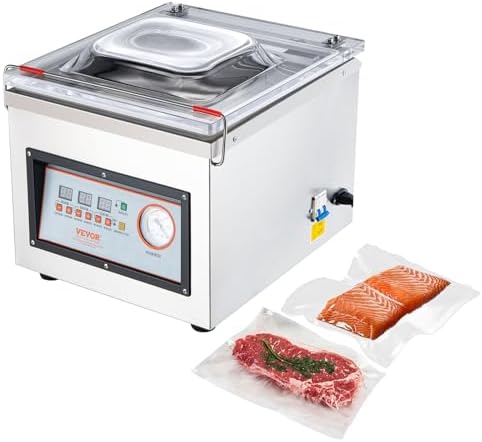
VEVOR lists the DZ-260C with a 12.6 inch seal bar, 320 watts of sealing power, a stainless steel casing and a maximum relative vacuum of minus 100 kPa. The listing gives a chamber of roughly 14 by 13.4 by 2.8 inches and a shipping weight near 61 pounds. There is also a smaller chamber model with a 10.2 inch seal bar.
Read that spec sheet for two numbers only. The seal bar width tells you the widest pouch you can lay flat, and the chamber depth tells you how tall a filled bag can stand without tipping. Everything else on the page is describing a machine that behaves the same way every chamber sealer does.
Why a Chamber Machine Handles Soup and Brine
A chamber sealer removes air from the whole box, not from inside the bag. Because the pressure drops on both sides of the pouch at once, nothing gets pulled toward the pump, and liquid stays where you put it. An external sealer works the opposite way, sucking air out through the open end, which is exactly how broth ends up inside the machine.
What Changes on the Counter
You stop freezing soup in blocks before bagging it. You stop propping bags on cookbooks at an angle so the liquid stays low. Marinades go in wet, chili goes in from the pot once it has cooled, and stock portions come out flat enough to stack in a chest freezer. That single change is why people put up with the weight.
The trade off is cycle time. A chamber machine runs a full pump down and seal cycle on its own schedule, so it is slower per bag than a countertop unit on a dry load. Ours is a volume argument, not a speed argument, and it is covered further in sealing liquids without wrecking the pump.
The Bag Cost Is the Real Argument
Chamber machines use plain smooth pouches. External sealers need embossed or channeled bags, because the texture is what gives the air a path out. Smooth pouches are simpler to make and cost noticeably less per bag, which is why a chamber sealer that looks expensive on day one can look sensible after a deer season or a garden year.
Buy pouch thickness by the job. Thinner mil suits dry goods and portioned vegetables, thicker mil suits bone in cuts and anything that will sit in a freezer for a year. Our guide to bag types, thickness and what fits which machine lines up the differences, and note that embossed rolls left over from an old sealer will still work in a chamber, just at a higher cost than they need to be.

Where the VEVOR Costs You: Weight, Noise and Oil
Three things surprise first time chamber owners. The machine is heavy enough that you will not be lifting it in and out of a cabinet, VEVOR lists noise at 70 dB or under, and the pump runs on oil that needs checking and changing. None of that is a defect. It is what an oil sealed rotary vane pump asks in return for pulling a deep vacuum.
Living With an Oil Pump
Oil turns cloudy when it takes on moisture, which happens faster if you seal a lot of wet food. Cloudy oil pulls a weaker vacuum, so owners who run the machine hard get into the habit of checking the sight glass and changing oil on a schedule rather than waiting for a bad seal to tell them. Keep a spare bottle in the cabinet so a change never turns into a delayed project.
Place the machine where it can stay. A rolling cart, a basement prep bench or a garage counter all work better than a kitchen worktop you need back for dinner. Owners who tuck a chamber sealer away in a closet almost always report that they stopped using it, which is the most expensive outcome of all.

Chamber or External: Which One Your Kitchen Needs
The honest split is by what you seal, not by how serious you are. Liquids and volume point to a chamber machine, occasional freezer portions and pantry jars point to a countertop unit, and a lot of kitchens are better served by the cheaper machine plus better habits. The table sorts it by the job in front of you.
| Setup | Handles liquids | Bag cost per seal | Best suited to |
|---|---|---|---|
| VEVOR DZ-260C chamber | Yes, straight from the pot once cooled | Low, plain smooth pouches | Soups, brines, bulk meat, sous vide batches |
| Compact VEVOR chamber, 10.2 inch bar | Yes, in smaller portions | Low, but limited pouch width | Small kitchens that still bag wet food |
| External countertop sealer | Only with pre freezing or a moist mode | Higher, embossed bags or rolls | Freezer portions, dry pantry goods, jars |
| Handheld pump and zip bags | No | Reusable bags, no heat seal | Fridge leftovers and short term storage |
If you land on the external side of that table, start with the countertop sealer guide. If you land on the chamber side but want the wider comparison first, the chamber sealer guide covers the tier above VEVOR as well.

Frequently Asked Questions
Can I use my old FoodSaver bags in a chamber sealer? Yes, embossed bags seal fine in a chamber machine. You are simply paying for a texture the chamber does not need. Most owners switch to plain pouches once the leftover rolls run out, because that is where the running cost drops.
Does a chamber sealer stop freezer burn better than a countertop model? It pulls a deeper vacuum, which helps, but freezer burn is mostly about bag quality and how tightly the seal holds over months. Thicker pouches and a clean, wrinkle free seal line matter more than the last few kPa. See sealing meat for the freezer for the details that actually change results.
How loud is it really? VEVOR lists the DZ-260C at 70 dB or below, which is in the range of a kitchen extractor on a middle setting. It is a run of ten to forty seconds per cycle rather than constant noise, but it is not a machine you use quietly at midnight in an apartment.
Is a chamber sealer safe for shelf stable storage? No, and this is the mistake that matters. Vacuum sealing slows spoilage, it does not make low acid food shelf stable, and it does not replace canning. Sealed wet food goes in the fridge or freezer. Our comparison of vacuum sealing against canning sets out where each one belongs.
Do I need special bags for sous vide? Use pouches rated for the temperature you cook at and check the listing before a long low temperature cook. Chamber pouches are a common choice for sous vide because the seal is wide and the bag is smooth. See the sous vide sealer guide.
The Bottom Line
The VEVOR DZ-260C makes sense for two kitchens: the one that bags liquids every week, and the one that seals in enough volume for cheap smooth pouches to pay back the purchase. Everyone else is better off with a countertop machine and better bags. Budget for a permanent spot, a bottle of pump oil and a habit of checking it, because a chamber sealer rewards being left out and punishes being stored away. Read next: the chamber sealer buying guide, and the countertop sealer guide if the table pointed you back that way.