Last updated: August 23, 2026
The moment that sends people looking at heavier machines is always the same. Twenty five packs into a hog, or halfway through a deer, the machine flashes a cool down light and refuses to run. The meat is out, the counter is a mess, the bags are cut and waiting, and there is nothing to do but stand there.
That is a duty cycle problem, and no amount of suction power fixes it. A household sealer is designed for a handful of bags at a time and protects itself when you ask for more. Machines built for continuous work solve it with a different motor and a cooling fan, and that is essentially the whole difference you are paying for.
This article contains affiliate links. If you buy through them, we may earn a commission at no extra cost to you. Learn more.
Quick Answer
Do you need a commercial vacuum sealer at home?
- Only if you seal in long sessions. Duty cycle, not vacuum strength, is what separates these machines.
- Look for a fan cooled motor and a listed number of consecutive seals. Silence on that spec is the answer.
- Wider seal bars matter for roasts, backstraps and whole fish that never fit household bag widths.
- Listings use commercial grade as a marketing phrase, not a certification, so read the specs under it.
Bottom line: buy this class of machine for stamina and bar width. Buy nothing for the word on the box.
What Commercial Actually Means on These Listings
Usually nothing regulated. Weston describes the Pro-2300 as commercial grade in its own listing, and that is a marketing description rather than a certification. What sits underneath the phrase can be genuinely different hardware, and it can also be a normal machine in a stainless shell, so the phrase is a prompt to read further, not a conclusion.
The specs that actually distinguish these machines are a fan cooled or continuous run motor, a stated duty cycle, a wide seal bar, and a metal body that does not flex when you close the lid. When a listing gives you those, the label is earned. When it gives you only the label, it is not.
Duty Cycle, the Spec That Decides Everything
Duty cycle is how many seals a machine will make before it needs to stop and cool. Household machines almost never publish one, and machines built for volume do. LEM lists the MaxVac 250 with a continuous run fan and roughly 250 consecutive seals, which is about two and a half hours of steady work.
Weston lists a fan cooled motor on the Pro-2300 designed for continuous repetitive use. That is the same idea stated differently. When a spec sheet is silent, assume the machine wants breaks, because thermal protection is the cheapest way to keep a small sealer alive.
What Actually Breaks Down in a Bulk Session
Three things, in this order. The motor gets hot and the machine pauses itself. The heat strip and its cover degrade faster under back to back cycles. And the foam gaskets compress and stop recovering between lids, so the vacuum gets shallower as the afternoon goes on.
The Symptom People Misread
Seals that were fine at pack five and marginal at pack thirty look like a failing machine. Usually the machine is warm and the gaskets have not recovered. If your bulk day always ends with weak seals, that is the pattern, and a machine built to run continuously is the fix rather than a repair.
Suction or Chamber at This Size
Both exist in the heavy class and they solve different problems. A heavy suction machine gives you a wide bar and a long duty cycle for dry and semi dry packs. A chamber machine gives you liquids and cheaper pouches, and it costs you counter space and weight.
For a hunter or a household processing a bulk meat order, a heavy suction machine is usually the right call, because the food is not liquid and bag width matters. For anyone also putting up stock, brine or sauce, the chamber route is worth the space it takes.
The Machines People Actually Buy for Volume
Four choices cover the range, from a heavy suction sealer to a chamber machine that home butchers use. Match to the widest cut you pack and the longest session you run.
If You Want the Widest Bar in a Suction Machine
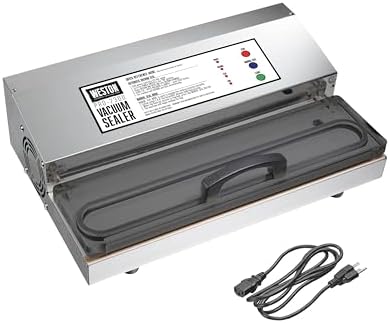
Weston lists the Pro-2300 in stainless with a double piston pump, a 15 inch seal bar with an extra wide 5mm heat element, LED stage indicators, an automatic mode and a manual seal mode for controlling pressure on soft items. The fan cooled motor is the part that matters for a long day.
If You Process Game Every Season
LEM lists the MaxVac 250 with a 13.39 inch seal bar, a continuous run fan, a stainless body, an integrated roll holder and cutter, a one handed locking lid, and both automatic and manual modes so you can dial back the vacuum on delicate cuts. It is aimed squarely at hunters and home processors.

If You Want Programmable Control for Repeat Packs
Weston lists the Pro 3000 with a 935 watt motor, an extra wide bar for bags up to 15 inches and programmable LED controls, which is useful when you are running the same pack size dozens of times and want the cycle identical each time.

If Liquids Are Part of the Volume
VacMaster lists the VP215 with a 10.25 inch removable seal bar with a double seal wire, a digital control panel and a heavy duty oil pump. It is the chamber machine that turns up in home butchery setups, and it handles stock and brine that a suction machine cannot.
Heavy Machine Against a Household One
The gap is narrower than the marketing suggests on vacuum and wider than most people expect on everything else. The table sorts what changes in practice.
| Factor | Heavy duty machine | Household machine | Matters when |
|---|---|---|---|
| Consecutive seals | Fan cooled, often a listed figure | Thermal pause after a handful | Processing a whole animal |
| Seal bar width | Wide enough for roasts and loins | Usually caps near 11 inches | Large cuts and whole fish |
| Serviceability | Replaceable strips and gaskets | Often replace the machine | Long ownership |
| Storage | Heavy, stays where you put it | Fits in a cabinet | Small kitchens |
Serviceability is the underrated row. A machine whose seal strip, cover tape and gaskets are sold as parts can be kept running for years, which is the difference between a tool and an appliance.
Who Should Not Buy One
Anyone whose complaint is seal quality rather than session length. Weak seams on a household machine are usually moisture in the seal line, a short bag tail or tired gaskets, and all three are cheap to fix. Work through the troubleshooting sequence before spending, because a bigger machine repeats the same failure faster.
Also worth pausing if your food is mostly wet. A heavy suction machine still pulls liquid toward the pump, and the workarounds in the liquid guide apply at any size. Volume plus liquid points to a chamber machine, not to a bigger suction one.
Frequently Asked Questions
Will a heavy machine make my seals stronger? Sometimes, mostly through a wider heat element and a double seal. It will not fix moisture in the seal line, which is the usual cause of a failed seam on any machine.
Do these use special bags? Heavy suction machines still use embossed bags, just wider ones. Chamber machines use smooth pouches. The formats are covered in the bag guide.
How much space do I need? More than you think, especially in depth. Measure the counter before ordering, and remember you also need room to lay a full bag flat in front of the bar.
Are they loud? Louder than a household machine, and the fan runs on after the cycle on some models. That is the cooling working, and it is why these often live in a garage or a basement prep area.
Is a used commercial machine a good buy? It can be, if the seal strip and gaskets are available as parts for that model. Check parts availability before the price, because an orphan machine is a heavy paperweight.
The Bottom Line
Buy this class of machine for stamina and bar width, and for nothing else. If your sessions end early because the machine needs to cool, a fan cooled motor with a published duty cycle solves it, and a wider bar means roasts and loins stop dictating how you butcher. If instead your problem is a seam that fails on a handful of packs, that is a technique and gasket issue and a heavier machine will reproduce it faithfully. Read the specs under the word commercial, since the phrase is marketing on most listings and the hardware beneath it varies a great deal. Read next: what a full freezer of meat needs and when a chamber machine is the better heavy buy.