Last updated: August 23, 2026
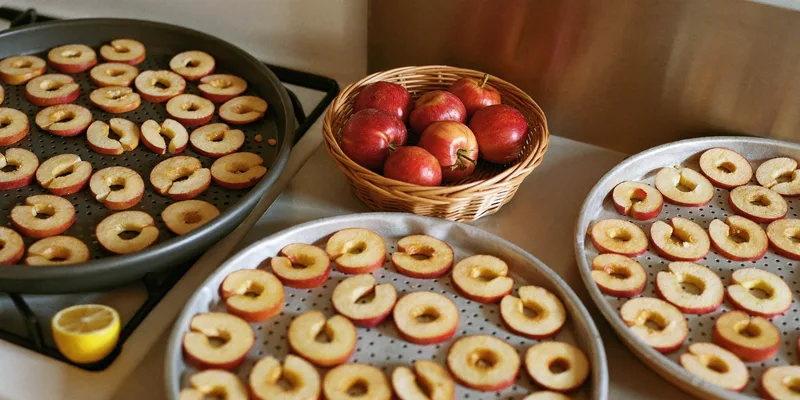
Apples are the crop that turns a curious buyer into a regular dehydrator user. A single tree, a neighbor with a tree, or a fall bulk box gives you far more fruit than anyone can eat fresh, apples slice fast, and dried rings keep in a jar all winter. It is the easiest crop to start with and the one where the first batch usually looks disappointing.
The disappointment is nearly always color. The rings go into the machine pale and come out the shade of weak coffee. Nothing is wrong with them, but they do not look like the ones in the store, and that has a straightforward cause and an equally straightforward fix that happens before the dehydrator is even switched on.
This article contains affiliate links. If you buy through them, we may earn a commission at no extra cost to you. Learn more.
Quick Answer
What do you need to dry apples well?
- An ascorbic acid dip before drying. This is the whole answer to brown apple rings.
- Even slices. A mandoline or a peeler corer slicer keeps every ring the same thickness, which is why some batches finish together and others do not.
- Enough tray area, because apples cannot overlap and a bushel fills more shelves than you expect.
- A thermostat you can trust at the fruit setting your extension service publishes.
Bottom line: pretreatment and slice consistency matter more than which dehydrator you buy.
Why Apples Turn Brown, and the Dip That Stops It
Cut apple flesh browns because enzymes in the fruit react with oxygen. Heat does not prevent it and neither does speed. An ascorbic acid dip does, because the vitamin C reacts with the oxygen first, and it is the pretreatment extension services publish for exactly this purpose.
Colorado State University Extension gives the mix as 2 and a half tablespoons of pure ascorbic acid crystals stirred into one quart of cold water, or 3 and three quarter teaspoons per 2 cups for a smaller batch. Slice into the solution, let the rings sit briefly, then drain and load.
Lemon Juice and the Alternatives
Lemon juice works to a degree because it contains ascorbic acid, but far less of it per spoonful than the crystals, so the effect is weaker and the flavor carries over. Commercial produce protector powders are ascorbic acid based and sold for this job. Follow the mixing directions on whichever product you use rather than guessing.

Slice Thickness Decides Everything Else
Uniform slices dry together. Mixed slices mean pulling the thin ones out early while the thick ones stay leathery, and most people do not bother, so the whole tray ends up either underdried or overdried. Consistency is worth more than any setting on the machine.
Colorado State University Extension notes that at a drying temperature of 140F, thin apple slices take roughly 6 hours while dense fruit such as peach halves can take up to 36. That spread between thin and thick is exactly why a mandoline or a crank peeler beats a knife on a bushel day.
Peel or Not
Both work. Peeled rings dry a little faster and have a softer texture. Unpeeled rings keep more color at the edge and hold their shape better. If you are running the fruit through a crank peeler corer slicer, peeling costs you nothing extra, and that tool is the reason a bushel becomes a two hour job.
Which Dehydrator Handles an Apple Harvest
Apples need tray area more than anything else, because rings must lie flat in a single layer. A machine that handles a dozen sliced apples comfortably will need four runs for a bushel, and that is the difference buyers notice in October rather than in the listing.
Best If You Have One Tree and a Kitchen Counter
A compact stainless unit with a digital thermostat covers a steady supply of fruit without dominating the counter. Cosori lists its premium six tray model with stainless steel trays and a digital temperature control, which is the setup that makes it easy to hold a fruit temperature over a long run.

Best If You Bring Home Bushels
A nine tray box dehydrator with a rear mounted fan doubles your tray area and dries every shelf without rotation. Excalibur lists the 3926TB with nine trays and a built in timer. For an orchard year, that timer plus the extra shelves is the difference between one long evening and three.
Best If You Want the Classic Stackable
Round stackable units still make excellent apple chips and store in a cupboard. Nesco lists the Snackmaster Pro FD-75A with an adjustable thermostat and expandable trays. The trade is airflow, since vertical designs need tray rotation, which matters more on a long fruit run than on herbs.

Knowing When Apples Are Done
Dried apple slices should feel pliable and leathery with no visible moisture when you tear one, and a piece squeezed in the hand should spring apart rather than stick together. Crisp chips are a different target and need longer, at the cost of some flexibility.
Always test a cooled piece. Warm fruit straight off the tray feels softer than it will be at room temperature, which is why so many batches get overdried by people checking them hot. Pull one ring, let it sit for a few minutes, then judge.
| Goal | Slice thickness | Texture when done | Best for |
|---|---|---|---|
| Snack rings | Medium, even | Pliable, leathery, no wet spots | Lunchboxes, trail mix |
| Apple chips | Thin, uniform | Snaps cleanly when bent | Crisp snacking, shorter storage |
| Baking and cooking | Medium to thick | Leathery, rehydrates well | Pies, oatmeal, sauce |
| Long term storage | Medium, even | Fully dry after conditioning | Jars and sealed pantry stock |
Conditioning Before the Jar
Conditioning evens out the moisture left in a batch so no single piece can spoil the jar. Colorado State University Extension describes placing cooled dried fruit loosely in large containers about two thirds full, storing them in a warm dry ventilated place for four to 10 days, and shaking daily to separate the pieces.
If condensation appears on the inside of the container during those days, the batch is not dry enough and goes back into the dehydrator. Once conditioning is clean, move the fruit into sealed jars. Our guide to storing dehydrated food covers jars, sealers and desiccants.
The Best Apples for Dehydrating
Firm and sweet is the whole rule. Fuji, Gala, Honeycrisp and Braeburn dry into rings that hold their shape and taste like concentrated apple. Granny Smith works if you like the tartness, since drying sharpens it rather than softening it, and soft watery apples such as McIntosh collapse into limp pieces.
Sweetness counts for more than people expect, because drying removes water and leaves everything else behind, so a bland apple dries into a bland chip and a sharp one dries into a sour one. Storage apples that have sat in the crisper for weeks are worth using up this way, since they are past their best raw and the texture problem disappears once the water goes. If you have a mixed box, sort it by firmness and run separate loads, because a tray holding both Honeycrisp and McIntosh will never finish evenly.
Frequently Asked Questions
My dried apples went brown, are they still good? Yes. Browning is an enzymatic color change, not spoilage, and the fruit is fine to eat. It is a cosmetic problem with a cosmetic fix, which is the ascorbic acid dip before drying rather than anything you do during the run.
Do I have to peel apples before drying? No. Skins are edible and help rings hold their shape. Peel if you prefer a softer chip or if you are running fruit through a peeler corer slicer anyway, since the tool does it in the same pass.
Which apple varieties dry best? Firm, sweet varieties hold their shape and concentrate well, while very soft or very watery apples collapse into limp pieces. If you have a mixed box, dry them in separate loads by firmness so the trays finish at the same time.
How long do dried apples keep? That depends on how dry they are and how they are stored, so treat published figures with care. What you control is drying them fully, conditioning them as your extension service describes, and keeping them sealed, cool and dark.
Can I dry apples in the oven? Only if your oven holds a low enough temperature, and most cannot. The other issue is airflow, since an oven without a fan traps humidity. A dehydrator holds the temperature and moves the air, which is why the results are consistent.
The Bottom Line
Dry apples well by fixing the two things that happen before the machine runs: dip the slices in an ascorbic acid solution using the ratio your extension service publishes, and cut every ring to the same thickness so the tray finishes together. After that, buy tray area to match your harvest, test a cooled piece rather than a warm one, and condition the batch before it goes in jars. Read next: choosing the dehydrator and how to store what you dried.