Last updated: August 23, 2026
Garlic is the crop that runs out of patience before you do. A braid that was perfect in October is sprouting by February, and the cloves at the center of the head have gone hollow and papery. Drying is the answer that costs you nothing but an afternoon and a machine you already own, and it converts a shelf of heads into two small jars.
The gear side of this job has three parts: getting the cloves peeled and sliced without spending all day at it, keeping the small pieces out of the fan, and dealing with the smell, which is stronger than onion and lives in plastic trays for weeks. Below is what the extension guidance specifies for drying, plus the honest version of what home made garlic powder is like.
This article contains affiliate links. If you buy through them, we may earn a commission at no extra cost to you. Learn more.
Quick Answer
How do you dehydrate garlic?
- Peel and slice the cloves thin and even. Penn State Extension lists garlic among the vegetables that do not need blanching.
- Montana State University Extension puts the optimum drying temperature for food at 140 degrees F and warns that hotter cooks rather than dries.
- Use a fine mesh liner so slices do not drop through the tray, and run the machine away from living space.
- Dry until the slices snap, then store sealed and grind to powder only as you need it.
Bottom line: no blanching, thin even slices, a mesh liner, and somewhere to put the machine where the smell does not matter.
Peeling Is the Real Work
Everything else about drying garlic is quick. Peeling a few pounds of cloves is not, and it is the reason most people do this once and then decide it was not worth it. Two techniques cut the time down: the bowl shake, where cloves go between two bowls and get rattled hard, and a firm press with the flat of a knife to crack the skin.
Separate the heads first and discard any clove that is soft, hollow or has a dark spot. A sprouted clove is fine to dry, though the green shoot is bitter and worth pulling out if the batch is going to be powder rather than flakes.
Slice Thin, Slice Even
Thin slices dry faster and grind more cleanly. Uneven slices are the reason a batch has both scorched crisps and pieces that never quite finished. Cut lengthwise through the clove rather than crosswise for pieces that lie flat on the tray, and keep the thickness consistent across the load.
No Blanching, Moderate Heat
Penn State Extension lists onions, garlic, peppers and herbs as the vegetables that do not need blanching before drying, which makes garlic one of the simplest things in the machine. There is no dip, no pretreatment and no color to protect.
For heat, Montana State University Extension puts the optimum temperature for drying food at 140 degrees F, warning that higher temperatures cook the food instead of drying it and increase the likelihood of molding later. Garlic browns easily, so this is not a case where a little extra heat is harmless. Brown slices taste bitter and the bitterness carries through into the powder.
Judge It Cool, Not Warm
Montana State University Extension describes dried vegetables as tough, brittle or crunchy when done. Garlic should snap cleanly rather than bend. Take a slice out, let it sit for a minute, and try it, because a warm slice always feels softer than it is and pulling the batch early is what ruins the storage life.
Trays, Liners and the Smell
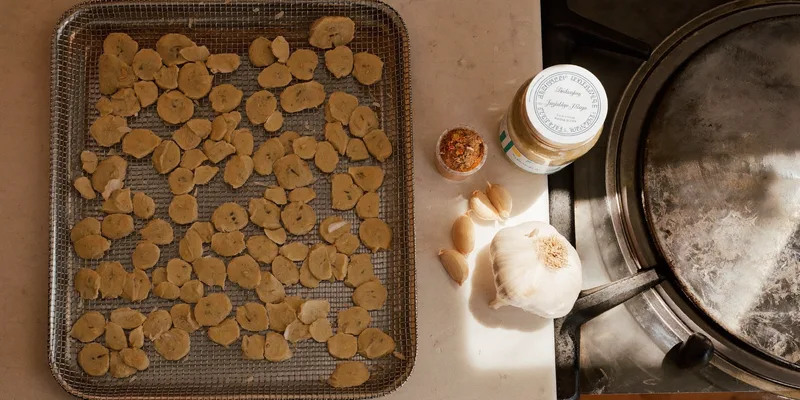
Garlic slices shrink considerably and small pieces drop through standard tray slots into the fan housing. A fine mesh liner over each tray solves it, and it also makes unloading a lot easier, since you can lift the whole liner rather than picking slices off one at a time.
The smell is the part nobody warns you about. It is stronger than onion, it fills a house, and it lingers in plastic trays and hands itself to the next batch. Run the machine in a garage, on a covered porch, in a basement or in a utility room with the door shut. There is no product that removes this, because the machine works by blowing warm air through the food and out into the room.

Stainless Trays Do Not Hold It
If garlic and onion are a regular job rather than an annual one, stainless steel trays are the upgrade that actually pays back. Plastic absorbs the compounds and gives them back to a load of apple rings months later. Our guide to stainless steel dehydrators covers which machines ship with steel and which sell it as an accessory.
Flakes, Minced and Powder
Dried garlic ends up as one of three products, and the difference is what you do after the machine rather than during. Powder is the most convenient and the most trouble to store, and flakes are the opposite. The table sorts them out.
| Form | How you get it | What it suits | Storage behavior |
|---|---|---|---|
| Slices or chips | Dry whole slices to brittle | Stocks, roasts, infusions | The most stable form, keeps best |
| Minced | Break dried slices coarsely | Rubs, dressings, camp meals | Good, slightly more surface area |
| Powder | Grind fully dried slices | Seasoning blends, gravies | Clumps readily, needs a small sealed jar |
| Garlic salt | Blend powder with salt | Table seasoning | Salt helps, but still absorbs moisture |
Grinding Powder Without the Brick
Home made garlic powder sets into a solid lump more often than any other home ground spice, and the reason is almost always moisture. Either the slices were pulled before they were truly brittle, or the jar is sitting somewhere humid, or both. Commercial powder contains anti caking agents and yours does not.
The practical fix is to grind small. Keep the bulk of the batch as dried slices, which handle humidity far better, and grind a few weeks worth at a time into a small sealed jar with a desiccant packet. Our guide to storing dehydrated food covers conditioning, desiccants and why small jars beat one big one.

One Thing Drying Does Not Solve
Dried garlic is shelf stable in a way fresh garlic is not, and it is tempting to extend that thinking to garlic in oil. Do not. The National Center for Home Food Preservation states that mixtures of garlic in oil stored at room temperature are at risk for the development of botulism, and gives refrigerated storage at 40 degrees F or lower for no more than 4 days, or freezing for up to several months.
That applies to garlic infused oils made at home regardless of whether the garlic went in fresh or roasted. If you want a shelf stable garlic product, dried slices and powder are it. Our guide to storing garlic covers the safe handling in full, along with curing and cold storage for the heads you are not drying.
Frequently Asked Questions
Does garlic need blanching before dehydrating? No. Penn State Extension lists onions, garlic, peppers and herbs as the vegetables that do not need blanching, which makes garlic one of the easier things to dry.
What temperature should I dry garlic at? Montana State University Extension puts the optimum drying temperature for food at 140 degrees F and warns that higher temperatures cook rather than dry, raising the chance of molding. Garlic browns easily, so do not push it.
Why does my garlic powder go hard in the jar? Moisture, from slices that were not fully brittle or from a humid storage spot. Grind small amounts, keep the rest as slices, use a small sealed jar and add a desiccant packet.
How do I stop the house smelling of garlic? Move the machine to a garage, porch, basement or utility room with the door closed. A dehydrator vents warm air into the room by design, so there is no filter or setting that prevents it.
Can I dry garlic in the same load as fruit? No. Garlic perfumes everything drying alongside it and the trays hold the smell afterward. Keep alliums to their own runs and wash the trays promptly.
Is dried garlic as strong as fresh? It is different rather than weaker. Drying softens the sharp raw bite and brings out a rounder, toastier flavor, so dried garlic is not a straight substitute in dishes where raw garlic is the point.
The Bottom Line
Peel efficiently, slice thin and even, skip the blanching, and dry at the temperature the extension guidance gives until the slices snap. Keep most of the batch as slices and grind powder in small amounts, because powder is the form that fights you in storage. For the machine, our food dehydrator buying guide covers capacity and airflow, and the stainless steel dehydrator guide covers the trays that do not keep the smell.