Last updated: August 23, 2026
The twenty five pound bag was a bargain, and eight months later it smells musty, or there are small brown beetles walking around the pantry shelf, or the paper sack has split and half of it is in the bottom of the cupboard. Rice is one of the cheapest things to store and one of the easiest to lose.
Stored properly it is also one of the best performers in a home pantry. Utah State University Extension states that when properly sealed and stored, polished white rice will store well for twenty five to thirty years. The gap between eight months and thirty years is entirely about packaging and temperature.
This article contains affiliate links. If you buy through them, we may earn a commission at no extra cost to you. Learn more.
Quick Answer
How do you store rice long term?
- Use white rice for the long haul. USU Extension puts properly sealed and stored polished white rice at twenty five to thirty years.
- Package it in a real barrier. USU Extension lists food safe plastic containers, glass jars, lined number ten cans and mylar type bags as what works.
- Add a food safe oxygen absorber. USU Extension recommends them to preserve quality and protect against insect infestation.
- Keep it cool. USU Extension gives 40 degrees F or below as the best storage temperature for grains, and notes that rice held at a constant 70 degrees F with oxygen absorbers stores well for up to ten years.
Bottom line: white rice, mylar with an absorber, inside a food grade bucket, somewhere cool and dark.
What Actually Ruins Stored Rice
Three things end a bag of rice: insects, moisture and oxygen. Insects usually arrive in the grain rather than crawling in later, moisture lets mold take hold and makes rice smell musty, and oxygen slowly degrades quality and lets any eggs present develop. Everything in this guide targets one of those three.
A paper sack or the original plastic bag resists none of them, and a pantry shelf that warms up every time the oven runs makes all three worse. That combination is why so much bulk rice never makes it to its second year.
White Rice and Brown Rice Are Not the Same Project
Polished white rice has had the bran and the oil removed, which is exactly why it stores for decades. Brown rice keeps its oil, and oil goes rancid regardless of how airtight the container is. Treat brown rice as a refrigerator or freezer item bought in smaller quantities, and keep the long term plan for white.
The Packaging That Works
USU Extension lists the containers suited to long term storage: food safe plastic (PETE) containers, glass jars, number ten cans with a food grade enamel lining, and mylar type bags. What these share is a genuine barrier against moisture and, in the case of mylar and cans, against light and air as well.
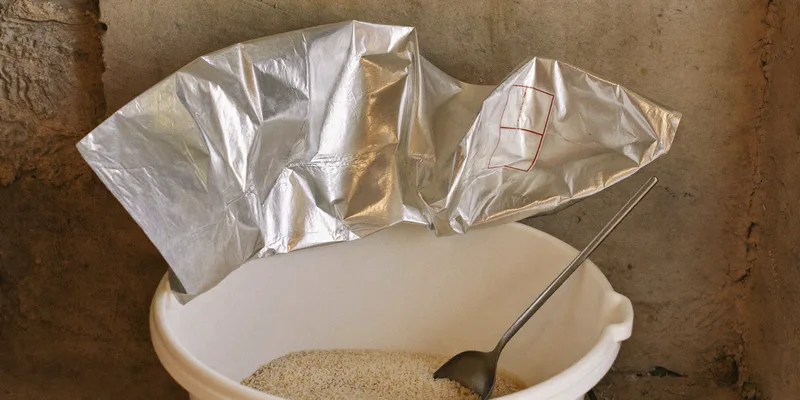
For home use, the common setup is a mylar bag inside a food grade bucket. The mylar does the sealing work and the bucket takes the abuse, keeps rodents out, and stacks. Thickness matters more than people expect, since a thin bag punctures on the grain itself when you move it. Our guide to mylar bags works through the thickness question in detail.
Best barrier for a bucket sized portion

The Bucket Is the Armor, Not the Seal
A bucket on its own is not an oxygen barrier and its lid gasket is not a long term seal. Use a food grade bucket with a lid you can actually open again, and treat it as the outer shell around the mylar rather than the storage container itself. Our guide to food storage buckets covers grades and lid types.
Best outer container for stacking and rodent protection

Oxygen Absorbers and How to Size Them
An oxygen absorber is a small sachet of iron powder that pulls the remaining oxygen out of the sealed bag. USU Extension recommends food safe oxygen absorbers to preserve rice quality and to protect against insect infestation, and the second half of that is the part people underrate.
Size the absorber to the air volume in the bag rather than the weight of the food, and err upward, because too much capacity does no harm and too little does. Keep unused absorbers in an airtight jar, since an open packet on the counter is spent within hours. Our absorber guide has the sizing detail.
Best absorber stock for bucket and jar sized batches

The Workflow, Start to Finish
Line the bucket with the mylar bag, pour in the rice, and tap the bucket to settle it. Drop in the correctly sized absorber, press the air out of the bag by hand, and seal the top with a hot iron or an impulse sealer in one pass. Fold the sealed top over, fit the lid, and label the bucket with the contents and the date.
Come back the next day and look at the bag. A properly sealed bucket with a working absorber shows the mylar drawn in tight against the rice, which is the visible confirmation that the seal held. A bag that is still loose means either the seal or the absorber failed, and it is far better to find that out on day two than in year five.
Where the Buckets Live
USU Extension gives 40 degrees F or below as the best storage temperature for grains, while noting that rice stored at a constant 70 degrees F with oxygen absorbers will store well for up to ten years. Most homes cannot manage the first figure, so the practical goal is the coolest, most stable place you have. A basement beats a garage, and an interior closet beats an exterior wall.
Container Options Compared
The table sets out the realistic choices. Notice that convenience and duration pull in opposite directions, which is why many pantries run two systems at once.
| Container | Protects against | Best for | Watch out for |
|---|---|---|---|
| Mylar in a bucket | Light, air, moisture, rodents | Decade scale storage | Opening it commits you to the whole bag |
| Glass jars with sealed lids | Moisture, insects, some air | Kitchen quantities in rotation | Light, so keep them in a dark cupboard |
| Number ten cans | Light, air, moisture, pests | Portions you open one at a time | Needs a canner or a purchased pack |
| Original bag on a shelf | Very little | Rice you will use within months | Insects and humidity |
Frequently Asked Questions
How long does white rice really last? USU Extension states that properly sealed and stored polished white rice will store well for twenty five to thirty years, and notes that rice held at a constant 70 degrees F with oxygen absorbers stores well for up to ten years. Cooler storage is what buys the longer end of that range.
Can I store brown rice the same way? No. The oil in the bran goes rancid no matter how good the seal is, so brown rice belongs in smaller quantities in the refrigerator or freezer. Save the mylar and bucket routine for white rice, which has had that oil removed.
Do I need both a vacuum sealer and oxygen absorbers? Not usually. For dry staples, a sealed mylar bag with the right absorber does the job, since the absorber removes the oxygen the pump cannot reach. Vacuum sealing suits kitchen quantities and jars, as our guide to jar sealing dry goods covers.
Will freezing the rice first kill any insects? It deals with what is already in the grain, which is a reasonable precaution with bulk purchases. University of Minnesota Extension advises freezing at 0 degrees F for at least four days to kill eggs and insects, and the food must be fully dry and at room temperature again before it is sealed.
What if the mylar bag never pulls tight? Either the seal has a gap or the absorber was already spent. Reseal the bag with a fresh absorber, and check your storage jar of unused absorbers, since a poorly closed jar exhausts the whole batch.
The Bottom Line
White rice, a heavy mylar bag with a correctly sized oxygen absorber, a food grade bucket around it, and the coolest dark corner you have. That is the whole system, and USU Extension’s twenty five to thirty year figure applies to rice stored that way rather than to rice in the sack it came in. Read next: our mylar bag guide and oxygen absorber sizing before you buy either.