Last updated: August 23, 2026
Two complaints come up every August, and they are the same complaint. The sauce is thin and watery, and it is full of seeds and curls of skin. People blame the tomatoes, then the recipe, then the pot, and cook it down for another two hours hoping the texture will sort itself out.
It will not, because a blender cannot fix either problem. Blending chops the skins and seeds finer and whips air into the sauce, and it releases the water held in the flesh rather than separating it. A food mill takes a different approach: it pushes the pulp through a perforated disc and keeps the skins, seeds and cores on the other side. That one mechanical difference is the whole reason the tool still exists.
This article contains affiliate links. If you buy through them, we may earn a commission at no extra cost to you. Learn more.
Quick Answer
Which food mill should you buy for canning season?
- Stainless steel over plastic if tomatoes are the main job. Acid and heat are hard on plastic hoppers and cheap coatings.
- Three interchangeable discs, fine, medium and coarse. Fine for sauce and jelly, coarse for chunky applesauce.
- A hopper big enough for your batch. Small mills turn a bushel into an afternoon of refilling.
- Step up to a crank strainer or an electric one once you are processing bushels rather than bowls.
Bottom line: a stainless mill with three discs handles a household harvest. Volume is what justifies a strainer.
How a Food Mill Fixes Thin, Seedy Sauce
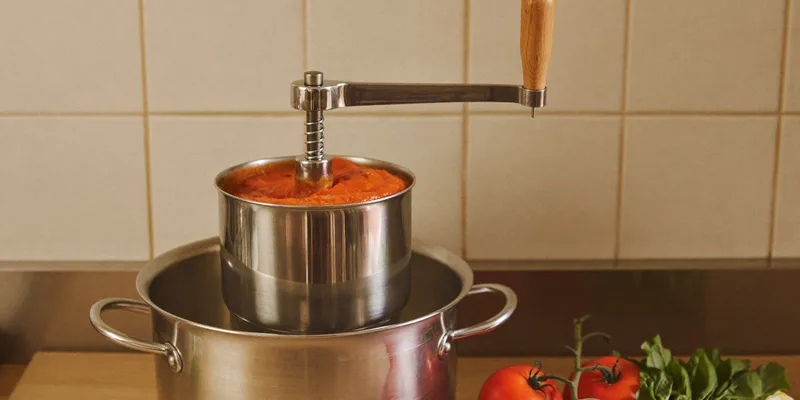
A food mill is a bowl with a perforated disc in the bottom and a curved blade on a crank that sweeps across it. Soft cooked food gets forced through the holes, while skins, seeds, cores and fibers stay behind and collect under the blade. You end up with pulp on one side and waste on the other, no peeling and no seed straining.
The texture change is immediate. Sauce comes out smooth and slightly thicker than the blender version, because you have removed the skins and seeds rather than pulverized them, and you have not beaten air into it. It still needs reducing on the stove, but it starts from a much better place.
Why Not Just Use a Blender
A blender is the right tool when you want everything in the jar. For tomatoes it grinds the seeds, which adds bitterness, and it emulsifies the skins into flecks that never look right. For apples it means peeling first. The mill exists to separate rather than to chop, and nothing in a modern kitchen has replaced it.
Discs, and Which One You Will Actually Use
Most mills ship with three discs. The fine disc gives smooth sauce, purees and seedless jelly pulp. The medium is the everyday choice for tomato sauce and applesauce. The coarse leaves texture, which suits rustic applesauce, chunky potato dishes and berry pulp where you want body.
In practice most people use the medium for nearly everything and the fine for jelly. Buy the three disc version anyway, because the fine disc is what turns a berry harvest into seedless jam pulp and there is no substitute for it.

Stainless or Plastic, and Size
Tomatoes are acidic and hot, which is hard on plastic. Stainless mills clean up better, do not stain, and take the leverage of a full hopper without flexing, which is where cheap plastic bodies fail. Plastic mills are lighter and fine for occasional applesauce, and they are the ones owners most often report cracking at the leg or the crank mount.
Size is the other half. A small mill is pleasant for a bowl of apples and miserable for a bushel of tomatoes, since you spend the afternoon topping it up and scraping the disc. If canning season means crates rather than bowls, buy the biggest hopper you can store.

Legs, Grip and the Bowl Underneath
Look at how the mill sits on the pot. Three legs that span a wide stockpot are more stable than two hooks, and a mill that slides while you crank is a mill you will fight. A rubberized grip on the legs helps on a slick stainless rim, and a hook or a wide flange keeps it from tipping when the hopper is full.
When to Step Up to a Strainer
A food mill is a hand tool sized to a household. Once the garden is producing crates, the crank strainer with a screw auger takes over, because it separates skin and seed continuously and you feed it whole cooked tomatoes rather than working in batches. It clamps to the counter and empties waste out one chute and pulp out another.
Applesauce is where people feel this most. Making sauce by the gallon with a hand mill is genuinely hard work, which is the complaint behind most upgrades. A crank strainer halves the effort, and an electric strainer removes it entirely at the cost of storage space and a motor to look after.

The Electric Option
Electric strainers are the answer for a serious orchard or a market garden, not for a household with one tree. They are heavy, they need a counter run, and they are worth it when you measure the harvest in bushels. If you make applesauce two weekends a year, put the money into a bigger hand mill and a second pot instead.

Which Tool for Which Batch
The table lines up the three tiers against the batch size they suit and the trade off. Capacities are the practical ones for a home kitchen rather than a manufacturer rating.
| Tool | Batch it suits | What it does well | Trade off |
|---|---|---|---|
| Hand food mill | Bowls to a half bushel | Sauce, applesauce, jelly pulp, potatoes | Refilling and arm work at volume |
| Crank strainer | Bushels | Continuous feed, separates as it goes | Clamps to the counter, more to clean |
| Electric strainer | Repeat bushels | Removes the effort entirely | Storage space and a motor to maintain |
| Blender or sieve | Small, occasional | Already in the kitchen | Grinds seeds, keeps skins, thins the sauce |
Beyond Tomatoes
The mill earns its shelf space the rest of the year too. Applesauce without peeling, seedless raspberry and blackberry pulp for jam, pumpkin and squash puree for the freezer, mashed potatoes without gluey overworking, and baby food. Anything soft enough to push through a hole and awkward enough to have skins or seeds is mill work.
Once the pulp is made, the preserving decision is a separate one. Acidified tomato products and fruit go to the water bath canner with a tested recipe, and our guide to water bath canners covers that end. Plain purees and low acid vegetables do not, as what you cannot water bath can explains.
Frequently Asked Questions
Why is my tomato sauce watery even after milling? Milling removes the skins and seeds, not the water. Tomatoes are mostly water, so sauce still needs reducing on the stove, or you can drain some of the juice off the crushed tomatoes first and save it for soup. Paste type tomatoes give a thicker starting point than slicers.
Do I have to peel tomatoes before using a food mill? No, and that is the point of the tool. Cook them soft, then mill them and the skins stay behind. Some people still core larger tomatoes first, which speeds up the milling and keeps the disc from clogging.
Is a stainless food mill worth it over plastic? For tomatoes, yes. Acid and heat are hard on plastic, and the leverage of a full hopper is what cracks cheap bodies at the leg. Plastic is fine if applesauce a couple of times a year is the whole job.
Can a food mill make applesauce without peeling? Yes. Quarter the apples, cook them soft, and mill them. Skins and cores stay in the hopper. For bushel quantities the hand crank becomes real work, which is when a crank or electric strainer starts to make sense.
Is a food mill dishwasher safe? Many stainless mills are, but check the listing for your model and dry the discs promptly either way. Rinse it straight after use before pulp dries in the perforations, because dried tomato in a fine disc is the worst cleaning job in the kitchen.
The Bottom Line
A stainless hand mill with three discs solves thin, seedy sauce and skips the peeling, and it handles a household harvest without complaint. Move up to a crank strainer when the garden starts producing crates, and to an electric one only if that happens every year. Read next: apple peeler corers for the other half of apple season, and canning tools for the rest of the counter.