Last updated: August 23, 2026
Anova arrived at vacuum sealing from the other direction. The company built its name on immersion circulators, and the sealers exist because sous vide cooks needed a way to get air out of a bag before it went into the water. That heritage shows in the design, and it explains both what these machines are unusually good at and where they are beaten by cheaper boxes.
There are two of them, and the difference is larger than the shared name suggests. One is a full width countertop unit with an accessory port, the other is a slim bar that stores in a drawer. Buying the wrong one is the main way people end up disappointed, so this review separates them clearly.
This article contains affiliate links. If you buy through them, we may earn a commission at no extra cost to you. Learn more.
Quick Answer
Which Anova vacuum sealer should you buy?
- The Pro is the full featured one. Anova lists a 12 liter per minute extraction rate, 110 watts, dry and moist settings, a pulse function and a double sealer.
- The Pro also lists built in roll storage with an integrated cutting blade and an accessory port with a hose for containers and specialized lids.
- The compact Precision sealer is the drawer sized option. Anova lists an extraction rate of 4 liters per minute, a pressure figure of minus 0.5 bar and a weight of 2.3 pounds.
- Anova lists a 2 year warranty on both.
Bottom line: buy the Pro if you seal regularly or want the accessory port, and the compact only if storage space is the deciding factor.
What Anova Lists for the Two Sealers
The Precision Vacuum Sealer Pro is the countertop machine. Anova lists 120 volts and 110 watts, an extraction rate of 12 liters per minute, dry and moist settings, a pulse feature for delicate or moisture laden items, a double sealer, built in roll storage with an integrated cutting blade, and dimensions of 14.75 by 7 by 4.3 inches.
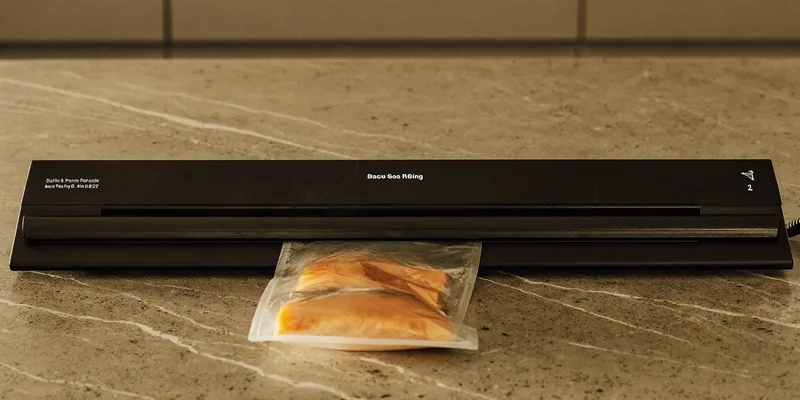
The standard Precision Vacuum Sealer is a different shape entirely. Anova lists it at 16.73 by 4.80 by 3.14 inches and 2.3 pounds, with an extraction rate of 4 liters per minute and a pressure figure of minus 0.5 bar. It is a bar rather than a box, and it is built to disappear into a drawer between uses.
The Pro Is Built Around the Accessory Port
The accessory port is the feature that justifies the size difference. Anova lists a vacuum hose and an accessory port for sealing containers and specialized lids, which turns one machine into a bag sealer, a container pump and a marinating tool without buying anything else with a motor in it.
The pulse function is the other reason cooks reach for it. Holding a short burst rather than running a full cycle lets you stop the pull just before soft food starts to compress, which is how you seal bread, berries or a delicate fillet without turning it into a puck. Our page on vacuum containers and canisters covers what the port actually connects to.
If you want the full countertop machine

The Compact Precision Sealer
The slim model is honest about what it is. Anova lists 4 liters per minute of extraction against the Pro’s 12, in a body weighing 2.3 pounds. That is a meaningful gap, and it shows up as longer cycles on larger bags rather than as a failure to seal.
Who It Actually Suits
Small kitchens, apartment cooks and anyone whose sealing is a few sous vide bags a week. If the machine has to come out of a cupboard every time, a lighter unit gets used and a heavy one gathers dust, which is a genuine argument even when the specification is lower.
Who Should Skip It
Anyone processing a bulk meat order or working through a garden. Repeated bags on a slower pump means a longer session and more heat in the sealing bar, and that is exactly the situation where the Pro’s larger pump and double seal earn their space.
If drawer space is the deciding factor
Sous Vide Is Still the Reason People Buy It
A sous vide bag has to hold a seal underwater at cooking temperature for hours, and it has to hold it around whatever awkward shape is inside. That is a different demand from freezer storage, where the bag only needs to keep air out at a steady low temperature.
Anova’s double sealer on the Pro is aimed at that job, and the moist setting exists because bags going into a water bath usually carry marinade or rendered juice at the seam. If sous vide is the main use, read our dedicated guide to sealers for sous vide, which covers bag choice and the float problem.
If you need bag stock for the machine

The Two Models Side by Side
Everything in the table comes from Anova’s own product listings. The last two rows are the situations where neither Anova model is the right answer, which is worth knowing before you spend.
| Option | What Anova lists | Strength | Who it suits |
|---|---|---|---|
| Precision Vacuum Sealer Pro | 12 L per minute, 110 watts, dry and moist, pulse, double seal, roll storage and cutter | Accessory port and repeat sealing | Regular cooks, sous vide, freezer batches |
| Precision Vacuum Sealer | 4 L per minute, minus 0.5 bar, 2.3 pounds, slim body | Storage size and weight | Small kitchens, occasional use |
| Any external sealer | Air pulled along embossed bag channels | Fast, cheap consumables | Not for soup, brine or loose liquid |
| Chamber machine | Bag sits inside a sealed chamber | Seals liquids without freezing them first | Bulk processing and liquid heavy cooking |
Anova lists a 2 year warranty on both sealers. Retailer listings sometimes quote different coverage, so treat the manufacturer page as the reference.
Where Anova Loses
Against FoodSaver, the weak point is the accessory ecosystem. FoodSaver’s jar sealers, canisters and replacement parts are stocked nearly everywhere, and if you plan to seal mason jars of dried goods regularly that availability matters more than pump speed. Against a chamber machine, the loss is liquids, which no external sealer handles properly.
Owners also report that the Pro takes real counter space and that the bag rolls are a premium consumable compared with generic embossed stock. Neither is a fault, they are the trade you accept for the port and the double seal. Third party embossed rolls in the right width work fine, and we cover choosing them in vacuum sealer bags.
Frequently Asked Questions
What is the difference between the Anova Precision Vacuum Sealer and the Pro? Pump capacity and features. Anova lists 4 liters per minute for the compact model against 12 for the Pro, and only the Pro is listed with dry and moist settings, a pulse function, a double sealer, roll storage with a cutter and an accessory port.
Can an Anova sealer handle liquids? Not loose liquid. Like every external suction machine it pulls liquid toward the pump. Freeze soups and marinades solid first, or use a chamber machine, as covered in sealing liquids.
Do I have to use Anova bags? No. Any embossed or channeled roll in a width that suits the seal bar works, since external machines draw air through those channels. Smooth bags do not work on any machine of this type.
Is it worth buying for freezer storage rather than sous vide? Yes, though the calculation changes. For plain freezer work the double seal and pulse are still useful, but so is a cheaper machine with a wider bar. Our vacuum sealer buying guide and the meat sealing guide cover what changes when volume goes up.
Does the accessory port work with other brands of container? It works with containers and lids designed for a standard hose fitting, and Anova lists the port as intended for containers and specialized lids. Check the fitting before assuming a jar attachment from another brand will seat properly.
The Bottom Line
Anova makes a strong countertop sealer and a genuinely small one, and the specification gap between them is wide enough that the choice should be deliberate. Take the Pro for its listed 12 liters per minute, its double seal and its accessory port if you seal often, and take the compact only if the machine has to live in a drawer. If liquids are the real problem you are trying to solve, read our chamber machine guide before either, and start with the vacuum sealer buying guide if you are still comparing categories.