Last updated: August 23, 2026
By the second week of September the counter is a tomato problem. The canner is already booked for sauce, the neighbors have stopped answering the door, and there is another bucket of Romas on the porch. Drying is what absorbs the overflow, because a dehydrator runs unattended overnight while the water bath canner needs you standing there.
Dried tomatoes also earn their shelf space in a way canned sauce does not. A quart jar of dried slices weighs almost nothing, goes into soups and braises straight from the jar, and grinds into a tomato powder that thickens a sauce without adding liquid. The two things to get right are the cut and the storage, and the second one has a real safety rule attached.
This article contains affiliate links. If you buy through them, we may earn a commission at no extra cost to you. Learn more.
Quick Answer
How do you dehydrate tomatoes?
- Use paste types where you can. Roma and San Marzano style tomatoes have less water and fewer seeds than slicers.
- Colorado State University Extension lists steaming or dipping in boiling water to loosen the skins, chilling, peeling, then slicing 1/2 inch thick or cutting into 3/4 inch sections.
- CSU Extension lists a dip in a solution of 1 teaspoon citric acid per quart of water for 10 minutes, and no blanching step.
- CSU Extension gives a drying window of 6 to 24 hours with a dryness test of crisp.
Bottom line: dry them to crisp and store them dry, because the NCHFP does not recommend preserving tomatoes in oil.
Which Tomatoes Dry Well
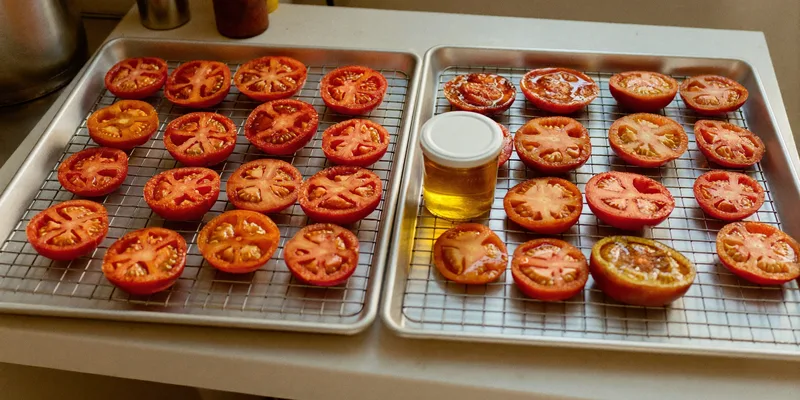
Paste tomatoes win on every axis that matters here. They carry less juice, fewer seeds and thicker walls, so a tray of Romas turns into dense, meaty pieces instead of tomato paper. Slicing tomatoes work, they just take much longer and shrink to almost nothing.
Cherry and grape tomatoes are the exception worth making room for. Halved and dried skin side down, they concentrate into intensely sweet nuggets, and they are the easiest way to use up the plant that will not stop producing.
Peel or Not, and How to Cut
Peeling is a texture decision. CSU Extension lists steaming or dipping tomatoes in boiling water to loosen the skins, chilling in cold water, peeling, then slicing 1/2 inch thick or cutting into 3/4 inch sections. Peeled slices dry a little faster and rehydrate more evenly.
When to Leave the Skin On
For halved cherry tomatoes and for pieces headed for the grinder, the skin is not worth the work. It dries to a papery edge that disappears in powder and goes unnoticed in a long braise. For slices you plan to rehydrate whole and serve, peel them.
The Citric Acid Dip
CSU Extension lists a dip in a solution of 1 teaspoon citric acid per quart of water for 10 minutes for tomatoes, drained before drying. It is there to protect color rather than to make the dried product shelf stable. If you also can tomatoes, note that added acid in canning is a separate requirement with its own rules, which we cover in citric acid for canning.
Time, Temperature and the Crisp Test
CSU Extension lists 6 to 24 hours for tomatoes with a dryness test of crisp, and gives 140 degrees F as the drying temperature for oven drying in the same fact sheet series. That is an unusually wide window because a thick slicer half and a halved cherry tomato are barely the same project.
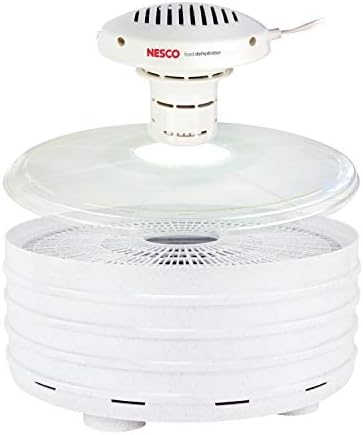
Load size drives the rest. Nine full trays hold a lot of water, and the machine has to move all of it out through the same fan, so a full load can easily run twice as long as a half load. Rotate trays if your machine stacks vertically, and check the corners nearest the fan first, because they finish first.
If you are drying a full harvest load at once
Do Not Store Dried Tomatoes in Oil
This is the safety line of the whole article. The NCHFP states that preserving tomatoes in oil is not recommended, because oil may protect botulism organisms trapped in a water droplet. The jar of oil packed sun dried tomatoes on the store shelf was produced under controls a kitchen does not have.
The same logic applies to the flavored oils people make alongside them. The NCHFP allows herb flavored oils only when made for fresh use, refrigerated and used within two to three days, and its research on garlic in oil found room temperature storage carries a botulism risk, with refrigeration at 40 degrees F or lower for no more than four days. Keep your dried tomatoes dry, and add the oil in the pan.
Cut Style and What It Is For
Choose the cut for the meal, not for the tray. The table lines up the four cuts most home dryers use, with the prep CSU Extension lists and what each one is actually good at afterward.
| Cut | Prep | Drying behavior | Best use later |
|---|---|---|---|
| Slices, 1/2 inch | Peel after a boiling water dip, citric acid dip | Middle of the 6 to 24 hour window | Rehydrated slices, sandwiches, pasta |
| Sections, 3/4 inch | Peel, cut into wedges, citric acid dip | Longer, holds shape well | Braises, stews, roasted vegetable mixes |
| Cherry halves | Halve, skin side down, no peeling | Fast, sticky with sugar | Snacking, salads, antipasto style plates |
| Thin slices for powder | Peel optional, slice as thin as you can cut evenly | Fastest, dries to crisp | Tomato powder for sauces and soups |
Preparation steps, the citric acid dip and the 6 to 24 hour range above come from the CSU Extension drying vegetables fact sheet.
Conditioning and Storage
Tomatoes carry sugar, and sugar holds moisture, so conditioning matters more here than with most vegetables. CSU Extension has you place cooled, dried pieces loosely in containers about two thirds full, hold them in a warm, dry, well ventilated place for four to 10 days, and stir or shake daily. Condensation means the batch is not finished.
After that, seal them away from air and light. CSU Extension notes properly stored dried vegetables keep well for six to 12 months. Pieces that stay slightly pliable rather than crisp belong in the refrigerator or the freezer instead of the pantry, and our guide to storing dehydrated food covers the containers worth buying.
If you want long term storage for the surplus

Frequently Asked Questions
How long does it take to dehydrate tomatoes? CSU Extension lists 6 to 24 hours with a dryness test of crisp. Halved cherry tomatoes sit at the short end, thick peeled slices from a full load at the long end. Judge by the crisp test on cooled pieces rather than by the clock.
Can I store dried tomatoes in olive oil like the ones at the store? No. The NCHFP states preserving tomatoes in oil is not recommended, because oil may protect botulism organisms trapped in a water droplet. Store them dry and add oil when you cook.
Do I have to peel tomatoes before drying them? Not for safety. CSU Extension lists peeling after a steam or boiling water dip, which gives a better texture for slices you plan to rehydrate. Halves headed for the grinder do not need it.
Why did my slices come out leathery instead of crisp? Usually thickness or load size. Thick slices in a full machine hold moisture in the center long after the edges look done. Give them more time at the same temperature, then condition the batch before sealing.
What can I do with the pieces that broke? Grind them. Tomato powder made from fully crisp pieces stirs into soups and sauces, and it is the best use for the ragged edges nobody wants to eat whole. Keep the powder in a small sealed jar, because it draws moisture quickly.
The Bottom Line
Dry paste tomatoes to crisp, follow the CSU Extension prep for peeling and the citric acid dip, condition for four to 10 days, and store them dry rather than under oil, which the NCHFP does not recommend. That is the whole September overflow plan. If you still need the machine, our food dehydrator buying guide covers capacity for harvest sized loads, and the mistakes that ruin a batch is worth reading before your first full run.