Last updated: August 23, 2026
Somebody in every family has a recipe card for water bath green beans. It is in a grandmother’s handwriting, the family ate it for forty years, nobody ever got sick, and it is not safe. That is an uncomfortable sentence and it is also the plain reading of every current recommendation from the NCHFP and the USDA.
The rule is not about tradition or about being careful in the kitchen. It is about one organism that survives boiling water, and about the fact that boiling water is the hottest a water bath canner ever gets. This page sets out what cannot go in a boiling water canner, why, and what to do with those foods instead.
This article contains affiliate links. If you buy through them, we may earn a commission at no extra cost to you. Learn more.
Quick Answer
What can you not water bath can?
- All plain vegetables, meat, poultry, seafood, soups, stews, beans and broth. These are low acid foods and the NCHFP and USDA direct that they be pressure canned.
- Mashed or pureed pumpkin and winter squash, and pumpkin butter. The NCHFP states there are no properly researched directions for canning them.
- Dairy, eggs, anything thickened with flour or cornstarch, oil based pestos and butters, and breads or cakes baked in jars.
- Anything without a tested recipe. If you cannot point to the tested process, that is the answer.
Bottom line: high acid foods go in a boiling water canner, low acid foods go in a pressure canner. There is no third option.
Why Acidity Decides Everything
Clostridium botulinum spores are common in soil and on produce, harmless to eat in ordinary food, and dangerous only when they find a sealed jar with no oxygen, low acid and room temperature. Then they can grow and produce the toxin that causes botulism. Acid stops them from growing, and heat destroys the spores, and canning uses one or the other.
The dividing line is pH 4.6. Foods at or below that level are acidic enough that the spores cannot grow, so a boiling water canner is sufficient. Foods above it are low acid, and the NCHFP explains that boiling water reaches only 212 degrees F while destroying those spores requires the 240 degrees F that a pressure canner produces.
The Canner Cannot Get Hotter
This is the part that answers most of the follow up questions. You cannot compensate with a longer boil, a bigger pot, a tighter lid or a hotter burner, because water at sea level boils at one temperature and stays there. Processing green beans for three hours in boiling water still leaves them at boiling water temperature the whole time.
The Foods That Need a Pressure Canner
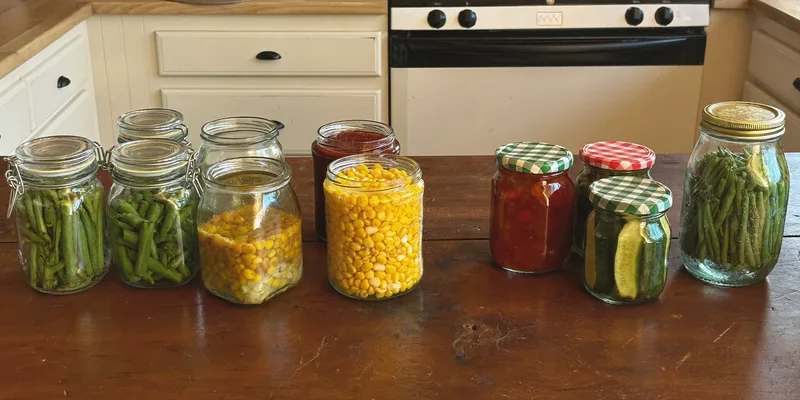
All vegetables in plain water: green beans, corn, carrots, potatoes, beets, peas, greens, asparagus, mushrooms. All meat, poultry, game and seafood. All soups, stews, chili, broth, stock and dried beans. Anything combining those, including spaghetti sauce with meat in it. The NCHFP and USDA direct all of these to a pressure canner.
The exception is pickled vegetables, where a tested recipe adds enough vinegar to bring the whole jar below the acidity threshold. That is not the same as adding a splash of vinegar to plain beans, because the tested recipe controls the ratio of vegetable to brine as well as the acid strength. Our pressure canning guide covers the process for the plain versions.
Foods With No Tested Process at All
Some foods are not just wrong for a water bath, they have no home canning process of any kind. The NCHFP states there are no properly researched directions for canning mashed or pureed pumpkin or winter squash, or pumpkin butter, because research found too much variability in acidity, thickness and water activity for the product to be verified as safe. Cubed pumpkin has a pressure canning process; puree does not.
The same reasoning covers dairy, eggs, anything thickened with flour or cornstarch, oil based pestos and herb butters, and breads or cakes baked in jars. Density and fat both interfere with heat reaching the middle of the jar. For these, the freezer and the dehydrator are the preservation methods, not the canner.
Milk, Butter and Cheese
Home canned milk, butter and cheese circulate widely online and there is no tested home process for any of them. They are low acid, they are dense, and fat protects spores from heat. Freeze dairy, or store shelf stable commercial equivalents, and treat any recipe that tells you otherwise as unsupported.
The Methods That Are Unsafe, Not Just Old Fashioned
Open kettle canning, where hot food goes into jars and the lids seal from the heat of the food alone, is described as unsafe for low acid foods by the NCHFP, because the temperatures reached are not high enough to destroy spoilage and food poisoning organisms and because microorganisms can enter the food as it is transferred to the jar. Oven canning is unsafe for the same reason, with the added problem that dry heat transfers poorly and jars can shatter.
Electric multicookers are the modern version of the same mistake. An Instant Pot or similar appliance without a tested canning process is not a pressure canner, cannot be verified to hold a specified pressure, and the NCHFP does not recommend it for canning low acid food. Our guides to Instant Pot canning and canning mistakes go into both in detail.
Inversion and Other Shortcuts
Turning filled jars upside down to force a seal, sealing with wax, using aspirin, and processing in a dishwasher all appear in old recipe collections. None of them is a tested process, and a seal is not the same thing as a safe product. A jar can seal perfectly and still contain food that was never heated enough.
Where Each Food Belongs
The table sorts the common questions. The method column follows NCHFP and USDA guidance on which process each food category requires rather than any judgment of our own.
| Food | Water bath | Correct method | Why |
|---|---|---|---|
| Green beans, corn, carrots, potatoes | No | Pressure canning | Low acid, spores survive boiling water |
| Meat, poultry, game, seafood | No | Pressure canning | Low acid and dense |
| Soups, stews, chili, broth, beans | No | Pressure canning, tested recipe | Low acid mixtures |
| Mashed pumpkin, pumpkin butter | No | Freeze it | NCHFP: no researched directions exist |
| Milk, butter, cheese, eggs | No | Freeze or buy shelf stable | No tested home process |
| Jam, jelly, fruit, pickles, salsa | Yes, with a tested recipe | Water bath canning | Acidic enough to block growth |
| Tomatoes | Yes, acidified | Water bath with added acid, or pressure | Borderline pH, tested recipes add acid |
What to Do With the Food Instead
You have three good options for everything in the no column. Pressure can it with a tested recipe, which is what a pressure canner exists for and what turns a garden full of beans into shelf stable jars. Freeze it, which needs no equipment beyond bags or a vacuum sealer. Or dry it, which suits vegetables, herbs and jerky.
If a tested pressure process exists for the food but not for your particular recipe, follow the tested one. Changing thickeners, adding rice or pasta, doubling the meat or thickening the broth all change how heat moves through the jar, and the process time no longer applies. Our guide to water bath canners covers what the boiling water pot does handle well.
Frequently Asked Questions
My grandmother water bathed green beans for fifty years. Was she wrong? The method was wrong even when the outcome was fine. Botulism is rare and the risk in any single jar is low, which is exactly why unsafe practices survive for generations. The NCHFP and USDA direct all plain vegetables to a pressure canner, and older family recipes predate that testing.
Can I add vinegar or lemon juice to make low acid food safe? Only within a tested recipe. Pickled and acidified recipes are laboratory tested for the ratio of food to acid, the strength of the vinegar and the size of the pieces. Adding acid by eye to plain vegetables does not produce a verified result.
What about processing for a much longer time in the water bath? It does not help. The temperature stays at boiling no matter how long you go, and the NCHFP explains that destroying the spores in low acid food requires the higher temperature a pressure canner reaches. Extra hours only overcook the food.
Is a steam canner an alternative for vegetables? No. An atmospheric steam canner is an alternative to a boiling water canner for high acid foods with a tested process, and it reaches the same temperature range. It is not a pressure canner and does not extend what you can process.
I already canned something on this list. What now? Do not taste it to check. Refrigerate it and use it within a few days, freeze it, or dispose of it following the detoxification and disposal instructions the NCHFP publishes for suspect jars. Our guide to botulism and canning safety covers the warning signs and the disposal steps.
The Bottom Line
Boiling water canners handle acidic foods, and nothing else. Vegetables, meat, seafood, soups and beans go to a pressure canner with a tested recipe, pumpkin puree and dairy have no home canning process at all, and open kettle, oven and multicooker canning are unsafe rather than merely old fashioned. Read next: pressure canners for the equipment that does handle low acid food, and water bath canners for what the boiling pot is genuinely good at.