Last updated: August 23, 2026
The complaint shows up in review after review, in almost the same words. The machine worked fine, the bag looked sealed, and three weeks later the pack in the freezer is puffed back up with frost inside it. People blame the sealer. Most of the time the bag is what failed, either at the seam or at a pinhole where a rib bone pressed against thin film.
Bag stock is also the running cost of vacuum sealing. The machine is a one time purchase and the bags are forever, so the choice between rolls and precut, between thin and heavy, between the brand box and the off brand carton, is the choice that decides what a year of preserving costs you.
This article contains affiliate links. If you buy through them, we may earn a commission at no extra cost to you. Learn more.
Quick Answer
Which vacuum sealer bags should you buy?
- Suction machines need embossed bags. The channels are what let air out, and a smooth bag will stall the cycle.
- Chamber machines take smooth pouches, which are cheaper per bag because they skip the embossing.
- Rolls cost less per foot and let you size the bag. Precut bags are faster when you are sealing fifty portions.
- Go heavier than the standard film for bone in meat, shellfish and anything with a sharp edge.
Bottom line: match texture to your machine first, then thickness to what you are sealing, then price per foot.
Embossed or Smooth, and Why Getting It Wrong Wastes a Box
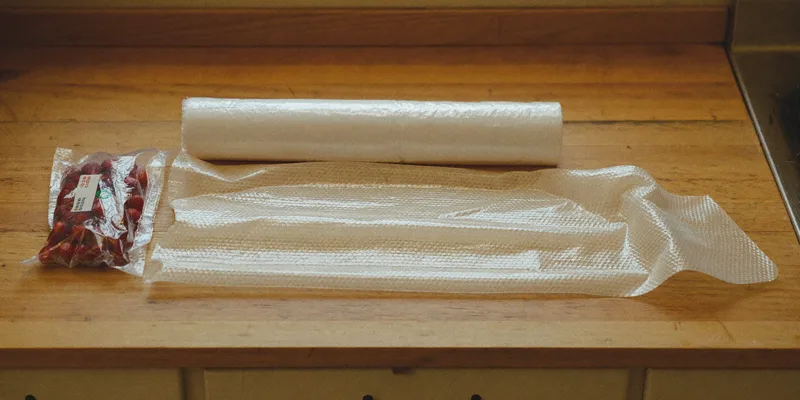
Embossed bags have a dimpled or ribbed pattern on one side that keeps an air path open while the bag collapses. Smooth chamber pouches have no pattern at all. A suction machine cannot evacuate a smooth bag, because the film seals itself flat against the food before the pump can finish. This is the single most common wasted purchase in the category.
Chamber machines run the other way around. They remove air from the whole chamber, so the bag never has to breathe through a channel, and industry suppliers point out that chamber pouches are typically made thinner than embossed bags for that reason. Chamber owners can technically use embossed bags, but they are paying for texture they do not need.
How to Tell Them Apart in the Listing
Look for the words embossed, textured, channel or the phrase compatible with FoodSaver, all of which mean a suction bag. Chamber stock is usually sold as chamber pouches or smooth pouches, and often in flat carton counts rather than rolls. If a listing says only vacuum bags, check the product photo for the dimple pattern.
Mil Thickness, and When Thicker Actually Matters
A mil is one thousandth of an inch, and it describes the film thickness. Higher mil means more puncture resistance and a better barrier. Suppliers list embossed bags at a heavier standard than chamber pouches precisely because the embossing eats into the effective wall thickness.
Where the extra thickness earns its cost is bone in cuts, shrimp and crab, hard sided pasta, and anything frozen in an awkward shape. Where it does not is berries, herbs, shredded cheese and dry goods, which never threaten the film at all. Buying one heavy box and one standard box, rather than one middle grade box, is usually the cheaper path.
Rolls or Precut Bags for the Way You Work
Rolls win on cost per foot and on fit, because you cut the bag to the food instead of leaving three inches of empty film above a chicken breast. Precut bags win on speed, because there is no cutting and no first seal, and that matters when a bulk order is thawing on the counter.
The Case for Keeping Both
Most people who seal regularly end up with rolls for odd shapes and a box of quart bags for portions they make constantly. The roll also solves the tail problem: leave enough empty film above the food to give the seal bar clean material to work with, and a short tail is one of the most common causes of a failed seam.

If you seal large quantities of the same thing, a bulk carton of precut bags in one or two sizes is faster and easier to store than a shelf of half used rolls.

Bags by What You Are Sealing
Four situations cover most of what leaves a home kitchen. Match the film to the sharpest, wettest or heaviest thing in the pack, not to the average, because the pack fails at its worst point.
Bone In Meat, Fish and Shellfish
Heavy film, and a double bag for rib ends and fin spines. A shard of bone that pushes through the film in month two does not announce itself, and you find it when the pack is gray. Trimming the bone corner or padding it with a folded paper towel inside the bag is the free half of this fix.

Chamber Machine Owners
Plain smooth pouches sized to your seal bar. Buy the bag size that fits the chamber, not the biggest one sold, because a pouch that will not lie flat inside the chamber cannot be sealed straight. Our chamber sealer guide covers matching bag size to chamber size.

Sous Vide Cooking
You need film rated for a long warm water bath, not just for the freezer. Many standard bags are fine and some thin off brand stock is not, and the failure mode is a seam that opens in the bath. We go through it in the sous vide sealer guide.
Dry Goods for the Pantry
Standard film is plenty, because nothing inside is going to puncture it. For rice, beans and flour going away for years rather than months, a vacuum bag is the wrong container anyway. Plastic is oxygen permeable over long periods, which is why mylar bags with oxygen absorbers are the standard for long term pantry storage.
Why Bags Leak, in Order of Likelihood
Almost every leak is one of five things: food or moisture in the seal line, a tail too short for the bar to grip, a wrinkle across the seam, a puncture from something sharp, or film too thin for the job. None of those is a broken machine, and four of the five are free to fix.
Wipe the inside of the bag mouth before sealing, leave a generous tail, pull the bag flat across the bar with both hands, and run a second seal a finger width below the first on anything going into the freezer for months. The table below sorts the causes by how they show up.
| Symptom | Likely cause | Free fix | When to spend |
|---|---|---|---|
| Seam opens within days | Moisture or fat in the seal line | Wipe the bag mouth, freeze wet food first | Only if it repeats on dry food |
| Bag puffs up slowly | Pinhole from bone or shell | Pad the sharp point, double bag | Heavier film for bone in cuts |
| Machine will not start the cycle | Smooth bag on a suction machine | Switch to embossed stock | Correct bag type |
| Wrinkled, patchy seal | Bag not pulled flat, tail too short | Leave more film, hold both corners | Nothing |
If dry food in a good bag still will not hold, the machine side is worth checking, and the troubleshooting walkthrough starts with the gaskets.
Frequently Asked Questions
Do off brand bags work in a FoodSaver? Usually yes, as long as they are embossed and the width matches your machine. The failures people report tend to be thin film rather than the wrong brand. We look at the specific question in the FoodSaver bag guide.
Can I reuse vacuum sealer bags? For dry goods, yes. Wash, dry completely and cut below the old seam, and you lose an inch of bag each time. Do not reuse bags that held raw meat, raw fish or eggs, because the film has crevices you cannot reliably clean.
Are cheaper bags a false economy? Not automatically. The price per foot varies more than the quality does in the mid range. What you should not buy cheap is film for bone in meat, where a single failure costs more than the box.
Can I boil food in a vacuum sealer bag? Only in bags the manufacturer rates for it, and even then a simmer is different from a rolling boil. Check the listing rather than assuming, and see our sous vide notes.
What size bag should I stock if I only buy one? Quart size for portions covers most households. An 11 inch roll covers everything a quart bag cannot, which is why the roll and box combination is the usual endpoint.
The Bottom Line
Buy texture to match your machine, thickness to match the sharpest thing you seal, and format to match how you work. Embossed for suction sealers, smooth pouches for chamber machines, heavy film for bone and shell, rolls for odd shapes and precut for volume. Then treat the seal line as the part that fails, because it usually is: wipe it clean, leave a real tail, and double seal anything going away for a season. Read next: which sealer type fits what you store and the mistakes that cost people a freezer.