Last updated: August 23, 2026
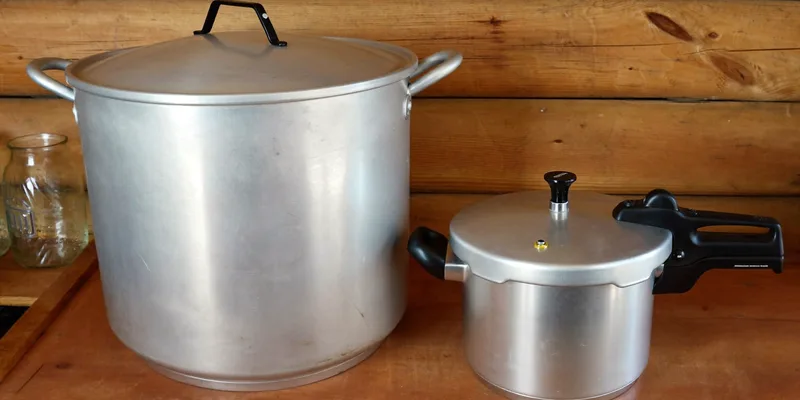
The two pots look related. Both are heavy, both lock shut, both hiss, and both work by trapping steam. Retailers file them under the same heading, and plenty of listings use the words interchangeably. That is where a lot of home canners get into trouble, because only one of them is equipment the canning guidelines were written for.
The short version is that a pressure cooker is a fast cooking appliance and a pressure canner is a piece of processing equipment. They overlap in physics and separate completely in what you can trust them to do with a sealed jar of green beans.
This article contains affiliate links. If you buy through them, we may earn a commission at no extra cost to you. Learn more.
Quick Answer
What is the difference between a pressure canner and a pressure cooker?
- Size and mass. USDA processes for low acid foods were developed in canners comparable to today’s 16 quart and larger models, and NCHFP will not call a pot a canner unless it holds at least four quart jars.
- Pressure control you can verify. A canner has a weighted gauge or a dial gauge you can have tested; most cookers have a working valve and nothing to check it against.
- Heating behavior. A canner heats and cools slowly enough that the published process times actually apply to the food inside the jars.
- A pressure cooker cooks beans, stock and pot roast beautifully. It is not processing equipment.
Bottom line: if the goal is shelf stable jars of low acid food, the tool is a pressure canner. There is no workaround.
What Each Pot Is Built to Do
A pressure cooker exists to raise the boiling point so food cooks faster. You put the food straight in the pot, it comes up to pressure, and dinner is ready sooner. A pressure canner exists to hold sealed jars in pressurized steam at a controlled level for a controlled length of time, so the contents get a measured heat process.
Those are different jobs and they produce different hardware. Canners are taller and heavier, come with a rack for jars to stand on, and use a pressure control you can read or verify. Cookers optimize for speed, convenience and a small footprint on the counter.
Why Size Is a Safety Feature, Not a Capacity Feature
A big pot of steam heats up and cools down slowly, and that slow ramp is baked into the published process times. A small pot reaches pressure quickly and drops out of it quickly, so the food spends less total time hot than the recipe assumes. That is why USDA guidance points at canners in the 16 quart and larger class rather than at small pressure saucepans.
Why the USDA Processes Do Not Transfer
Because the numbers came from testing in real canners. The research behind the process times in the USDA Complete Guide to Home Canning was done with jars inside canners of that size and construction, measuring the temperature at the coldest point in the jar. Change the vessel and you change the heating curve the numbers describe.
NCHFP does not recommend pressure saucepans and small pressure cookers for canning, and sets the practical floor at a pot that will hold at least four quart jars. This is not a brand preference. It is the smallest configuration the tested processes were validated in.
Gauges: The Part Most Buyers Overlook
A canner regulates pressure in one of two ways. A weighted gauge rocks or jiggles at a fixed setting and needs no calibration, which is why it is the low maintenance choice. A dial gauge shows a needle reading and needs annual testing, usually through a county extension office, because a drifting dial under processes every jar it ever sees.
Most pressure cookers have neither. They have a working valve set by the manufacturer, no way for you to verify it, and no extension office that will test it. If you cannot confirm the pressure, you cannot confirm the process, and there is nothing to inspect after the fact. Our pressure canner guide goes through weighted and dial gauges in detail.
Where Electric Pressure Canners Sit
Between the two, and worth being honest about. Some manufacturers now sell countertop appliances marketed specifically as electric pressure canners, with canning programs built in. Those are a different product from a multicooker, and the maker publishes its own instructions and validation claims for them.
What has not changed is the source of the published process times. USDA and NCHFP processes were developed on stovetop canners, and NCHFP has not tested its processes inside electric appliances. A manufacturer’s own claim is the manufacturer’s, not a USDA endorsement, and we do not repackage one as the other. Our electric pressure canner page lays out what each maker actually states.
What a Multicooker Is Definitely Not
A general purpose electric multicooker with a pressure setting is not in this conversation at all. NCHFP does not recommend canning in electric multicookers, having not tested its processes in them. Our page on Instant Pot canning covers that specific question, including what the manufacturer removed from its own materials.
Canner and Cooker Side by Side
The table compares the two on the four things that decide whether a pot can carry a canning process. Size and gauge statements follow USDA and NCHFP guidance for recommended canners.
| Feature | Pressure canner | Pressure cooker | Why it matters |
|---|---|---|---|
| Capacity | Holds at least four quart jars | Usually too small for jars | Tested processes assume canner size |
| Pressure control | Weighted or testable dial gauge | Fixed valve, nothing to verify | Unverified pressure means unverified process |
| Heating curve | Slow up, slow down | Fast up, fast down | Process times depend on total heat time |
| Jar rack | Included, keeps jars off the base | Not designed for jars | Direct contact cracks glass |
Note the last row. A jar sitting flat on the bottom of a pot takes heat straight from the burner through the metal, which is a common cause of breakage as well as an uneven process.
Which One Should Be on Your Counter
If you want to put up green beans, carrots, soup, stock, chili or any meat, you need a pressure canner and nothing else will do. If you want dry beans cooked in under an hour and stock in the evening, a pressure cooker or multicooker earns its space and a canner is a clumsy way to do that job.
Plenty of kitchens have both, and they do not compete. The canner comes out in August and October and sits in the basement the rest of the year. The cooker runs weekly. Buying a cooker because it was cheaper and hoping to can with it is the one path that does not work. Our pressure canning guide covers venting, pressure and altitude once the right pot is on the stove.
Frequently Asked Questions
Can I use a pressure cooker as a pressure canner if I only do pints? No. NCHFP does not recommend pressure saucepans and small cookers for canning, and the jar size is not the deciding factor. The published process times were developed in canners with a much slower heating and cooling curve, so a small fast pot does not deliver the same total heat.
Can I use a pressure canner as a pressure cooker? Usually yes, and many people do. Check your manual, since some canners are explicitly dual purpose. It is a large pot to heat for a weeknight meal, but there is no safety issue in cooking food directly in one.
What about water bath canning in a pressure canner? That works. With the lid off or unlocked and enough water to cover the jars, a pressure canner is simply a deep pot. Check that your model’s manual allows it, and see our water bath canner guide for depth and rack requirements.
My cooker reaches the same pressure the recipe lists. Is that not enough? Reaching a pressure is not the same as holding a verified pressure through a whole process while jars heat through. There is no way to test a cooker’s valve the way an extension office tests a canner dial gauge, and the food inside the jars may lag behind the pot.
Do I need a dial gauge or a weighted gauge? A weighted gauge needs no annual testing, which suits most home canners. A dial gauge gives a live reading and has to be checked yearly, commonly through a county extension office. Both are accepted equipment when used as directed.
The Bottom Line
A pressure cooker cooks food fast. A pressure canner runs a validated heat process on sealed jars, and its size, its rack and its verifiable gauge are all part of that. USDA processes were developed in canners of that class and NCHFP will not call a pot a canner unless it takes four quart jars, so the substitution people hope for is not available. Read next: our pressure canner guide for choosing size and gauge, and the pressure canning walkthrough for venting and altitude.